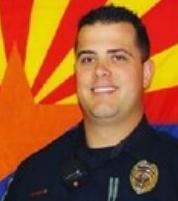
Jeff Adam Moritz was a 30-year-old white male police officer in Flagstaff, Arizona, working the quiet, early hours of June 21, 2000, when a routine call pulled him toward the south side of town. Residents in a typically calm neighborhood had been jolted awake by the same sound over and over again: a pickup truck circling the block, loud music blaring into the night. Multiple people called police to complain about the disturbance, describing the vehicle that kept looping past their homes.
Officer Moritz, a four-year veteran of the Flagstaff Police Department, field training officer, and SWAT operator, drove into the area to investigate, as he had done countless times before for less serious calls.
He soon spotted the truck and activated the lights and siren on his marked patrol car. The driver, a teenager later identified as 17-year-old Eric Michael Clark, pulled over. What unfolded in the next moments ended up searing itself into the memory of the city. Within roughly a minute of the stop, Clark opened fire on the officer at close range with a. 22-caliber handgun. Witnesses and later reports said five shots were fired. Although Moritz wore a bullet-resistant vest, one round struck him in the shoulder in a spot the vest did not cover, severing an artery. Bleeding heavily, he managed to make an emergency broadcast over the radio that he had been shot, sending a jolt of urgency through fellow officers racing toward his location.
Neighbors, awakened by both the music and then the gunfire, came outside and saw the wounded officer. Several residents tried desperately to save him, performing CPR in the street while they waited for paramedics and backup units to arrive. Despite their efforts and the rapid response, Moritz was pronounced dead a short time later at Flagstaff Medical Center. He left behind a wife and a young son; later accounts note that on the same day he was killed, his wife learned she was pregnant with their second child. His ashes were ultimately scattered over the San Francisco Peaks north of Flagstaff, a place tied closely to the landscape of the community he had chosen to serve and where he had grown up and gone to school.
The man who shot him fled the scene on foot as the neighborhood erupted in sirens and search activity. Investigators and responding officers quickly began sweeping the area. Clark was found later that same day, with evidence of gunpowder residue on his hands. Nearby, officers recovered the murder weapon hidden inside a knit cap, linking him physically and forensically to the shooting. He was arrested and charged with first-degree murder for killing a law enforcement officer, a charge that carries especially severe penalties under Arizona law. From the beginning, his case intertwined questions of criminal responsibility with questions of mental illness.
Clark was just 17 at the time and soon claimed that he had been suffering from severe delusions. Court records and later appellate opinions describe how he insisted he believed aliens had invaded Flagstaff and taken over the bodies of government agents, including police officers. His trial did not proceed quickly. Court-appointed psychological experts initially found him incompetent to stand trial, resulting in his commitment to a state hospital for treatment. Over months, he received antipsychotic medication, including Haldol injections, and by late 2001 state experts reported that he had become competent. His own defense experts disagreed, and the court ordered further treatment, prolonging the pretrial period while his mental state was argued and reassessed.
After years of evaluations and legal wrangling, Clark was finally brought to trial in 2003. Rather than a jury, a judge heard the case over the course of an 11-day trial. The defense presented evidence of Clark’s mental illness and delusional beliefs, attempting to invoke Arizona’s narrow insanity defense. The court allowed some evidence on his mental state, but ultimately the judge, applying the state’s strict standard, found that the legal requirements for insanity were not met. Clark was convicted of first-degree murder and sentenced to life in prison, with the possibility of release after 25 years, effectively ensuring he would spend the rest of his youth and much of his adulthood behind bars for the killing of Officer Moritz.
The case did not end with the trial. Clark’s conviction and the way Arizona law treated insanity defenses drew attention well beyond Flagstaff. His legal team pursued appeals that climbed all the way to the U.S. Supreme Court, which reviewed aspects of Arizona’s insanity statute and competency framework. The Supreme Court concluded that the state’s law was too narrow in certain respects but stopped short of overturning Clark’s conviction, stating that it could not be sure the trial court had actually misapplied the standard in his particular case. Years later, a federal appeals court again examined his claims, including arguments that his attorneys had been ineffective and had not properly preserved or presented evidence of his mental condition. That court ultimately upheld the conviction, leaving the original life sentence in place and closing yet another chapter in the long legal aftermath of the shooting.
In Flagstaff, however, the story has been remembered in more personal terms. Moritz was a local son of the city, a Flagstaff High School graduate who chose to raise his family there and to patrol the same streets he had known as a child. Colleagues described him as adventurous, compassionate, and generous with his time, the sort of officer who quietly helped elderly residents with household chores on his days off without seeking any recognition. Among his peers he set a standard for professionalism and heart, volunteering for demanding roles such as SWAT and field training officer while simultaneously working toward an engineering degree. His death marked the first time a Flagstaff police officer was killed in the line of duty, a milestone no community wants to reach, and the memory of that early summer morning in 2000 has continued to shape how the city honors its officers and confronts the legacy of violence that took his life.