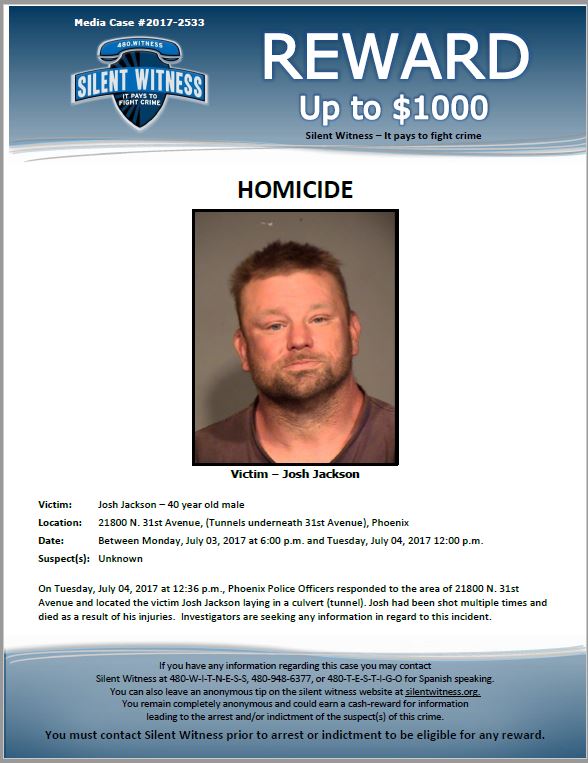
Joshua Jackson, a 40-year-old White / Caucasian male from Phoenix, Arizona, was found fatally shot in a concrete culvert on July 4, 2017, in the north Phoenix desert near 31st Avenue and Deer Valley Road. Responding police and fire personnel discovered him around mid-day lying on a makeshift bed, wearing only underwear, with multiple gunshot wounds; the medical examiner later documented five gunshot injuries and ruled the manner of death a homicide.
The location, a drainage tunnel or culvert not far from nearby neighborhoods, was known as a place where people experiencing homelessness sometimes sought shelter, and initial information indicated that Jackson had been living unsheltered in the area at the time of the killing.
As detectives canvassed the neighborhood and reviewed Jackson’s background, they began to focus on a nearby resident, 36-year-old John Adam Bachler, who had repeatedly complained about homeless people in the vicinity. According to court records and news reports, Bachler had vented in text messages and on social media about the “growing homeless population,” and at one point declared online that he would “kill a transient if he could get away with it.” His wife later told investigators that he frequently ranted about those living in the culverts, once saying that if he could get away with killing “one of those lowlifes,” he would, and even mused that fireworks could be used to cover the sound of gunshots—statements that took on chilling significance after Jackson’s body was found shortly after the July 4 holiday.
The investigation reconstructed Bachler’s movements in the hours before Jackson’s death. On the evening of July 3, 2017, surveillance footage from a nearby gas station showed Bachler with a handgun in a holster and a plastic shopping bag, shortly before he walked toward the culvert where Jackson was staying. Police and prosecutors later argued that the plastic bag indicated forethought, suggesting he intended to catch spent shell casings to prevent them from being found. That night, according to investigators, Bachler—intoxicated and angry—armed himself and went into the tunnel specifically to confront those sheltering there, then opened fire on Jackson, striking him multiple times before leaving him mortally wounded and failing to call for help. Evidence showed he checked into a nearby hotel afterward, and when his wife saw him the next day, he had fresh scratches and bruises and soon discarded or “donated” the clothes and shoes he had worn, items police were never able to locate.
In the weeks and months that followed, detectives pieced together electronic records, witness statements and physical evidence. They recovered a single 9mm shell casing near Jackson’s body and learned that Bachler owned a 9mm handgun, though the weapon itself was missing. His wife, disturbed by his behavior and his lack of curiosity about a high-profile killing so close to their home, contacted police, telling them about his long-standing hostility toward homeless people and his unexplained overnight stay at a hotel the night of the shooting. On November 16, 2018—about sixteen months after the homicide—authorities arrested Bachler on federal firearms-related and harassment charges; during a lengthy, recorded interview that day, he eventually admitted shooting Jackson in the culvert, while characterizing the killing as an accident after being “startled,” and asked investigators to tell Jackson’s family that he was sorry.
Prosecutors ultimately charged Bachler with murder in connection with Jackson’s death, alongside aggravated harassment counts tied to threatening communications he had sent to his ex-wife. At trial, he changed his story and claimed he shot in self-defense after a confrontation in the culvert, but jurors rejected that account. A Maricopa County jury found him guilty of first-degree premeditated murder, and the court imposed a natural life sentence, reflecting the conclusion that Jackson’s killing was a deliberate act rooted in hostility toward the homeless rather than a sudden, unavoidable encounter. Subsequent appellate decisions in 2024 upheld both the conviction and the sentence, and public case summaries now list the homicide as solved, closing the criminal case surrounding Joshua Jackson’s death in Phoenix.