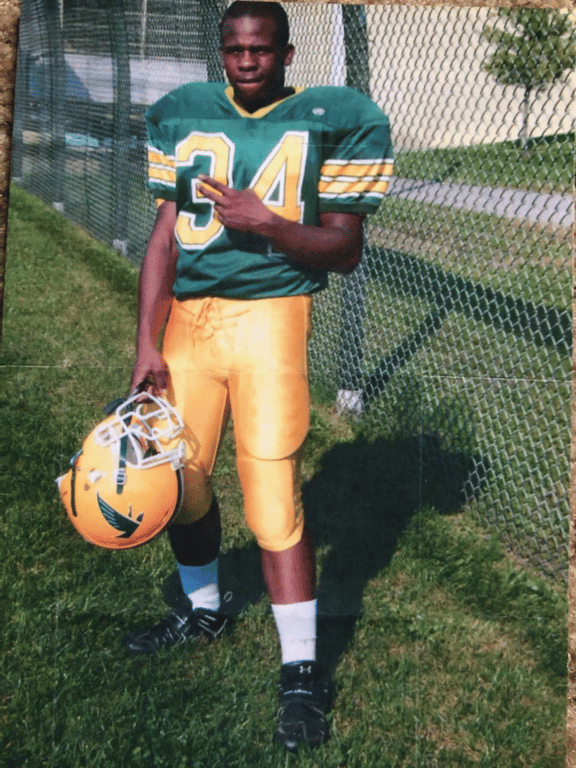
Sameir J. Handy was a 25-year-old Black man from Wilmington, Delaware, whose life ended after a shooting inside a residence in the 1000 block of North Pine Street on February 26, 2016. At approximately 6:45 that Friday evening, Wilmington police responded to the home and found Handy suffering from a gunshot wound to the chest. Emergency personnel treated him at the scene before rushing him to Christiana Hospital, but his injuries proved fatal.
His death left behind two children, Synceir Handy and Wa’Seem Martinez, as well as his parents, Katina Handy and Craig Kelson, his grandmother, siblings, other relatives, and friends.
The investigation soon focused on Adam Jablonski of New Castle. Police arrested Jablonski, who was 19 at the time, on March 3, 2016, while he was already being held at the James T. Vaughn Correctional Center near Smyrna on an unrelated matter. Authorities accused him of firing the shot that killed Handy. The nature of the principal charge indicated that investigators and prosecutors treated the death as the result of criminal negligence rather than an intentional murder. Jablonski was initially charged with criminally negligent homicide, possession of a firearm during the commission of a felony, and possession of a firearm by a person prohibited. He was held without bail following the new charges.
The prosecution was resolved through a guilty plea rather than a murder trial. On September 28, 2016, Jablonski pleaded guilty to criminally negligent homicide and possession of a firearm by a person prohibited. The available court record does not describe the precise handling of the gun, the events immediately preceding the discharge, or any argument between the men, but the plea established Jablonski’s criminal responsibility for the fatal shooting. No additional suspects or accomplices were identified in the available reporting or court records.
On March 2, 2017, the Delaware Superior Court imposed an eight-year Level V sentence for criminally negligent homicide, suspending it after eight months of incarceration. That sentence was followed by six months at Level IV supervision and another 18 months at Level III supervision. For possessing a firearm while legally prohibited from doing so, Jablonski received a separate eight-year Level V term, suspended after one year, followed by one year at Level II supervision. The sentences were structured so that much of the announced prison time was suspended, leaving Jablonski subject to progressively less restrictive correctional supervision after serving the required confinement.
Jablonski later violated the terms of his probation. On July 25, 2019, the court resentenced him on both convictions. For the probation violation connected to the homicide conviction, the court imposed the remaining seven years, three months, and 12 days at Level V, but suspended that term after 90 days for six months of Level IV work release and one year of Level III supervision. On the firearm conviction, the court imposed seven remaining years at Level V, again suspending the term after 90 days and ordering one year of Level III supervision. The Level IV portion was subsequently modified from work release to placement at the discretion of the Department of Correction.
In May 2020, Jablonski sought another reduction, asking the court to suspend his remaining Level IV placement so that he could begin the less restrictive Level III phase. He pointed to concerns about vulnerability to COVID-19, prospective employment, his desire to return to his family, and his completion of programs that included Project New Start, Alternatives to Violence, Thresholds, and Lifeskills. The Superior Court rejected the request on June 17, 2020, finding that it was his third sentence-modification application, that the court had already granted a modification, and that the existing sentence remained appropriate. The denial left the revised probation-violation sentence in place.