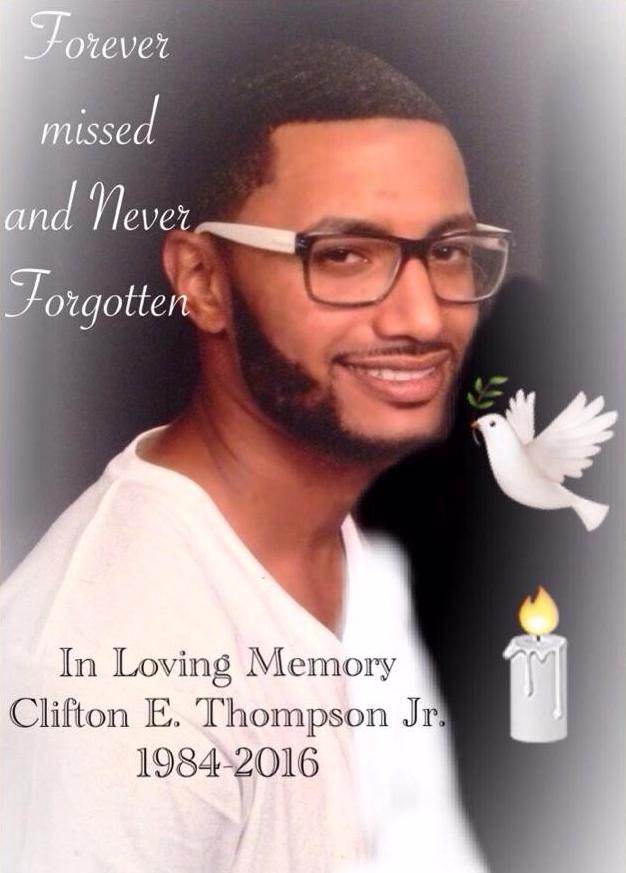
Clifton Thompson, a 31-year-old Black man, was fatally shot on the evening of February 27, 2016, outside the Prides Court Apartments in the Ogletown/Newark area of Delaware. Thompson had arrived at the apartment complex with his girlfriend, Cassie Brown, and their daughter to visit his mother, Jean Cameron. As their daughter headed toward Cameron's apartment, she became frightened after noticing a hooded man lurking near the bushes and returned to her parents. When the family attempted to go inside, the man confronted them and told Thompson to send his family into the apartment. Thompson and his daughter went inside, while Brown was temporarily left outside and recognized the man as Reginald Waters. She questioned Waters about why he was looking for Thompson before she was eventually able to enter the apartment.
The confrontation had developed from a dispute that had been building during the day. Court records later showed that Thompson and Waters had been introduced through a mutual acquaintance, Rapha Moore, who was also known as "Six." Evidence presented at trial indicated that Waters was demanding a refund over marijuana he considered moldy, while Thompson was attempting to calm the situation without returning the money. Communications among the men became increasingly frequent and hostile as the day progressed. The court ultimately concluded that the dispute provided a motive for what happened at Prides Court that evening.
Thompson contacted Moore after encountering Waters at his mother's residence, and Moore headed to the apartment complex in an effort to defuse the confrontation. By the time Moore arrived, Thompson had come back outside. Moore was speaking with Thompson when he noticed a person wearing a black hood approaching and then heard gunfire. Thompson was struck multiple times. New Castle County Police officers responding to reports of shots found him seriously wounded, including gunshot injuries to his torso and leg. Emergency personnel treated him before transporting him to Christiana Hospital, where he was pronounced dead shortly after arriving. Moore told investigators at the scene that Waters was the person who shot Thompson and also told police that the two men had been arguing over money.
Investigators focused on Waters early in the homicide investigation. Police obtained telephone and cell-site records associated with him and developed additional witness and circumstantial evidence connecting him with the confrontation. About a month after the killing, on March 29, 2016, members of the New Castle County U.S. Marshals Task Force located Waters at the Best Western/Galaxy Inn on East Lebanon Road in Dover. He was taken into custody without incident. Authorities initially charged him with first-degree murder and possession of a firearm during the commission of a felony, and he was committed to the Howard R. Young Correctional Institution without bail. A New Castle County grand jury later indicted him on first-degree murder, possession of a firearm during the commission of a felony, possession of a firearm by a person prohibited, and possession of ammunition by a person prohibited.
The prosecution eventually presented the case in a bench trial held from May 14 through May 23, 2018. Among the evidence were witness accounts, telephone communications, prison calls and cell-site location information that prosecutors said helped place Waters in the vicinity of the shooting. Although Moore later signed an affidavit asserting that his original statement implicating Waters had been involuntary, the trial judge found Moore's statements made at the scene and shortly afterward more credible than his later recantation. The court also determined that other evidence independently connected Waters to the fatal confrontation.
Waters was not convicted of the first-degree murder charge originally brought against him. Instead, the judge found him guilty of the lesser-included offense of manslaughter, along with possession of a firearm during the commission of a felony, possession of a firearm by a person prohibited, and possession of ammunition by a person prohibited. In explaining the manslaughter verdict, the Superior Court concluded that the evidence established that Waters caused Thompson's death but did not prove beyond a reasonable doubt that he acted with the intent required for a murder conviction. The court found that Waters intended to cause serious physical injury and used a firearm in a manner that a reasonable person would recognize as likely to cause death.
The case did not end with the verdict. Before Waters was sentenced, the United States Supreme Court issued its decision in Carpenter v. United States, which affected the legal standards governing law enforcement access to historical cell-site location information. Waters argued that investigators had improperly obtained historical location records associated with his telephone and sought a new trial. The Delaware Superior Court agreed that the historical cell-site information had been obtained in a manner that did not comply with the constitutional requirements subsequently established in Carpenter. Nevertheless, the judge concluded that the remaining testimony and evidence still proved Waters' guilt beyond a reasonable doubt even without the disputed location data and denied his request for a new trial.
Waters was eventually declared a habitual offender because he had prior felony convictions involving sexual assault and weapons offenses. In November 2019, a Superior Court judge sentenced him to 75 years in prison, followed by six months of either home confinement or work release and then one year of probation. The lengthy sentence brought the criminal prosecution of Thompson's killing to a conclusion, although Waters continued to challenge his convictions through the appellate courts.
Waters appealed to the Delaware Supreme Court, arguing in part that he should have received a new trial because of the improperly obtained cell-site records, that certain prison telephone calls should not have been admitted, and that the trial court should have granted his attorney additional time to review evidence. On November 23, 2020, the Delaware Supreme Court rejected those arguments and affirmed the Superior Court's judgment. The appellate court concluded that, despite the problem with the historical location evidence, the trial judge had properly determined that the other evidence established Waters' guilt beyond a reasonable doubt. The manslaughter and firearms convictions therefore remained intact, as did the prison sentence imposed for Thompson's killing.