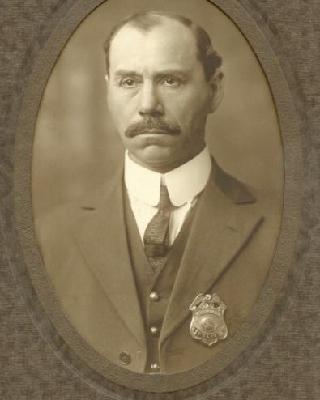
Enos L. “Bud” McCracken, a 44-year-old man, was the sheriff of Barber County, Kansas, when a warrant turned into a killing on the night of March 19, 1908. Contemporary accounts place the shooting in Kiowa, Kansas, not Kiowa City, Alabama. McCracken and Kiowa City Marshal Bunton went to the home of James Clark, an older local bootlegger, to arrest him on a warrant for selling whiskey. Clark had already been avoiding officers and had reportedly barricaded himself inside his house. When the officers forced their way in, Clark slipped out through a window and ran to an outhouse in the dark, turning the arrest into a tense, close-quarters standoff.
McCracken circled the little building, calling on Clark to surrender. For a moment it appeared the suspect might give himself up. But when McCracken stepped toward the partly opened door and reached for him, Clark drove a revolver forward and fired at point-blank range into the sheriff’s chest. Even after being hit, McCracken fought back, firing several shots into the outhouse. Clark then tried to break away, but Marshal Bunton fired and struck him in the leg, stopping his escape. McCracken managed to walk a short distance before collapsing, realizing too late how badly he had been wounded. He was carried to a nearby restaurant near the Santa Fe depot, where several doctors worked through the night to save him.
For a brief time there was hope that he might survive, but the wound was catastrophic. A postmortem later described the bullet as entering high in the chest, traveling downward, passing below the heart, and lodging in the stomach. Internal bleeding proved fatal. McCracken lingered until 12:10 in the afternoon on March 21, 1908, when he died from the wound he had received two days earlier. The killing sent a shock through Barber County. Newspaper accounts described widespread fury and a real fear that Clark would be lynched if he remained in Kiowa. Because of that danger, officers rushed him away on a freight train to Wellington for safekeeping.
James Clark was the only suspect publicly identified in the case, and he was immediately in custody after the shooting because he had been wounded during his capture. No trial ever took place. The gunshot to his leg turned grave, gangrene set in, and an amputation was attempted, but Clark never recovered consciousness after the operation. He died in the Wellington jail on Monday evening, only days after McCracken’s death. With Clark dead before court proceedings could move forward, there was no prosecution, no conviction, and no formal trial record in the usual sense. In the public mind, though, the case was settled almost instantly: the man accused of killing Sheriff McCracken was captured at the scene, identified by the surviving lawmen and witnesses, and died before the county could bring him back to answer for the murder in court.
The aftermath only deepened the tragedy. McCracken’s body was taken to Medicine Lodge, where the funeral drew one of the largest crowds the town had seen. His wife had given birth just two days before the shooting, leaving her bedridden as the county mourned around her. The image that remained in local memory was of a sheriff dying in the line of duty while trying to carry out a warrant against a man long regarded as dangerous and lawless. In that sense, the story closed quickly in legal terms but never emotionally for the community: the suspect was caught, the arrest was effectively made in blood, and the county was left to bury both its sheriff and the hope of ever seeing the case tried before a jury.