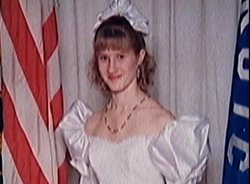
In the spring of 1933 in North Adams, Massachusetts, eighteen-year-old Leah Lloyd Johnson lived a quiet life with her grandfather, A. M. Burdick, a retired janitor. Described as a reliable worker, Leah was employed as a housekeeper for a local couple, Walter and his wife. She seemed content with simple pleasures like going to the movies, reading, or listening to the radio. She kept her personal life private but often spoke on the phone with her close friend, Ruth Crapo. To those who knew her, she was a typical young woman of her era, navigating the path to adulthood in a small New England city.
On the evening of Saturday, April 22, 1933, Leah told her grandparents she was leaving their home to babysit for a neighbor. It was a pretense; investigators later determined she had no such appointment. She walked out into the night and was never seen alive again.
Six days later, on April 28, a man named Edward Dolan, who was out for a walk, made a devastating discovery in a thicket of thornapple bushes off Church Street. He found the body of Leah Lloyd Johnson.
An autopsy conducted by Dr. Ellis Kellert revealed the violent end Leah had met. She had been stabbed and strangled with a shoestring, the kind used for a heavy work boot. The examination also concluded she had not been sexually assaulted. Not far from where her body lay, searchers located her leather pocketbook. Inside were a comb, a mirror, and a dented wristwatch, its hands frozen at 11:10, offering a silent clue to the time of the attack. The location of the pocketbook suggested the killer had crossed the road, descended a steep embankment toward the Boston & Maine railroad tracks, and thrown the items away.
The investigation into the female teenager's murder began immediately but was quickly hampered. In the hours after the discovery, thousands of curious residents descended upon the hillside, trampling the brush-covered crime scene and destroying any potential evidence the killer might have left behind. The North Adams Police, assisted by State Detective Silas P. Smith and Assistant District Attorney Harold Goewey, were left with a case that grew colder by the day. They pursued numerous leads and rumors, including a persistent but false story that Leah had attended a "whoopee party" with two other couples on the night she was killed.
Detectives interviewed multiple persons of interest. They questioned a 23-year-old man named Albert Reynolds after finding letters he had written to Leah. Reynolds explained they had been friends but that he had broken off the correspondence; he had a solid alibi and was quickly cleared. Leah’s friend Ruth Crapo and others were interrogated for 48 hours but could provide no useful information. Years later, in 1936, two confessed killers in an unrelated case were questioned about Leah’s murder but were also eliminated as suspects. The motive for the brutal slaying remained a complete mystery.
Frustration mounted, and within weeks of finding Leah, investigators admitted the mystery was likely beyond solution. The case was periodically reviewed over the decades, including a re-interview of Edward Dolan in 1942, but no new evidence emerged. Rumors persisted for years, including one shared by a local resident in her old age, who recalled hearing that Leah was secretly involved with a prominent, married man in town, but this was never substantiated by law enforcement.
More than 90 years have passed, and the murder of Leah Lloyd Johnson remains one of Berkshire County's oldest and most haunting unsolved homicides. In October 2026, the case received renewed attention when the North Adams Public Library, along with the local police and historical society, hosted a presentation by retired police officer and historian Jeffrey Kemp to discuss Leah's life and the enduring mystery of her death. As of that date, no charges have ever been filed, and the identity of the person who ended a young woman's life in a thornapple thicket remains unknown.