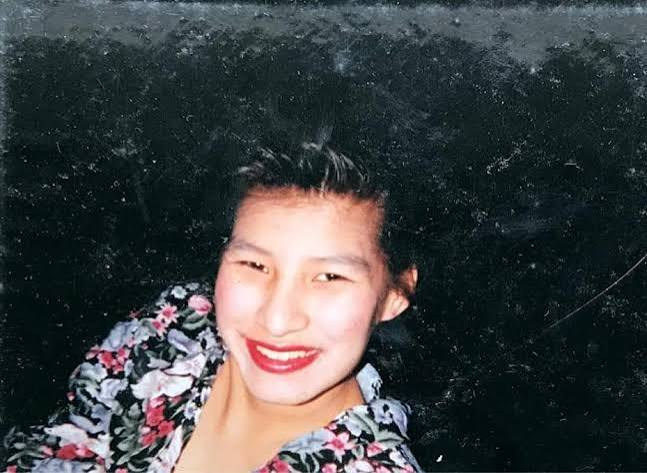
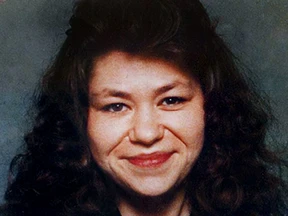
Bernadette Lynda Ahenakew was a spontaneous and nurturing person who loved to cook and was fluent in the Cree language. A member of the Métis community of Ile-à-la-Crosse, Saskatchewan, the 22-year-old woman is remembered for her kindness, like the way she would help around the house or braid her niece’s hair. She was a mother to three children, including two young sons, Kurt and Dallas, who were not yet five years old when their mother's life was taken from them.
Bernadette’s life had been marked by hardship, including time in government care where she experienced abuse, and she struggled with addiction as a way to cope with her pain.
In September 1989, Bernadette was living in Edmonton, Alberta, when she disappeared. Her common-law husband grew worried when he couldn't find her and began searching the streets for her, eventually filing a missing person report with the city police. Her family learned she was missing when her sister, Nancy Masuskapoe, saw an article about it in a newspaper. The search for Bernadette ended in heartbreak a month later. On October 24, 1989, a man clearing brush discovered her body in a ditch on a rural road near Sherwood Park, a community just east of Edmonton. Investigators determined she had been manually strangled and believe she was killed before her body was left at the location where she was found.
The Royal Canadian Mounted Police (RCMP) launched a homicide investigation, which is now handled by Project KARE, a special unit that investigates cases of murdered or missing vulnerable persons in Alberta. Despite the passage of decades, no suspect has ever been identified, and no arrests have been made in connection with her murder. Her case remains unsolved, leaving her family with a profound and unending sense of loss and a lack of answers. "There's somebody that knows what happened to her," her sister Nancy has said. "It's like a big mystery."
Investigators have considered the possibility that Bernadette’s murder is connected to a larger pattern of violence. Her death is one of several unsolved cases involving women, many of them Indigenous, who were living high-risk lifestyles in Edmonton and whose remains were later discovered in rural areas surrounding the city. This cluster of killings has led to speculation about one or more serial predators, sometimes referred to as the Edmonton Killing Fields Killer. Bernadette's case fits the pattern: she was last seen in Edmonton, and her body was found on a rural road in a manner similar to other victims. The cause of death, strangulation, also aligns with other cases in the region.
The pain of Bernadette’s violent death has been a heavy burden for her family. Within days of her discovery, her sister and husband traveled to Edmonton to bring her body home. She was buried in her home community of Ile-à-la-Crosse. The grief was compounded a year later when Bernadette's other sister, Laura Ann Ahenakew, also met a violent end in 1990. "The pain is so great sometimes," Nancy Masuskapoe said, reflecting on the loss of both her sisters.
Years later, Bernadette's sons have spoken publicly about the difficulty of growing up without their mother, remembering her only through photographs. The family has also expressed frustration with the investigation, stating that they are rarely, if ever, contacted by police with updates. "I never hear from anyone anymore," Nancy said, adding that any contact is usually initiated by her. She believes that even a call to say there is no new progress would be helpful. The family continues to hope that someone will come forward with information that could finally bring justice for Bernadette.