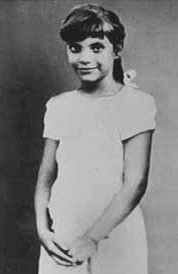
On August 24, 1951, ten-year-old Caucasian female Beverly Rose Potts vanished from her neighborhood in Cleveland, Ohio, in what would become one of the city’s most haunting unsolved cases. That evening, Beverly, a quiet and responsible child known for her love of music and dancing, had attended a children’s performance event called the Showagon at Halloran Park, just a few blocks from her home. She had gone with her best friend, 11-year-old Patricia “Patsy” Swing.
After returning home briefly to drop off their bicycles, the girls walked back to the park. Around 8:45 p.m., Patsy decided to leave, but ten-year-old Caucasian female Beverly Rose Potts chose to stay and watch the rest of the show. That was the last confirmed sighting of her.
When Beverly failed to return home, her disappearance triggered the largest manhunt in Cleveland’s history at the time. Authorities scoured the neighborhood, questioned residents, and followed thousands of leads. Despite the massive effort, no trace of ten-year-old Caucasian female Beverly Rose Potts was ever found. Her family was quickly ruled out as suspects, and investigators believed she had a happy home life. One theory suggested she may have been lured into a car or nearby house by someone offering her a babysitting job or a ride home—offers she might have accepted, as she was known to babysit for neighbors.
Over the decades, several suspects and confessions emerged, but none led to a resolution. In 1955, a man named Harvey Lee Rush confessed to killing a girl he claimed was Beverly, but he gave incorrect details and later recanted. In 1980, two retired Cleveland police officers identified a man who had lived in the area and admitted to molesting young girls. He was considered a viable suspect, but prosecutors declined to press charges. Another potential suspect was William Henry Redmond, a former carnival worker indicted in 1988 for the 1951 murder of an eight-year-old girl in Pennsylvania. While in prison, he allegedly confessed to killing three other girls, but no direct link to ten-year-old Caucasian female Beverly Rose Potts was ever established.
In 2000, a series of anonymous letters sent to a local reporter claimed to be a confession from the person responsible for Beverly’s disappearance. The writer, an elderly man, described details that suggested familiarity with the case, but he died before authorities could confirm his identity or verify the confession. Despite these leads, no one has ever been arrested or charged in connection with the disappearance and presumed death of ten-year-old Caucasian female Beverly Rose Potts. Her case remains one of Cleveland’s most enduring and tragic mysteries.