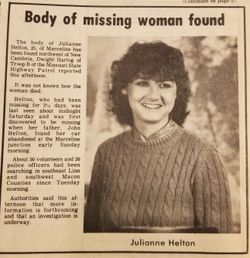
Julianne Helton, a 25-year-old White woman, vanished after a winter night out in northern Missouri, and by morning the first uneasy clue was sitting off the roadway at the Marceline junction in Macon County: her car, found early on January 8, 1984, and found in a condition investigators read as sabotage, not bad luck. Her parents reported her missing when she didn’t come home from a party in New Cambria, and a search quickly spread across Macon and neighboring Linn County as the hours stretched into days.
On January 11, 1984, volunteers and railroad workers came upon her fully clothed body in a field near the Santa Fe railroad tracks, about eight miles northwest of where the car had been discovered. The scene told a violent story: she had been raped, beaten, and stabbed, her hands bound in front with baling twine, and one hand showed injuries consistent with trying to fight back. Some things that might have explained where she’d been headed—or who she’d crossed—were gone: her purse was missing, and so was the weapon used to stab her.
For years, the case lingered in that painful space between certainty and proof—certainty that someone had done this, and a lack of physical evidence strong enough to close the circle around a name. Investigators came to view James B. Grinder as a primary suspect, but the case remained out of reach. At different points, other people fell under suspicion; later reporting on the case indicated a former policeman named Wilfrid Swank was ultimately cleared through DNA evidence, a reminder of how long the investigation wandered through dead ends before it found firmer ground.
The break came from a different kind of arrest altogether. In March 1998, Grinder and two others were arrested for burglary, and in the aftermath he confessed, but his account of Helton’s murder shifted and contradicted itself often enough that it threatened to collapse the only bridge prosecutors had to a conviction. With the confession wobbling and the physical evidence still thin, Macon County Sheriff Robert Dawson turned in 1999 to “brain fingerprinting,” bringing in Lawrence Farwell to test whether Grinder’s brain responses showed recognition of crime details known only to investigators and the killer.
According to the materials describing the case and the sheriff’s request, Farwell conducted the test on August 5, 1999, and the results were presented as demonstrating that Grinder recognized key, specific details of the crime. Shortly afterward—described as about a week later—Grinder entered a plea agreement, pleading guilty to the rape and murder in exchange for a life sentence without parole, avoiding a potential death sentence.
With that plea, the long, raw uncertainty that had hung over Macon County since January 1984 finally narrowed to a legal conclusion. Grinder was convicted in 1999 and received life imprisonment, and after Missouri, he was sent back to Arkansas to face additional murder cases there, where he also pleaded guilty and received another life sentence. He remained in prison until his death in 2010.