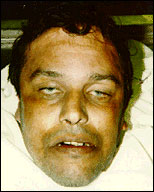
On October 18, 1987, Thomas Waite Gerry, a 36-year-old white man from Maine, was last known to be in the Turner, Maine area in Androscoggin County. His missing person case is listed in NamUs as MP54388, and public case summaries identify Turner as the location connected to his disappearance. Thomas was described as about 5 feet 5 inches to 5 feet 7 inches tall and 130 to 140 pounds, with brown hair and blue eyes.
He also had identifying marks that could help distinguish him: a red birthmark on his left eyelid and a large scar on his left hand, described in the case data as extending toward a ring finger.
The heart of Thomas’s disappearance centers on a flight. Publicly available case information says he was the pilot of a Cessna 172 seaplane traveling from Auburn, Maine, to Nova Scotia. At some point after he set out, he did not arrive as expected, and the explanation believed most likely by the available case summaries is that the aircraft crashed either in the Gulf of Maine or somewhere in the Maine woods. The uncertainty of that route is part of what has made the case so difficult: the possible search area could include open water, coastline, islands, and remote inland terrain, any of which could conceal evidence of an aircraft accident for years.
Thomas’s clothing and personal details add a human dimension to the record. He was reported to have been wearing or associated with a leather flight jacket, size 40, from Howard’s Leather Shop in Yarmouth, pants sized 30-30, and size 9 L.L. Bean hunting boots. These are small details, but in a missing person investigation they matter deeply, because they preserve a picture of the person as he was last known and provide practical identifiers if wreckage, belongings, or remains are ever located. His case was reported on the same date he was last known to have contact, and the listed investigating agency is the Cape Elizabeth Police Department, with agency information in the case file also connecting the report to Yarmouth, Maine.
No public source located for this synopsis states that Thomas was found alive or that his case was formally resolved after a recovery. The available public summaries instead continue to describe the case as one in which no wreckage was ever found. That absence has left his loved ones without the kind of clear answer that families hope for after an aviation disappearance: where the aircraft went down, what happened in the final moments of the flight, and whether a definitive recovery can ever be made. Maine State Police note that NamUs is used by the Maine Office of Chief Medical Examiner to help track and manage missing person case files, and NamUs describes itself as a national resource for missing, unidentified, and unclaimed person cases, underscoring why a case like Thomas’s remains documented even decades later.
Thomas Gerry’s case began as a routine flight from Maine toward Nova Scotia and became a long-running mystery rooted in distance, weather, geography, and the unforgiving nature of both wilderness and water searches. He was 36 years old when he vanished, a pilot in a Cessna 172 seaplane, last associated with Turner, Maine, on October 18, 1987. The central facts remain stark and painful: he departed, he did not arrive, authorities believed the plane may have crashed in the Gulf of Maine or the Maine woods, and no wreckage has been publicly reported as found. The case endures as the story of a man whose final known journey has never been fully traced, and as an unresolved disappearance in which even one discovered clue could finally help explain what happened to Thomas Waite Gerry.Last Seen: Oct 18, 1987