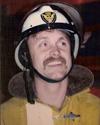
Gerald W. Mork was a 31-year-old White/Caucasian male serving as a patrol officer with the Iola Police Department when he was murdered during the early morning hours of July 14, 1985. Mork had been with the police department for approximately eight months and was also deeply involved in emergency services in the Iola community, having worked as an EMT and firefighter and serving as the village's fire chief. His father, William Mork, was the Waupaca County sheriff.
The killing occurred during the weekend of the Iola Car Show, when thousands of visitors were in the small community and local first responders were especially busy. Mork was working the overnight shift. At about 4:45 a.m., Waupaca County Deputy Sheriff James Kneisler attempted to make radio contact with him but received no response. During the search that followed, Kneisler passed Riverside Cemetery, roughly a quarter-mile outside the village limits along Highway 161, and noticed Mork's police vehicle. Its headlights were still on, but Mork was nowhere inside.
Following the gravel drive into the cemetery, the deputy discovered Mork lying face down in the grass near his squad car. He had been shot twice in the head at close range. Later reporting described wounds to the rear of his head and the left temple and indicated that investigators believed he probably had little or no warning before the shots were fired. His service weapon remained in its holster, suggesting he had not drawn it to defend himself. Why Mork had gone to the cemetery, why he had gotten out of his patrol car, and whether he had been summoned there were questions that investigators were unable to conclusively answer.
Because Mork was the sheriff's son, Sheriff William Mork removed himself from the investigation. Chief Deputy Robert Andraschko took charge and requested assistance from the Wisconsin Department of Justice. The Waupaca County Sheriff's Department, Wisconsin State Crime Laboratory and state investigators began examining the cemetery and reconstructing Mork's movements. DOJ special agents Louis Tomaselli and Carl Paetzke were assigned to assist.
Two fired. 380-caliber cartridge cases and bullet fragments recovered from the crime scene became particularly important. Laboratory examination determined that the ammunition and fragments were consistent with having been fired from an Italian Beretta Model 1934. 380-caliber semiautomatic pistol. Investigators soon learned that Iola Police Chief Michael Schertz had previously taken several firearms from an Iola tavern, including a Beretta of that type. Tavern operator Frances Hayden testified that the weapon had never been returned, while a former Iola officer recalled seeing handguns bearing the Hayden name in the police department's evidence locker in 1984. The Beretta believed capable of firing the ammunition found at the murder scene was never recovered.
Schertz told investigators that he had sold two of the firearms to an unknown person for approximately $200 at a bar several months before Mork's murder, explaining that he needed money because of medical expenses associated with a serious neck injury. Investigators searched Schertz's home with his consent on July 24 and took him into custody on separate allegations involving theft of a firearm and misconduct in public office. Authorities accused him of taking firearms from citizens and improperly removing them from police custody. A judge subsequently authorized a search of Schertz's property.
Investigators also focused on the strained relationship between Schertz and Mork. The village president told authorities that Schertz had opposed Mork's hiring and had repeatedly attempted to have him removed from the police department. Complaints attributed to Schertz included accusations of insubordination, poor performance, reckless handling of a weapon and failure to use proper restraints. Witnesses also testified during the investigation that Schertz had made threatening remarks about Mork before the killing. These statements became part of the prosecution's attempt to establish a possible motive, although Schertz denied murdering Mork.
One of the most significant witnesses described activity in Iola shortly before the shooting. At about 4:00 a.m., the witness and several other people were on Main Street when they saw one Iola police car travel toward Riverside Cemetery. A few minutes later, they saw the department's second squad car head in the same direction. At the time, the Iola police force consisted essentially of Mork and Schertz. Approximately five minutes later, the witness heard a noise he believed could have been a gunshot or firecracker. Soon afterward, the second squad car returned toward town. The witness later identified the driver as Schertz.
A secret John Doe proceeding was conducted between August 3 and August 22, 1985. Eleven witnesses, including Schertz, testified during five days of proceedings. After considering the testimony and evidence, Waupaca County Circuit Judge Philip Kirk found probable cause to believe Schertz had killed Mork and issued a warrant charging him with first-degree murder. Schertz, then 38, was formally charged on August 23 and initially held on $200,000 cash bond. A preliminary hearing involving fifteen witnesses also resulted in a finding of probable cause, and a second judge later independently reviewed the record and concluded there was sufficient evidence for Schertz to stand trial.
The prosecution's case was circumstantial. Authorities argued that Schertz potentially had the means, motive and opportunity to commit the murder: a weapon consistent with the murder ammunition had previously passed through his control, witnesses described hostility and threatening comments toward Mork, and testimony placed what appeared to be both Iola squad cars traveling toward the cemetery shortly before the gunfire. No murder weapon, however, was ever recovered, there was no confession, and no eyewitness testified to actually seeing Schertz shoot Mork.
The investigation also became controversial because of evidence that Schertz and his defense argued had been mishandled or insufficiently examined. Court records later documented allegations that the cemetery was taped off but not continuously secured, that an emergency vehicle drove over tire tracks, and that the tracks were photographed but not cast. Blood or other material reported on Mork's shoes, inside his police vehicle and elsewhere around the scene was cited by the defense as evidence that had not been adequately tested. Mork's firearm and the interior of his squad car were not fingerprinted. A private citizen also reported finding another. 380 cartridge case near the cemetery but was allegedly told it was of no investigative value.
Another potentially important discovery occurred about a week after the murder, when a tent containing sleeping gear was found roughly a quarter-mile from the area where Mork died. Someone at the tent's location apparently would have had a view toward the crime scene. Schertz later argued that investigators failed to photograph or forensically examine the tent for fingerprints, hair, blood or gunshot residue. These disputed aspects of the investigation became part of the defense argument that authorities had concentrated too heavily on Schertz while failing to fully investigate other possibilities.
Schertz's murder trial was moved to Eau Claire and lasted approximately two weeks. His attorneys attacked the circumstantial nature of the prosecution's case and challenged the quality and direction of the investigation. After a little more than four hours of deliberation, the jury returned its verdict on December 12, 1985: Michael Schertz was found not guilty of Gerald Mork's murder. Because the verdict was an acquittal, he could not later be retried for the same murder.
The separate firearm-theft and misconduct-in-office allegations continued after the murder trial. Schertz was ultimately tried on those charges as well, and on July 11, 1986, another jury found him not guilty. He later filed a federal civil-rights lawsuit against Waupaca County and several state and local investigators, arguing among other things that he had been arrested and detained without probable cause and that investigators had mishandled or ignored evidence. The courts nevertheless concluded that the judicial findings of probable cause supporting the searches, arrest and prosecution had been legally sufficient, even though the criminal juries ultimately acquitted him.
No other person has been convicted of killing Gerald Mork, and his murder remains unresolved. Decades later, the Waupaca County Sheriff's Office continued to regard the case as open. In 2025, the department said the case had been assigned to a detective and that authorities remained in communication with the Wisconsin Department of Justice. The disappearance of the suspected murder weapon and the limitations of forensic testing available in 1985 have continued to complicate efforts to determine who shot Mork in Riverside Cemetery that July morning.