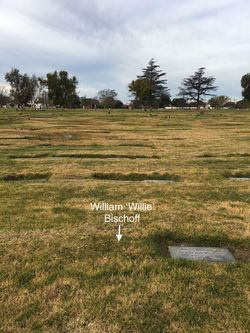
On December 21, 1958, William Henry Bischoff, a 26-year-old white male from the Phoenix, Arizona area, was shot to death and left in the desert scrub of Papago Park near Tempe. Contemporary accounts and later reconstructions describe him as an ex-convict and parole violator from Washington state, whose life had become transient and precarious by the time of his death.
His body, eventually found lying off a dirt road in the park, bore two gunshot wounds in the back, and investigators believed he may have lived for several hours after being shot before finally succumbing to his injuries.
In the weeks leading up to the killing, Bischoff had been traveling with Vera Nadine Whipple, with whom he was living as common-law husband and wife. The pair arrived in Phoenix from Washington in early December 1958 essentially destitute, relying on assistance from the Salvation Army for food and shelter. Around mid-December they met Honor Robinson, who, after learning they were homeless, invited them to stay at his house in south Phoenix. According to court summaries, the three adults soon began “lining up” places to burglarize, driving around the city to scout targets; other sources describe this as participation in a small robbery ring centered on Robinson’s home.
Tension escalated when Robinson became romantically involved with Whipple. Several times Robinson and Whipple went out together without Bischoff, and one night Whipple stayed out all night with Robinson. The next morning Bischoff telephoned the Maricopa County Sheriff’s Office in an effort to locate her, but before an officer arrived Robinson and Whipple returned, and a heated argument broke out when Bischoff confronted her about the night away. This confrontation deepened the antagonism between the two men. That evening, Robinson proposed that he and Bischoff go to Papago Park to burglarize a house; once there, the pair walked up a dirt road. Robinson feigned a stumble to get behind Bischoff and then shot him twice in the back. At trial Robinson claimed he fired in self-defense when Bischoff allegedly lunged at him with an ice pick, but the physical circumstances described in the court record showed him firing from behind. After the shooting, Robinson dragged the body off the road, removed all identification from Bischoff’s person to delay recognition, and returned home, where he continued living with Whipple for the next ten days.
Bischoff’s body was discovered in the Papago Park area near Tempe, a desert location then favored for both recreation and, grimly, for the disposal of crime victims. Reports note that he had been shot twice in the back and may have survived for some hours before dying, suggesting he was left without aid in an isolated stretch of the park. The case was treated from the outset as a homicide involving “death by force,” and later memorial listings record him specifically as a gun homicide victim in Arizona on that date.
In the immediate aftermath, police focused on Robinson and Whipple. Contemporary clippings quoted in later sources describe officers “holding a man and a woman” in connection with the “park killing,” identifying Bischoff as an ex-convict and parole violator from Washington and stating that Whipple was being held for investigation of homicide as well as on a parole-violation matter. More detailed legal summaries and later research indicate that Robinson was formally arrested on December 31, 1958, ten days after the body was found, after continuing to live with Whipple in Phoenix during that period. On April 2, 1959, prosecutors filed a formal first-degree murder charge against him; he pleaded not guilty on April 8, and his trial began on June 4 of that year.
At trial, the state’s case portrayed the killing as a calculated ambush rooted in a three-way relationship and the pair’s joint criminal activity. Testimony and later summaries emphasize that Bischoff and Whipple had moved into Robinson’s home, that the three had been scouting burglaries together, and that Robinson ultimately shot Bischoff in a dispute over Whipple’s affections. Evidence that the two victims had been helping Robinson in a robbery ring, combined with the facts of the ambush in Papago Park and Robinson’s efforts to conceal the body and remove identification, undercut his self-defense story. Robinson’s attorneys argued on appeal that pretrial publicity and racial prejudice—given that Robinson was Black and both Bischoff and Whipple were identified in contemporary accounts as white—had deprived him of a fair trial, but the Arizona Supreme Court rejected those claims and upheld both conviction and sentence.
The jury found Robinson guilty of first-degree murder on June 30, 1959, and he was sentenced to death. He was executed in Arizona’s gas chamber on October 31, 1961, with contemporary write-ups noting that officers who had arrested him after Bischoff’s killing were among the witnesses at his execution. Vera Nadine Whipple, though central to the events and initially held and investigated alongside Robinson, ultimately faced a separate legal process; available summaries state that she was acquitted of any direct involvement in the homicide after prosecutors were unable to prove her culpability beyond a reasonable doubt. No other suspects beyond Robinson and the initially questioned Whipple appear in the surviving records, and Robinson’s conviction and execution stand as the legal culmination of the investigation into the killing of William Henry Bischoff.