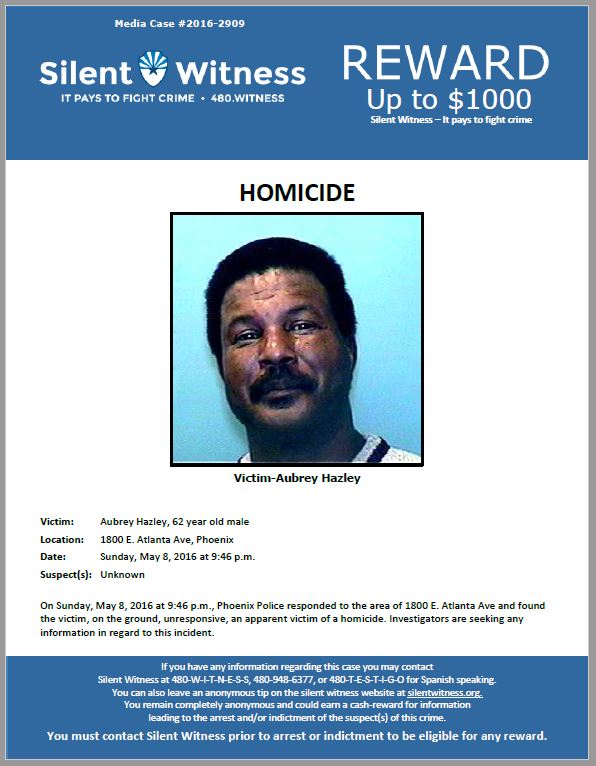
On the evening of May 8, 2016, 62-year-old Aubrey Hazley, a male resident of Phoenix, Arizona, became the victim of a deadly attack that has never been fully explained. Born in October 1953, he had already lived through six decades by the time that spring Sunday arrived, yet the events of a single night would erase him from his community and leave those who knew him with more questions than answers.
As daylight faded over Phoenix that night, an emergency call brought officers to the area of the 1800 block of East Atlanta Avenue. At approximately 9:46 p.m., police arrived and found Hazley lying on the ground, unresponsive, in that stretch of neighborhood street. It was immediately apparent that something violent had happened to him, and responders treated the scene as a homicide from the outset. Despite the quick response, there was nothing they could do to save him; the man they found on the pavement would not make it to another sunrise.
Publicly available records do not reveal much about the moments leading up to Hazley’s death. They do not say where he had been earlier that evening, whether he was walking through a familiar neighborhood or passing through on his way somewhere else, or who, if anyone, was close enough to see or hear the violence that took his life. The details that might give shape to his final hours – a conversation, an argument, a chance encounter – remain locked away in police files or in the memories of people who have never stepped forward. What the record does show is stark: he was discovered outdoors in that block of East Atlanta Avenue, and his death was officially classified as a homicide.
In the days and years that followed, detectives treated Aubrey Hazley’s killing as an open case, returning to it as part of Phoenix’s growing roster of unsolved homicides. The case appears in cold-case listings, where it is summarized in just a few lines: the date, the time, the location, the fact that officers found a man on the ground and that he had been killed. Each entry emphasizes the same plea—that investigators are seeking any information that might explain who was responsible and why Hazley was targeted that night. No public record indicates that a specific suspect has ever been named, and there are no announcements of an arrest, charges, or a trial connected to his death. As far as the public record shows, the person or people responsible have not been brought before a court, and the homicide remains officially unsolved.
After his death, records show that Hazley’s life was formally bookended by the dates on his memorial: born in 1953 and dead on May 8, 2016. He was laid to rest at the National Memorial Cemetery of Arizona in Phoenix, a final resting place that quietly anchors his story in the same city where it ended. From there, his name lives on mostly in brief digital entries—on cemetery rolls, on cold-case summaries, in the terse language of databases that reduce a life to dates, an address, and the word “homicide.” Yet behind those sparse lines is a man whose death cut through a family and a neighborhood, and whose case still waits for the one piece of information that could finally move it from the cold-case lists into the realm of answered questions and accounted-for lives.