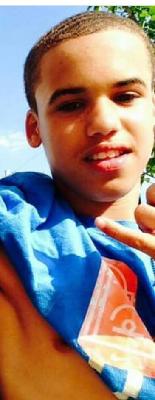
Brandon Nasir Wingo, a 15-year-old African American male from Wilmington, Delaware, was killed on May 19, 2016, while walking home from Howard High School of Technology, where he was a freshman and played varsity basketball. Shortly after classes let out, Brandon was walking with a group of schoolmates along Clifford Brown Walk in Wilmington. At about 3:20 p.m., in the area of the 900 block, the group noticed a person approaching in a black coat and hoodie, clothing that stood out because the
weather was warm. Brandon and one classmate had fallen a few steps behind the rest of the group. As the person approached, Brandon remarked that an “opp,” meaning someone viewed as being on the opposing side of a street conflict, was coming toward them. The approaching person passed some of the students, reached into a pocket, yelled something and drew a gun. Three shots were fired. The students scattered, and Brandon tried to run, but he was struck in the top of the head and in the buttocks and collapsed between two parked vehicles. He was transported for emergency treatment but died from his injuries.
The shooting was eventually placed by investigators in the middle of a violent feud involving the Wilmington street gang Shoot To Kill, known as STK, and a rival group called Only My Brothers, or OMB. Evidence later presented in court portrayed Brandon’s killing not as a random encounter but as retaliation connected to social media and the broader gang conflict. Kevon Harris-Dickerson, an admitted STK member who later cooperated with prosecutors, testified that Brandon had made a Facebook post considered disrespectful toward a deceased STK associate. Harris-Dickerson said that he, Diamonte Taylor and Zaahir Smith discussed the post on the day of the killing and agreed that if they encountered Brandon or another person associated with OMB, that person would be shot. He also testified that the group knew where Brandon attended school and knew the routes he was likely to use when walking home.
Harris-Dickerson’s testimony described the preparations immediately before the shooting. Latasha Pierce owned a Ford Fusion that Harris-Dickerson frequently used, and on the afternoon of May 19 he and Taylor drove Pierce to work. After dropping her off, Harris-Dickerson and Taylor drove toward Clifford Brown Walk and saw Brandon with other students. Harris-Dickerson testified that Taylor initially wanted to shoot from the vehicle but that he refused to allow a drive-by shooting. He stopped the car, and Taylor got out carrying a firearm and a winter coat. Harris-Dickerson drove away and heard gunfire moments later. Surveillance footage later showed Taylor running toward a residence at 508 Shearman Street around the time of the shooting. Harris-Dickerson said he subsequently met Taylor and Smith at that house, where Taylor said that he had shot Brandon. Harris-Dickerson further testified that the men later drove back along Clifford Brown Walk and passed the place where Brandon had fallen before eventually meeting Pierce and traveling to North Carolina. Pierce returned to Delaware quickly, while Taylor, Smith and Harris-Dickerson remained there for several days before returning. Investigators recovered 9mm shell casings at the homicide scene, and ballistics testing linked the firearm used against Brandon to other shootings that were part of the same period of violence.
The investigation produced several arrests and a major grand-jury indictment. Taylor was arrested by United States Marshals on June 1, 2016, while riding in a vehicle, and investigators later searched a residence on Shearman Street where they found black coats, a Canik 9mm firearm case and Herter’s 9mm ammunition. On June 20, a Delaware grand jury indicted Taylor, Harris-Dickerson and Smith on charges stemming from Brandon’s killing and a broader series of violent incidents. Each faced first-degree murder, gang participation, first-degree conspiracy and firearm-related allegations, along with additional counts tied to robberies, shootings and other incidents during May and early June. Prosecutors said the three had participated in planning and aiding the homicide. Pierce was also indicted on related allegations of giving a firearm to a prohibited person, second-degree conspiracy, falsely reporting an incident and providing a false statement to law enforcement. At the time the homicide indictments were announced, Taylor, Harris-Dickerson and Smith were already in custody on charges connected to other incidents. Cash bail was set at $1.5 million for Taylor, $1.5 million for Harris-Dickerson and $2 million for Smith, while Pierce was arrested when the indictments were announced.
Taylor became the central defendant in the prosecution. During his 2018 trial, prosecutors presented eyewitness accounts, Harris-Dickerson’s testimony, surveillance evidence, ballistics findings and evidence obtained from Taylor’s smartphones. A witness who knew Taylor from middle school testified that she saw him in a light-blue vehicle shortly before the shooting wearing black clothing and later saw the gunman firing at Brandon. Although she acknowledged that she could not clearly see the shooter’s face beneath the hoodie, she identified Taylor during the investigation. Another witness saw the shooter fleeing with a gun toward Shearman Street. The prosecution argued that Taylor personally fired the shots in retaliation for the social-media slight. In April 2018, a New Castle County Superior Court jury convicted Taylor of first-degree murder as well as first-degree assault, two counts of first-degree reckless endangering, two firearm counts, two counts of aggravated menacing and illegal gang participation. He was later sentenced to life imprisonment plus additional prison time.
That conviction did not end the case. Taylor appealed, challenging, among other things, the search of his smartphones. In September 2021, the Delaware Supreme Court concluded that the search warrant had been written far too broadly. It authorized investigators to search essentially any and all information stored on the devices without a meaningful time limitation or sufficiently narrow description of the evidence sought. The court determined that the warrant amounted to an unconstitutional general warrant and that evidence taken from the phones should have been suppressed. Because prosecutors had made substantial use of the smartphone evidence at trial and the court could not conclude that its admission had been harmless, Taylor’s convictions were vacated and the case was sent back for a new trial. The ruling was based on the unlawful scope of the digital search rather than a finding that Taylor had been factually cleared of Brandon’s killing.
Zaahir Smith’s case was resolved separately. Smith pleaded guilty in March 2019 to offenses arising from the broader STK crime spree, including first-degree conspiracy in connection with Brandon’s murder, gang participation, first-degree robbery, attempted first-degree robbery, first-degree assault and two firearm offenses. Prosecutors said Smith had conspired with Taylor to carry out the broad-daylight killing. In January 2020, Smith was sentenced to a total of 21 years in prison, followed by various levels of supervision. A later effort by Smith to obtain post-conviction relief was denied. Harris-Dickerson, meanwhile, had pleaded guilty to several charges stemming from the May 2016 series of crimes and became an important prosecution witness, providing the account of the discussions, preparations and events surrounding Brandon’s shooting that was presented at Taylor’s trial.
Taylor’s second murder trial began in December 2023, but it ended almost immediately in a mistrial. During testimony from a prosecution gang expert, information emerged concerning an interview the expert had conducted with Taylor while Taylor was incarcerated and the expert’s identification of Taylor as an STK member. The defense argued that the circumstances implicated Taylor’s constitutional rights and that the prejudice could not be cured simply by instructing jurors to disregard portions of what they had heard. The Superior Court agreed that, under the unusual circumstances, a fair trial could not continue and declared a mistrial. As the parties prepared for what would have been a third trial, they instead negotiated a plea agreement.
On September 4, 2024, Taylor pleaded guilty to the reduced offense of second-degree murder and to first-degree conspiracy. Through the plea, he accepted criminal responsibility for recklessly causing Brandon’s death under circumstances demonstrating a cruel, wicked and depraved indifference to human life. The parties jointly recommended that Taylor serve the statutory minimum prison term on the murder charge, but the sentencing judge was not bound by that recommendation. On January 17, 2025, Taylor received a 40-year sentence for second-degree murder, suspended after 23 years of incarceration for intensive community supervision and other descending levels of probation. His conspiracy sentence was suspended for probation. The Delaware Department of Justice announced the sentence as the resolution of the long-running prosecution over Brandon’s killing. In March 2026, Taylor sought correction of his sentence, arguing that it was illegal, but the Delaware Superior Court rejected the challenge, finding that the prison term fell within the lawful sentencing range for second-degree murder. The 23-year term therefore remained in place.