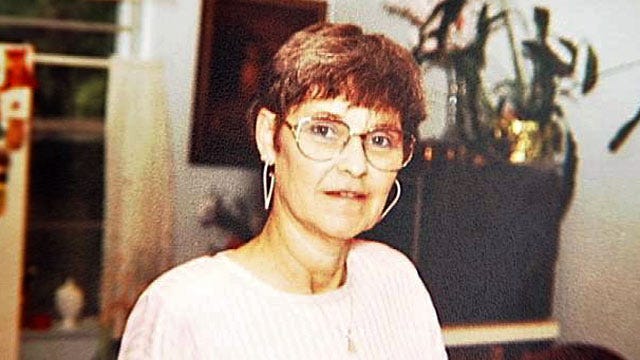
Do you know who murdered Buffy? In the early morning hours of July 12, 1994, 25-year-old white female Buffy Sue Mayo stepped out of the small Tulsa home she shared with her husband on South Utica Avenue, saying she was going to buy cigarettes and would be right back. It was sometime between 1:00 and 2:00 a.m. when she walked out into the warm Oklahoma night, leaving behind a familiar routine and the assumption that this would be just another short trip down the street. She never returned.
By the end of that day, the woman who was also known as Buffy Harris or Buffy Mayo Harris had effectively vanished, and the last confirmed sighting of her life was the moment she closed the door to her house.
Buffy was described as petite, about 5'5" and around 90–100 pounds, with brown hair, brown eyes, and glasses, and a rose tattoo on her right shoulder. She had grown up with significant hardship, and as an adult she was engaged in what advocates now call survival sex work, trading sex in order to pay for basic needs and keep herself afloat. According to case summaries and family accounts, she was known to frequent areas near 11th Street and Utica Avenue, and around Fifth Street and Birmingham Avenue, parts of Tulsa where drugs, sex work, and street crime often overlapped and where women like her faced constant danger. Shortly before she disappeared, one family member later recalled that she had sounded “off” and somewhat frightened during a phone call, although she never said exactly what was worrying her. Taken together, those fragments paint a picture of a young woman living on the edge, trying to get by in risky spaces, and possibly sensing trouble she could not name.
When she failed to come home after her cigarette run, it did not immediately trigger panic. Both her husband and her adoptive mother told investigators that Buffy sometimes disappeared for short stretches, dropping out of sight while she worked the streets or stayed with acquaintances. But by later on July 12, her husband realized this absence was different and went to police to report her missing, describing how she had left their residence in the 800 block of South Utica in the early morning hours and never came back. Tulsa authorities opened a missing-person case and entered her into national databases, but there was no quick break: no phone calls, no verified sightings, and no evidence that she had simply walked away to start over somewhere else. As days turned into weeks and then years with no trace of her, investigators and the family came to believe that she had met with foul play. Official records still classify her as a missing person, yet some advocacy and case-tracking sites now list July 12, 1994 as both the date she was last seen and her presumed date of death, treating her disappearance as a likely homicide even though her body has never been found.
Within that framework of uncertainty, the focus of suspicion narrowed quickly. In public case write-ups, Buffy's husband is repeatedly described as the only clear suspect or, more cautiously, a person of interest. He was the last known person to see her alive, the one who gave the account of her late-night cigarette trip, and the person who reported her missing the same day. According to cold-case summaries, police scrutinized his story and his relationship with her, but whatever they found was not enough to support an arrest. True-crime organizations and local advocates note that he remains the most obvious potential suspect purely by circumstance, yet they also emphasize that he did exactly what an innocent spouse might do by going to the police when she failed to return. At the same time, Buffy's work in high-risk street environments means investigators have also had to consider the possibility that a client, pimp, or violent stranger encountered along her usual routes was responsible. No other specific suspect has been publicly identified, no weapon or crime scene has been conclusively tied to her disappearance, and there are no public records of anyone ever being arrested or charged in connection with her case.
The mystery of what happened to Buffy sits against an even darker backdrop for her family. Advocates discussing her case have pointed out the chilling coincidence that her mother, Monnita Sue Kern, was herself murdered years earlier, leaving a legacy of unresolved violence that Buffy's disappearance only deepened. Decades later, online memorials, missing-person profiles, and cold-case features continue to circulate her photograph and basic details, urging anyone with information to contact the Tulsa Police Department’s Missing Person Unit. Official listings still describe her simply as missing, foul play suspected, while grassroots true-crime projects frame her story as an unsolved killing, a death by force that likely occurred on the same night she slipped out to buy cigarettes and never came back. What remains, in the absence of answers, is the haunting image of a young woman stepping into the dark for a trivial errand and disappearing so completely that not even a single confirmed trace has surfaced since, leaving her family and investigators to live only with theories, suspicion, and hope that one day the truth of her fate will finally be uncovered.