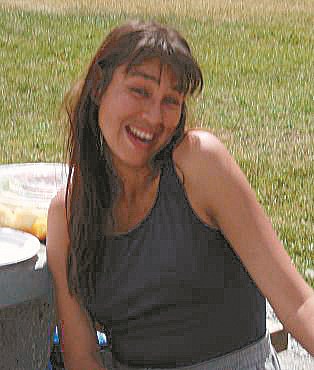
On a bright summer day in British Columbia, Nicole Louise Hoar was looking forward to a week off from her job as a tree planter. The 25-year-old female from Red Deer, Alberta, was an art student and an experienced traveler spending the summer working near Prince George. On June 21, 2002, she planned to surprise her sister in Smithers, a 370-kilometer trip west, to celebrate her birthday and attend a music festival.
Her friends dropped her off at a gas station on Highway 16, a stretch of road that would later become widely known as the Highway of Tears.
Nicole was last seen at the gas station on Gauthier Road on the western outskirts of Prince George. She was prepared for the trip, carrying a large black-and-purple backpack and a distinctive olive-green shoulder bag with an orange dragon appliqued on it. She was wearing greenish-brown capri pants, a red long-sleeved shirt, and wire-rimmed octagonal glasses. A witness reported seeing a woman matching her description walking toward a yellow or orange car around 2:50 p.m., but no one saw her get into a vehicle. She spoke with at least one driver who wasn't going far enough, but after that, Nicole vanished without a trace.
When Nicole didn't return to work after her week off, her employer reported her missing. Her disappearance launched one of the largest search efforts in the history of northern British Columbia. A dozen Royal Canadian Mounted Police (RCMP) officers and 170 volunteers scoured a vast 24,000-square-kilometer area between Prince George and Smithers. They knocked on doors and combed through thousands of kilometers of roadways, logging trails, and campsites, while aircraft searched from above. Despite the massive effort and hundreds of tips from the public, the official search was called off after four days with no sign of Nicole.
Nicole’s case brought national media attention to the alarming number of women who had disappeared or been murdered along the same corridor. As the first non-Aboriginal woman in a string of unsolved cases dating back decades, her disappearance highlighted a pattern of violence that had long plagued the region's Indigenous communities. Her case was included in the RCMP's Project E-PANA, a task force created to investigate the deaths and disappearances of at least 18 women along three major highways in northern B.C. These cases, connected by geography and circumstance, are collectively known as the Highway of Tears murders.
Over the years, the investigation has had few public breaks. In 2009, police conducted an extensive, multi-day search of a rural property in the District of Isle Pierre, west of Prince George. The property had once belonged to Leland Vincent Switzer, a man convicted of killing his brother just two days after Nicole disappeared. Switzer was named a person of interest in Nicole's case, but the search of his former home and a nearby unauthorized dump site yielded no evidence or human remains. Years later, Switzer took a polygraph test regarding the case, which he claimed to have passed, though police have never publicly confirmed the results.
Nicole’s parents, Jack and Barb Hoar, have endured years of uncertainty with grace and strength, never giving up hope for answers. "I will keep searching until we find her," her mother Barb said in the months after the disappearance. "I'm not sure I want details, I just need to know where our daughter is." The family has expressed their support for the police investigation while also acknowledging the pain shared by all families whose loved ones are missing from the area. "Nicole is just one of many missing persons in that area and our thoughts continue to be with their families as well," they said in a statement.
More than two decades later, Nicole Hoar’s disappearance remains an active and unsolved investigation. Her posters can still be found in diners and gas stations along Highway 16, a haunting reminder of the vibrant young woman who set out to visit her sister and never arrived. Her case stands as a painful and prominent chapter in the tragic story of the Highway of Tears, leaving her family and community waiting for the closure they desperately seek. Police continue to ask anyone with information, no matter how small, to come forward.