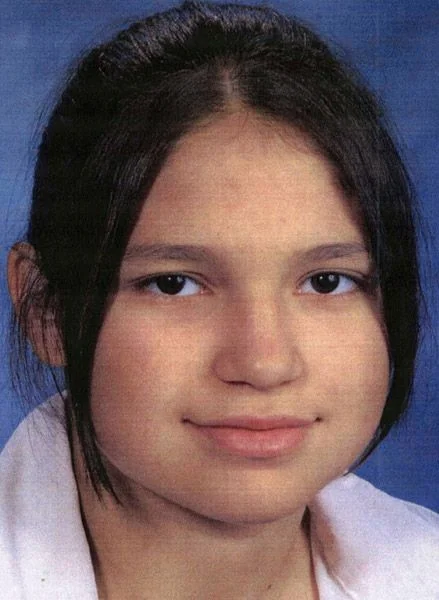
Alishia Augustina Germaine was a sensitive and affectionate girl who loved to sing and act. A member of a First Nations family in Prince George, British Columbia, the 15-year-old female was remembered by her mother as soft deep down, despite the hard exterior she developed over the years. Her life became difficult after her parents separated, and at age twelve, Alishia ran away from home.
A youth worker recalled her as "tough, independent, and someone who didn't fit in well at group homes or with foster families." She eventually ended up living on the streets of Prince George, where she was exposed to sexual exploitation and drug addiction.
Despite these immense challenges, by late 1994, Alishia was determined to change her life. She was a friend of Roxanne Thiara, another 15-year-old who had been killed just months earlier, and like her friend, Alishia had plans for a better future. She was trying to quit drugs and wanted to go back to high school to complete Grade 10. Her mother, Debra Germaine, desperately wanted to help her. "I tried but I didn't know how to help her," she later said. Her aunt, Connie Menton, saw her potential, stating, "We all make mistakes, but it didn't mean that mistake would be carried into her adult years."
On the evening of Friday, December 9, 1994, Alishia attended an annual Christmas party for street youth at the Prince George Native Friendship Centre. It was a festive event with a turkey dinner, dancing, and donated gifts for the roughly 150 kids in attendance. After dinner, Alishia told a youth worker she was leaving for a little while with her cousin but would be back. She asked them to save a present for her, a small sign of her intention to return to the warmth and celebration.
Alishia never made it back to the party. Later that night, at around 11:00 p.m., three teenagers walking behind Haldi Road Elementary School made a devastating discovery. In a forested area on the outskirts of the city, just off Highway 16, they found Alishia’s body. She had been stabbed to death. The last time she had been seen alive was on a downtown sidewalk.
The murder of Alishia Germaine, along with the recent killings of Roxanne Thiara and 16-year-old Ramona Wilson that same year, spurred a larger investigation into the alarming number of women and girls who had disappeared or been found murdered along the region's major highways. In 2005, the Royal Canadian Mounted Police (RCMP) formed Project E-PANA, a task force created to determine if a serial killer, or killers, was responsible for these crimes along what has become known as the Highway of Tears. Alishia’s case was one of the three foundational files that led to the task force's creation.
In the years since Alishia's death, the investigation has faced significant hurdles. Shortly after the murder, police released a sketch of a possible suspect, but it failed to generate any substantial leads. Investigators have stated they believe they have a suspect but have never had enough evidence to lay charges. The case was further complicated by the discovery of an unknown female's DNA at the crime scene, which has not been matched to anyone. To date, Alishia's murder remains unsolved, one of many cold cases that haunt the communities along the Highway of Tears. Her family is still waiting for answers and for justice for the affectionate girl who was just beginning to fight for a new life.