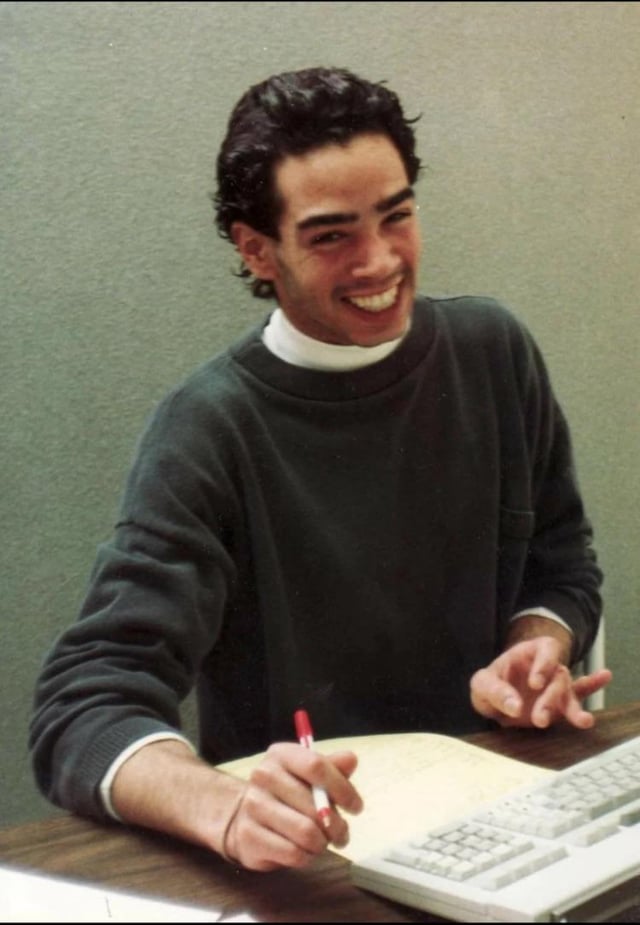
Jeremiah Benjamin Weinberger was a 23-year-old Hispanic/Latino man of Puerto Rican descent who was living in Chicago in the summer of 1991. He worked in customer service for a video business and was remembered by people close to him as organized, attentive to his appearance, interested in art, and close to his family. Although his death occurred in Milwaukee, Wisconsin, his disappearance began in Chicago, where he was last seen during the first weekend of July 1991.
Weinberger encountered Jeffrey Dahmer at Carol's Speakeasy, a gay bar in Chicago's Old Town neighborhood. According to the investigation and Dahmer's later statements, the two men left Chicago together and traveled by Greyhound bus to Milwaukee, where they went to Dahmer's apartment at the Oxford Apartments on North 25th Street. Weinberger remained there through much of the weekend. Accounts of Dahmer's confession indicate that after Weinberger expressed a desire to return to Chicago, Dahmer decided to prevent him from leaving.
Dahmer drugged Weinberger with sedatives and then carried out one of the experiments he had begun performing on victims in an attempt to leave them alive but incapable of resisting him. He drilled an opening through Weinberger's skull and injected boiling water into the cranial cavity. Weinberger survived the initial assault for a period of time but was severely disoriented. Accounts of Dahmer's confession describe him remaining alive into the following day before deteriorating, lapsing into a coma and dying from the injuries. Prosecutors ultimately charged Dahmer with murdering Weinberger on July 7, 1991.
After Weinberger died, Dahmer decapitated and dismembered his remains. Parts of the body were kept inside the apartment, with accounts stating that his head was placed in a freezer and his torso was eventually put into the large 57-gallon drum Dahmer used to store and chemically break down human remains. Weinberger's disappearance remained unresolved while Dahmer continued killing during the following weeks.
The case broke open on July 22, 1991, when Tracy Edwards escaped from Dahmer's apartment while partially handcuffed and encountered Milwaukee police officers. Edwards led them back to the apartment. Inside, officers discovered photographs depicting dismembered victims and then found human remains, including heads and other body parts. Dahmer was arrested that night, and the resulting search and investigation revealed evidence connected to numerous killings. Weinberger was subsequently identified through dental records. FBI records list his Chicago address and confirm that investigators positively identified him as one of Dahmer's victims.
On July 25, 1991, prosecutors initially charged Dahmer with four killings, including Weinberger's, along with the murders of Matt Turner, Oliver Lacy and Joseph Bradehoft. The charges expanded as investigators identified additional victims and assembled evidence from the apartment and from Dahmer's lengthy confession. By August 6, he had been charged with 12 killings, including Weinberger's, and the Wisconsin prosecution eventually encompassed 15 murders.
Dahmer ultimately admitted responsibility for Weinberger's murder and the other killings charged in Wisconsin. On January 13, 1992, he changed his pleas to guilty while maintaining a defense of mental disease or defect, meaning the subsequent trial focused primarily on whether he was legally responsible for his actions rather than whether he had committed the murders. On February 15, a Milwaukee County jury determined that Dahmer was legally sane when he committed each of the 15 killings. Two days later, Judge Laurence Gram Jr. sentenced him to 15 consecutive life terms in prison. Dahmer later received an additional life sentence in Ohio for the 1978 murder of Steven Hicks.
Weinberger's murder was therefore not left as an unidentified or unresolved homicide. Jeffrey Dahmer was arrested, formally charged in connection with his death, admitted responsibility, was convicted, and received a life sentence as part of the series of consecutive sentences imposed for his Wisconsin victims. Weinberger's remains were recovered only after Dahmer's arrest, bringing an end to the period in which his family knew only that he had disappeared after leaving Chicago for Milwaukee.