

True Crime: What It Is, Why We Watch, and How to Engage Responsibly

True crime is nonfiction about real crimes and the real people involved, told through books, documentaries, podcasts, series and online communities. It is also a genre with real victims behind every episode, which is why the best way to enjoy it is to know how to separate verified facts from drama, and how to turn curiosity into something that actually helps a case.
This guide covers what the genre includes, what draws audiences to it, how to check what you are being told, the ethical lines worth respecting, and where interest can become useful: reporting a tip properly, searching public missing-person records, and supporting cold case work.
TL;DR
- True crime is factual storytelling about real crimes, spread across books, TV, podcasts, social media and forums.
- People watch for mystery, a sense of involvement, and the hope of being better prepared for danger.
- Check claims against primary sources such as court records and firsthand reporting, and treat speculation as speculation.
- Never post unsupported theories about a real case. Send tips to the law enforcement agency that handles it.
- If you want to do more than watch, learn the public databases and join a community built around cold cases.
Table of Contents
- What true crime actually means
- Why so many people are drawn to it
- How to tell fact from rumor and dramatization
- The ethics: real victims are behind the content
- From watching to helping: what to do with real information
- Perspective: why cold cases deserve the audience’s attention
- Where Crime Solvers Central fits
- Who gets what from true crime
- How to build a healthier true crime habit
- FAQ
- Sources
What true crime actually means
The Library of Congress defines true crime stories as nonfiction crime narratives written in a novelistic style for popular audiences. That one line captures the tension in the genre: the events are real, but the telling borrows from fiction.
A broader description comes from academic work. A Bridgewater State University thesis describes true crime as a multiplatform genre involving real crimes and real people, appearing in books, television, films, documentaries, podcasts, social media, streaming video and internet forums.
What separates it from detective fiction
EBSCO’s research overview notes that true crime is factual and typically explores the criminals and the causes of their acts, while a fictional mystery follows a protagonist investigating a crime and reveals events through that investigation. In a novel, the author controls the ending. In true crime, the ending is whatever happened, and sometimes nothing has been resolved at all.
The subjects the genre keeps returning to
Training materials from EBSCO’s NoveList say true crime can center on one crime, several crimes, or a themed anthology, as long as the work is nonfiction and based on real events. The same materials list recurring subjects: serial killers, medical murder, white-collar crime and fraud, organized crime, cults, wrongful convictions and cold cases.
Cold cases matter most for this article. Unlike a finished trial story, an unsolved disappearance or homicide is still open, and the audience can sometimes be part of what happens next.
A wide range of quality
The genre runs from rigorous journalistic documentation to speculative storytelling that reflects an author’s personal reading of events, a spread Wikipedia’s overview points out. A well-sourced investigative book and a late-night theory video can both carry the label “true crime.” The rest of this guide helps you tell them apart.
Why so many people are drawn to it
The search volume for this topic is enormous, and researchers have offered several explanations that overlap more than they compete.
- Mystery and involvement. The University of Oregon’s media studies program says audiences are drawn by the mystery, the chance to feel involved in solving a case, and the hope of feeling better prepared for potential violence.
- Defensive vigilance. A 2025 study in the British Journal of Psychology found morbid curiosity and defensive vigilance among the motives for consuming true crime, with defensive vigilance linked to more adaptive self-regulation.
- Safe fear. Criminologist Michael Arntfield, writing in The Conversation, suggests audiences experience a kind of benign hedonic masochism: a paradoxical pleasure in controlled encounters with fear and uncertainty.
- Social glue. Researchers quoted by the BBC say true crime gives groups a subject for gossip, speculation and shared emotion. Criminologist Oriana Binik describes it as a way to process strong emotions and talk collectively about real danger.
Notice what these motives have in common. Most are about the viewer: feeling safer, feeling connected, feeling clever. That is not a flaw, but it is worth knowing, because the same motives that make a story compelling can pull us toward the most dramatic version of it rather than the most accurate one.
How to tell fact from rumor and dramatization
A true-crime account can be accurate, partly accurate, dramatized or flatly wrong, and the polish of the production tells you almost nothing. A few habits help.
Ask what the storyteller is standing on
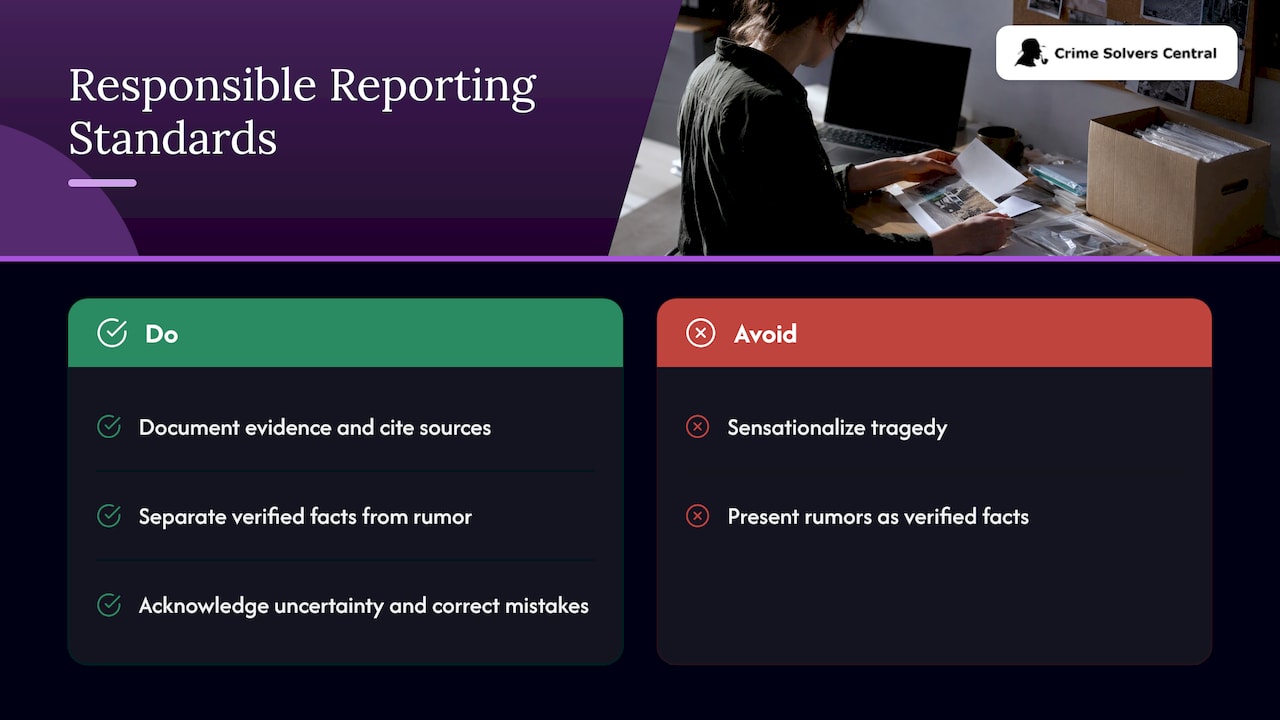
Washington State University’s Murrow College describes the standard for responsible work: documentary evidence and transparent sourcing, a clear line between verified facts and rumor, acknowledged uncertainty, corrected mistakes, and no sensationalizing of tragedy. Use that as a checklist. Does the creator tell you what is confirmed and what is not? Do they say when they were wrong?
Go back to primary sources
The University of Phoenix library advises checking original sources such as letters, firsthand newspaper accounts, court records and interviews, and notes that podcasts and social media may reflect a storyteller’s perspective and include speculation. Its research view is that primary sources anchor an account while secondary works can frame the same event differently and should be weighed for bias.
A quick credibility test
| Question | A good sign | A warning sign |
|---|---|---|
| Where do the facts come from? | Named records, court filings, firsthand reporting | “Sources say,” unnamed forums, screenshots |
| How is uncertainty handled? | Stated plainly | Gaps filled with confident guesses |
| Who is named as a suspect? | Only people charged or formally identified | Private individuals pointed at by the host |
| What happens to errors? | Corrections are posted | Old claims quietly deleted |
| How are victims portrayed? | As people with lives | As props for a twist |
For a deeper look at sourcing standards for case information, our guide to vetting cold case sources, including NamUs, ViCAP and FOIA limits walks through what each kind of record can and cannot tell you.
The ethics: real victims are behind the content
The University of Oregon’s analysis says creators and audiences should reflect on the stories they consume and remember that real victims and grieving families are behind the content. It also warns that branding real violence can reduce victims’ lives to marketable content, which dehumanizes them.
Practical ways to act on that:
- Learn the victim’s name and life, not only the offender’s.
- Notice whose stories get told. Students in particular should consider, as the Oregon analysis suggests, disparities in whose cases get attention and how race, gender and audience shape the telling.
- Be wary of content that treats a family’s worst day as entertainment, especially when the family has not been consulted.
- Keep your own commentary factual. If you do not know something, say so.
For more on famous cases and how to tell them responsibly, see our piece on true crime stories and ethical storytelling.
Why amateur theories can do harm
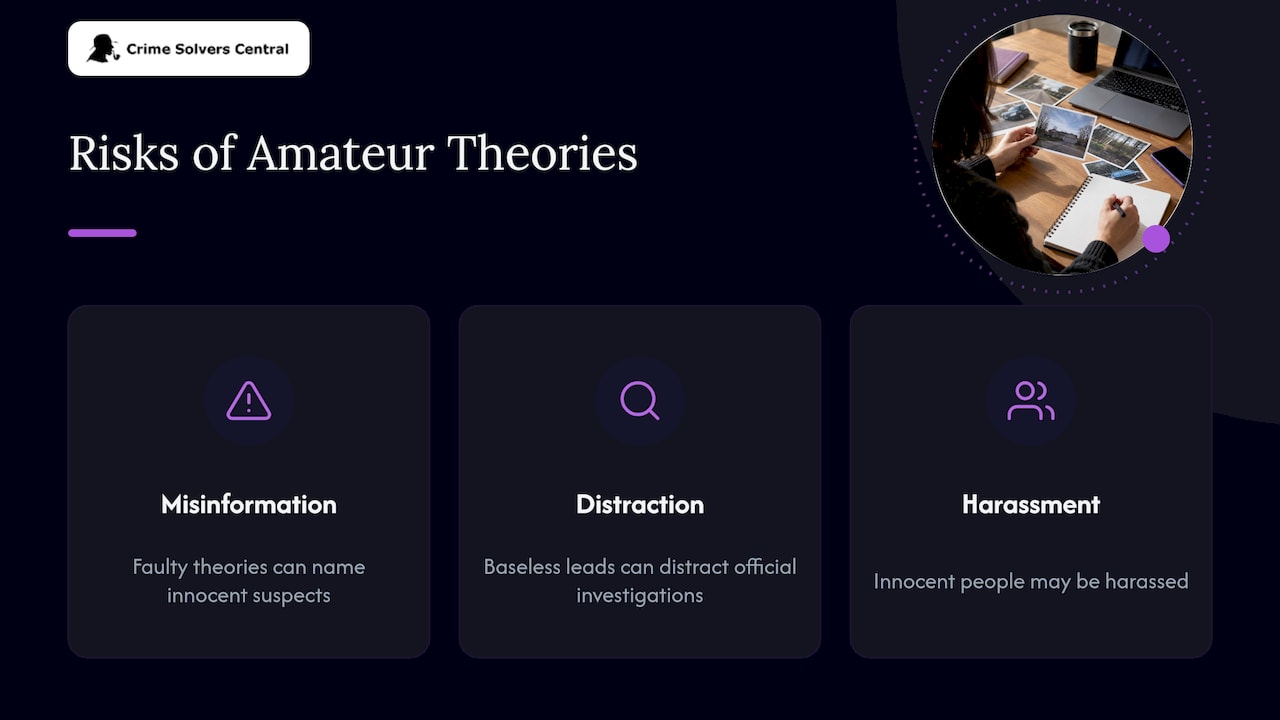
An Associated Press report on the genre’s influence points out that many content creators lack formal training, which can spread misinformation, including the public naming of innocent people as suspects based on faulty amateur theories. Legal and forensic experts quoted there say amateur sleuthing often lacks forensic or legal expertise and can distract official investigations with baseless leads.
The University of Oregon analysis gives the same guidance to community members: avoid posting unsupported theories about ongoing cases, since poor leads can distract investigators and innocent people may be harassed. Being wrongly accused of a violent crime carries serious legal consequences of its own, a reality explained in this overview of false accusations of violent crimes. That is the strongest reason to keep guesses about named people out of comment sections.
From watching to helping: what to do with real information
If an episode, post or case file makes you think you know something, the path matters more than the speed.
Sending a tip
USAGov explains that to report a crime or share a tip in the U.S., you contact the local law enforcement agency where the incident occurred, often through a non-emergency tip line or an online reporting system. For kidnapping inside the U.S., child exploitation or human trafficking, the same page directs you to the National Center for Missing & Exploited Children at 1-800-THE-LOST (1-800-843-5678). Our own walkthrough, how to report information about a cold case, covers what to gather before you call.
Using public missing-person records
NamUs, the national repository for missing and unidentified persons cases, is a good place to confirm what is officially known. Public users can enter missing-person cases, but each one goes through a Regional System Administrator who coordinates with the investigating law enforcement agency to verify accuracy before information is published. That verification step is why NamUs records are a more dependable starting point than a social media thread.
The scale is large. As of June 2024, NamUs held 25,149 missing person cases from 55 U.S. states and territories. Those are the figures for that report period, so check NamUs for current totals.
If you are searching for someone, these guides take you through it step by step:
- NamUs database search: a step-by-step family guide
- The official missing persons database guide for families
- Unidentified persons database: why U.S. families must search beyond NamUs
- Search cold cases by name: six steps from NamUs to a national index
- Search cold cases faster with NamUs advanced searches and FOIA triage
A short checklist before you share anything
- Is the information confirmed by a record or an agency, or is it a theory?
- Does posting it name or identify a private person?
- Would it be better delivered directly to the investigating agency?
- Would the victim’s family be comfortable seeing it?
If any answer worries you, send it to law enforcement instead of posting it.
Perspective: why cold cases deserve the audience’s attention
We built Crime Solvers Central because the genre’s attention is lopsided. A few cases get years of coverage, while hundreds of thousands of others sit in state files with a name, a date and little else. Our national database holds more than 264,000 cases, sorted by state and situation, so a family member, volunteer or student can find a case without already knowing where to look.
We think curiosity is an asset when it is pointed at the right place. That means starting from verified case records, organizing what is known on a digital evidence board instead of in a comment thread, and sending anything new to the agency that owns the case. Our tools, from the flyer builder to AI image progression, exist to help people keep a case visible without making up facts about it.
The people who write to us are rarely looking for entertainment. They are looking for a sister, a father, a name for remains, or a way to help. We would rather the genre’s energy go there, and we are proud of the testimonials from members whose use of these resources has helped reconnect families and move law enforcement investigations forward.
Crime
Where Crime Solvers Central fits
If you want something more active than a podcast queue, Crime Solvers Central is a searchable national database of cold cases: missing persons, unsolved homicides and unidentified or unclaimed remains, organized by state and type. Free case summaries give you the outline. Membership unlocks full case details, sources, videos, forums, digital evidence boards, the flyer builder, AI image tools and volunteer coordination.
Plans as published on our pricing page:
| Plan | Monthly | Yearly |
|---|---|---|
| Jr. Detective | $3.97 per month | $39 per year |
| Sr. Detective | $9.97 per month | $99 per year |
| True Crime Influencer | $39.97 per month | $399 per year |
You can also browse the cold case database by state first, and learn more about who we are on the About Us page. For a look at how families use NamUs alongside our index, read 264,913 cold cases: how families use NamUs and Crime Solvers Central.
Who gets what from true crime
The same interest looks different depending on who you are.
- Families of missing persons need accurate records, search strategies and a way to keep a case visible. Verified databases and flyers matter more than theories.
- Volunteers are most useful when they organize public information and support the agency’s work rather than running a parallel investigation.
- Students can use the genre as a source for questions about media, justice and representation, as long as they compare popular accounts with primary documents.
- Advocates can use case data to show which communities and regions get less attention.
- Law enforcement benefits from tips that arrive complete, specific and through the right channel.
How to build a healthier true crime habit
You do not have to give the genre up. A few small choices change what it does to you and to the cases it covers.
- Pick creators who show their sources. If a show never says where its facts come from, treat it as storytelling.
- Cross-check one claim per episode. Look up a court record, a news report from the time, or an official database entry.
- Rotate in cold cases. Give a lesser-known case the attention you would give a famous one.
- Take breaks. The BJP study’s finding that defensive vigilance is linked to better self-regulation suggests the aim is to feel prepared, not anxious. If content leaves you on edge, step away.
- Turn one story a month into an action. Read a case file, share an official flyer, or send a verified tip to the right agency.
FAQ
What is the difference between true crime and a crime documentary?
True crime is the broader genre, covering books, podcasts, series and online communities. A documentary is one format within it. Both are meant to be factual, but quality depends on how openly the makers show their sources and handle uncertainty.
Is everything in true crime shows actually true?
Not necessarily. The genre ranges from rigorous journalism to speculation shaped by the author’s interpretation. Look for documentary evidence, a clear line between confirmed facts and rumor, and acknowledged uncertainty, and check court records or firsthand reports when something matters.
Is it okay to investigate a cold case myself?
You can read public records and organize what is already known, but do not publicly accuse anyone or post unsupported theories. Poor leads can distract investigators and innocent people can be harassed. Share anything new with the local law enforcement agency that handles the case.
Where can I look up a missing person in the U.S.?
NamUs is the national repository for missing and unidentified persons cases, and its public entries are verified with the investigating agency before publication. Our database guides explain how to search NamUs and what to check beyond it, including unidentified persons records.
Why do people find true crime so appealing?
Researchers point to the mystery, a feeling of involvement in solving a case, the hope of being better prepared for violence, and the social bonding that comes from discussing shared fears. Studies also identify morbid curiosity and defensive vigilance as common motives.
Sources
- Library of Congress: True crime stories
- Bridgewater State University: Navigating True Crime in Viral Media Culture
- EBSCO: True-Crime Stories
- EBSCO NoveList: True crime crash course
- Wikipedia: True crime
- University of Oregon: True Crime Popularity and Ethics
- British Journal of Psychology: Out of the dark
- The Conversation: Why are we so obsessed with true crime?
- BBC Radio 5 Live: Why are we so fascinated by true crime?
- WSU Murrow College: The Murrow Standard
- University of Phoenix Library: From campfires to crime feeds
- Associated Press: The true crime genre’s popularity and real criminal cases
- USAGov: Report a crime
- NamUs User Guide: Entering missing persons cases
- NamUs Bi-Annual Report, June 2024
- How to defend against false accusations of violent crimes