

Search Cold Cases by Name: 6 Steps From NamUs to a National Index

The fastest way to look up a named cold case is to check NamUs first, then cross-reference FBI ViCAP and the relevant state cold-case page. If you have information, the right next step is submitting it through an official tip portal or your local police department, not contacting family directly. We maintain a searchable national index that can help you dig deeper once you’ve checked the official sources.
TL;DR:
- NamUs is most useful for cases open longer than 180 days, while FBI ViCAP focuses on violent crimes and helps connect cases across jurisdictions.
- Search exact names, surnames, aliases, and spelling variants, then narrow by location, dates, age, or physical details and record each case number.
- Before submitting a tip, preserve dated photos, messages, and witness details with notes on where and when each item came from.
- Check update dates and compare official records; when details conflict, confirm the agency of record and treat unverified claims as uncertain.
- Wait several weeks before following up, use your ticket number, and avoid duplicate submissions unless you have new information; silence does not mean rejection.
Table of Contents
- Primary databases and official case lists to search by name
- How to search cold cases by name effectively
- What to gather before you contact investigators or submit a tip
- How to submit information or tips safely and usefully
- How Crime Solvers Central helps you dig deeper
- Tips for verifying the accuracy and currency of cold case information
- Privacy and legal considerations when searching sensitive case data
- How to interpret case status updates and terminology in databases
- Best practices for following up on submitted tips
- Getting involved beyond searching
- Resources for families and support services linked to cold cases
- Why careful searching and official reporting matter most
- Try the search, then see what membership unlocks
- FAQ
- Sources
Primary databases and official case lists to search by name
Three types of public resources cover almost every named cold case in the country, and each one serves a different purpose.
NamUs is the primary federal clearinghouse for missing, unidentified, and unclaimed persons. It works best for cases that have been open longer than 180 days, and every published case must meet a set of required fields before it goes live, verified by a Regional System Administrator. The NamUs user guide lays out those 18 required fields and explains how RSAs confirm details with the investigating agency before publication.
FBI ViCAP focuses on violent crime: homicides, missing persons tied to foul play, and unidentified remains. It is built to help investigators link cases across jurisdictions, and its public listings let researchers search for potential matches without needing law enforcement credentials.
State and local cold-case pages fill in the gaps that national databases miss, especially older cases or ones still working through local agency review. Most allow you to search by:
- Name, including partial or alias spellings
- County or city of the incident
- Approximate date range of disappearance or death
Start broad with a name search across all three layers, then confirm any match using the agency’s own case number before treating it as current.
How to search cold cases by name effectively
A name search works best as a sequence, not a single query. Each step narrows the field until you’re looking at a short list of plausible matches instead of hundreds of loosely related records.
- Start with the exact full name, spelled the way you expect it in official records.
- Run the search again using only the last name, since first names and nicknames are often recorded inconsistently.
- Add known aliases, maiden names, or spelling variants if the person went by more than one name.
- Narrow by date range, city or county, state, approximate age at the time of the incident, and physical descriptors like height or distinguishing marks.
- Use quotation marks around exact phrases and any advanced filters the database supports to cut down false matches, a tactic that archival search guidance confirms narrows results more effectively than a name search alone.
- Save every case number, agency name, and page URL you find, even for near-matches you plan to rule out later.
When two or more records look similar, compare photos, incident details, and the official case number rather than relying on name alone. Databases sometimes list the same person under slightly different spellings across state and federal systems, so a photo or case number is often the only way to confirm you’ve found the right file. Our step-by-step NamUs search guide walks through this process with screenshots for readers who want a slower, more guided version.
Pro Tip: Keep a simple spreadsheet of every case number, URL, and date you check. It saves hours if you need to revisit a search weeks later.
What to gather before you contact investigators or submit a tip
A tip is only as useful as the details behind it. Before reaching out to any agency, collect the basics: full names involved, approximate dates, the last known location, and the agency or case number if you already found one in NamUs or a state database.
Beyond the basics, gather anything that shows provenance: dated photos, saved messages, license plate numbers, or witness names, along with notes on where and when you found each piece. Guidance on chain of custody explains that documenting the source and timestamp of any evidence helps investigators judge its credibility and keeps your tip from being dismissed as unverifiable.
A short checklist before you submit:
- Full names, nicknames, and any aliases involved
- Dates and locations tied to the information
- Case or agency reference number, if known
- Source and date of any photo, message, or document you’re including
Documented provenance matters: recording when and how you obtained information gives investigators a usable starting point instead of a vague lead, according to guidance on evidence handling.
How to submit information or tips safely and usefully
Once your information is organized, submit it through an official channel rather than trying to verify it yourself.
- For missing or unidentified persons, use the NamUs contact process, which routes your tip to the Regional System Administrator overseeing that case.
- For violent crime or unidentified remains tied to a possible homicide, submit through the FBI tips portal, which accepts file attachments and structured details.
- For a case listed only on a state or local page, use that agency’s tip line or online form directly.
- Attach your checklist items: who, what, when, where, and how you know it, along with any dated photos or documents and your own contact information in case investigators need follow-up.
Avoid contacting the victim’s family directly. Professional guidance consistently points toward routing information through law enforcement so the investigation isn’t compromised and families aren’t re-traumatized by unverified leads. After submission, most portals issue a reference or ticket number. An investigator may follow up directly, but many tips are logged and reviewed without immediate contact, so don’t read silence as a sign your information was ignored.
How Crime Solvers Central helps you dig deeper
Once you’ve checked the official databases, our tools are built to carry the search further. We maintain a large national indexed database categorized by state and case type, so you can move from a name search straight into related records without starting over on a new site.
Our resources for serious researchers include:
- A Cold Case Search Engine Playbook covering advanced NamUs searches and FOIA triage tactics
- Step-by-step guides for searching the NamUs database field by field
- A first-steps guide for families starting a search for the first time
- Membership access that unlocks full case files, digital evidence tools, and community coordination resources for members working a case long-term.
For readers who want a guided walkthrough of the broader database landscape, our missing persons database guide covers the family-facing side of this same search process.
Tips for verifying the accuracy and currency of cold case information
A name search can turn up outdated or conflicting details, so verification matters as much as finding the record in the first place.
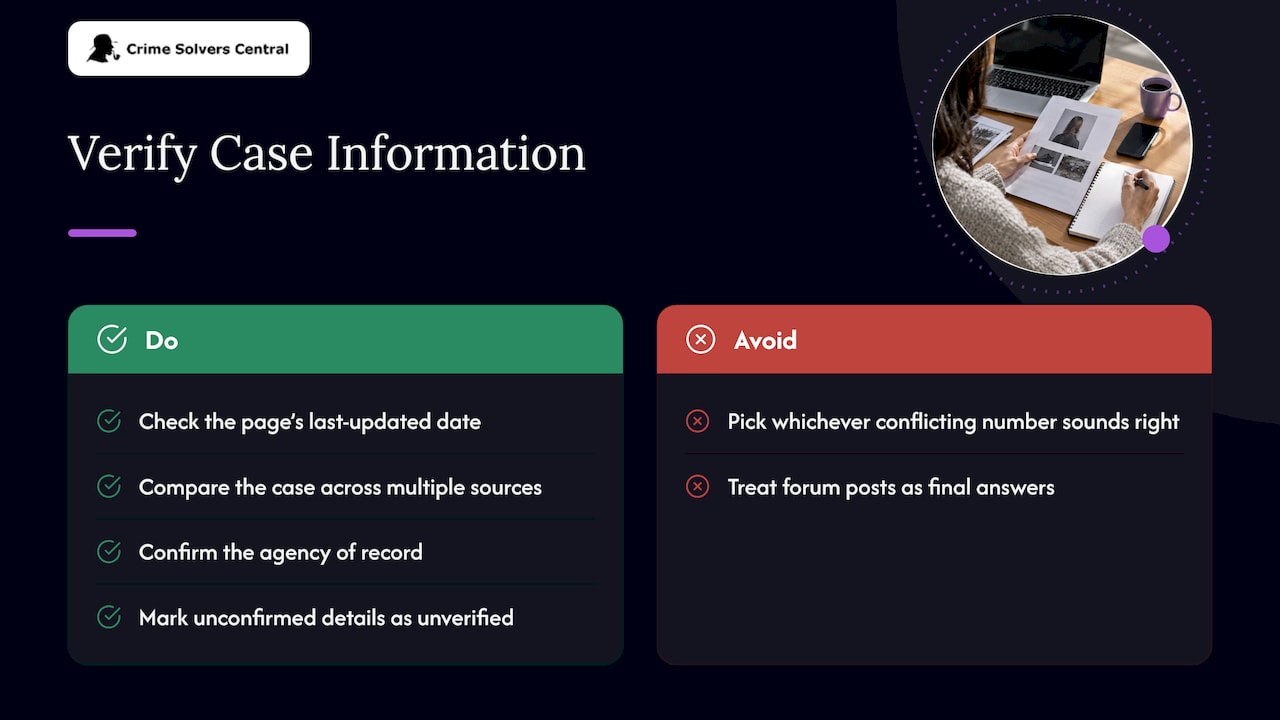
Check the date a case page was last updated. NamUs and ViCAP both display a last-modified or entry date, and a case that hasn’t been touched in years may still be accurate but could also be missing recent developments. Compare the same case across multiple sources: if NamUs, a state page, and a news report list different ages, dates, or locations, treat the discrepancy as a flag rather than picking whichever number sounds right.
Confirm the agency of record before relying on any detail. Case files sometimes transfer between jurisdictions, and an old local news story may name an agency that no longer holds the file. When in doubt, the case number listed on the official database page is more reliable than a secondhand summary, blog post, or forum thread repeating the details.
Treat crowd-sourced write-ups, including ones on social media or amateur forums, as a starting point for your own verification, never as a final answer. If a detail can’t be confirmed on an official page or through a direct agency contact, note it as unverified in your own records rather than repeating it as fact.
Privacy and legal considerations when searching sensitive case data
Searching a cold case by name means handling sensitive information about real people, often including living family members, so a few boundaries matter.
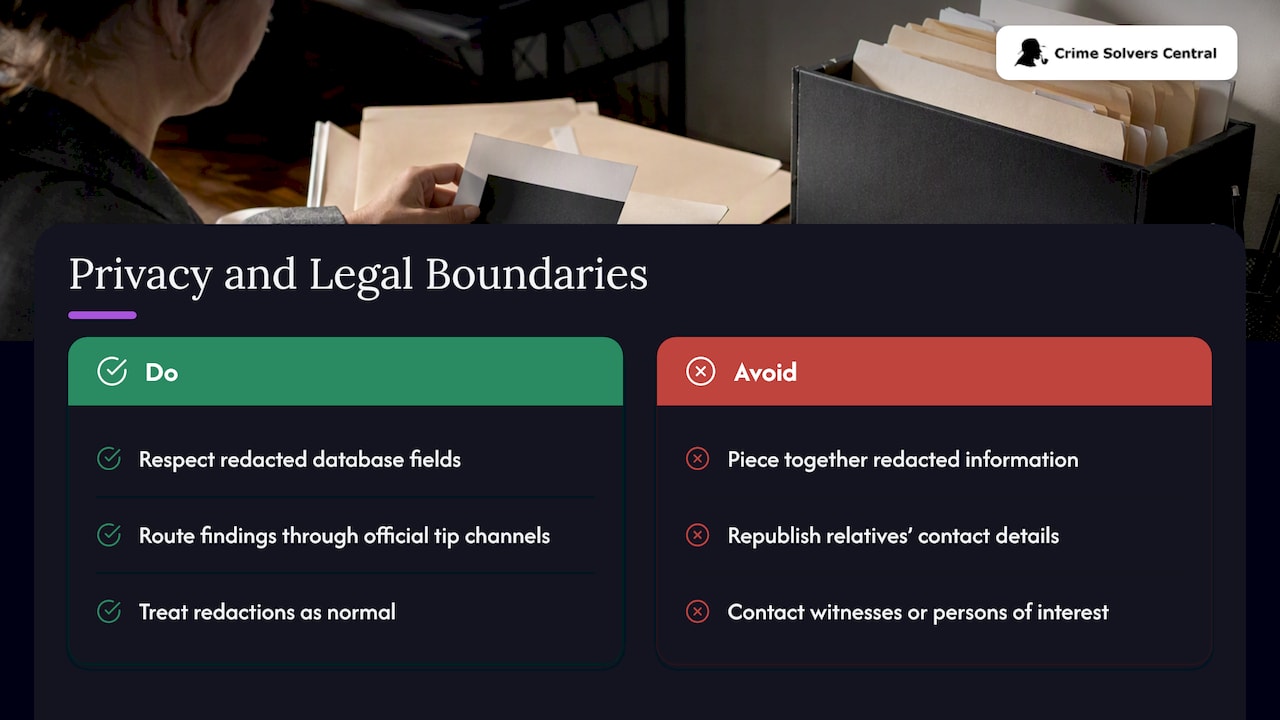
Public databases like NamUs and ViCAP intentionally limit certain fields, such as full addresses or some medical details, to protect families and preserve investigative integrity. Respect those limits rather than trying to piece together redacted information from other sources. Avoid republishing personal details you find, especially contact information for relatives, on social media or forums, since this can interfere with active investigations and cause real harm to grieving families.
If you plan to request historical records through a Freedom of Information Act request, expect that some material will be withheld or redacted where it could compromise an ongoing investigation or violate privacy protections. That’s a normal part of the process, not a sign the agency is hiding wrongdoing.
Finally, remember that “public” does not mean “unrestricted.” A case being searchable on an official database doesn’t grant permission to contact witnesses, confront persons of interest, or conduct independent investigative outreach. Channel anything you find back through the official tip process described earlier rather than acting on it yourself.
How to interpret case status updates and terminology in databases
Cold case databases use specific terminology that can be confusing without context. A case marked “active” or “open” simply means it remains under investigation, not that there’s new movement. “Cold” typically indicates no new leads have emerged in a significant stretch of time, though the case is technically still open.
“Unidentified person” refers to remains that have not been matched to a name, while “unclaimed person” means the identity is known but no family member has claimed the remains, a distinction that matters if you’re trying to figure out which search category applies to the person you’re looking for.
When a case shows a “resolved” or “closed” status, check whether that means identification, an arrest, or simply that the file was administratively closed without a resolution; databases don’t always use these terms the same way across agencies. If a status update is unclear, the agency case number is your best tool for getting a direct answer, since you can reference it when contacting the listed agency instead of trying to interpret the page language on your own.
Best practices for following up on submitted tips
After you submit a tip, patience matters more than persistence. Investigators often can’t share updates publicly while a case is active, so a lack of response doesn’t mean your information was dismissed.
If your submission included contact information, give the agency reasonable time (often several weeks) before following up, and when you do, reference your ticket or confirmation number rather than resubmitting the same information from scratch. A second submission with new information is useful; a duplicate of the same tip without anything added typically just creates extra work for investigators sorting through leads.
If you don’t hear back at all, check the case page periodically for status changes rather than repeatedly contacting the agency. A status update, even a small one, can tell you whether your tip led anywhere without requiring a direct response. For cases handled through NamUs, the Regional System Administrator is your point of contact if you have a specific, documented reason to check on a tip’s status.
Getting involved beyond searching
Searching by name is often the first step, not the only one. Community involvement can extend further for readers who want to stay engaged with a case or with cold case work generally.
Local victim advocacy groups and cold case working groups often welcome volunteers to help organize information, raise awareness, or support families through long investigations. Digital evidence boards and organized research groups, the kind many true crime communities build around a specific case, can help keep information organized and consistent instead of scattered across social media threads. Our guide on collaborating with communities on unsolved crimes covers how to do this without stepping on an active investigation.
Following reputable true crime coverage can also help you stay current on cases you’re tracking; shows like the Fox True Crime Podcast cover ongoing investigations and can surface updates that haven’t reached official pages yet. Treat any coverage as a lead to verify against the official databases, not as a substitute for them.
Resources for families and support services linked to cold cases
Families of missing persons and homicide victims often need more than a database search, and several resources exist specifically for that support. NamUs offers no-cost forensic and analytical services to families working with investigators on an open case, including DNA comparison support coordinated through the investigating agency.
Victim advocacy organizations connected to state attorney general offices frequently offer case navigation support, helping families understand where a case stands and what steps come next. Grief and trauma support services, often available through local victim services offices, exist specifically for families carrying the weight of an unresolved case, and many cold case units can connect families to these services directly.
If you’re a family member starting this process for the first time, our guide for families using missing persons databases walks through the search and support landscape together, rather than treating them as separate tasks.
Why careful searching and official reporting matter most
The gap between a hopeful lead and a resolved case usually comes down to documentation, not luck. A name search that ends with a verified case number and a properly submitted tip does more for an investigation than a dozen shared social media posts ever will.
Focus on what you can verify, and route it through channels built to act on it. If you want to build these skills further, our how-to guides go deeper into each tactic covered here.
— Crime
Try the search, then see what membership unlocks
Running a free search across our national cold case database is the fastest way to see if a name you’re researching already has a case file, photos, or agency details attached. Full case files, digital evidence boards, and community research tools are available through our membership plans, listed on our pricing page, starting at an affordable monthly rate for Jr. Detective access.
FAQ
Are cold cases open to the public?
Many cold case files are open to the public through databases like NamUs and FBI ViCAP, which publish case summaries for missing, unidentified, and unclaimed persons. Some details are withheld to protect the investigation or the family, so a public listing rarely includes every fact investigators hold.
Can you give me a list of unsolved cases?
Unsolved cases are searchable by state, case type, and name through NamUs, FBI ViCAP, and individual state cold-case pages rather than a single master list. Our database by state organizes cases the same way, letting you browse by location or case type.
Can civilians look at cold case files?
Civilians can view public case summaries on NamUs, ViCAP, and most state cold-case portals without needing law enforcement credentials. Full investigative files, including sensitive evidence, typically remain restricted to the agency of record.
Is there a free way to solve cold cases online?
Free public searches through NamUs, ViCAP, and state cold-case pages let anyone look up a name, submit a tip, or compare case details at no cost. Solving a case usually depends on investigators acting on verified leads, so the most useful free step is submitting accurate, well-documented information through official channels.
Sources
- National Missing and Unidentified Persons System | National Institute of Justice
- NamUs user guide — entering missing person cases (PDF)
- ViCAP unidentified persons — FBI
- What is chain of custody? — Grand Canyon University (criminal justice blog)