

Search 264,913 Cold Case Files: Database First Steps for Families

Cold case files are searchable, investigatory databases covering missing persons, unidentified remains, and unsolved homicides. If you’re looking for a loved one or researching an unsolved crime, start now: search NamUs and your state’s cold-case database, then confirm the case is officially entered with law enforcement. A national searchable database with a large number of cases is also available for deeper access once you’ve made those first checks.
TL;DR:
- Most public cold case files include limited identifiers like photos, basic demographics, and case summaries, but sensitive data such as dental records remain restricted to law enforcement.
- Searching effectively requires creating accounts, using Boolean filters, exporting results to compare updates, and verifying potential matches with multiple identifiers.
- Prompt reporting and documentation within the first 48 hours are crucial, including confirming case entry into NCIC and preserving physical evidence without disturbance.
- Regional and national databases increase chances of linking cases across jurisdictions, emphasizing the value of centralized, searchable case catalogs for visibility and cross-referencing.
- Membership with Crime Solvers Central unlocks full case files, export tools, discussion forums, and volunteer coordination, offering enhanced resources for ongoing investigations and public support.
Table of Contents
- What Cold Case Files Actually Contain
- Where to Search: NamUs, State Databases, and Export Tools
- Working With Law Enforcement and National Programs
- How to Search Smart and Avoid False Leads
- Your First 48 Hours and Beyond
- Why Centralized Case Catalogs Change the Odds
- What Membership With Crime Solvers Central Unlocks
- Sources
- FAQ
What Cold Case Files Actually Contain
A typical case file mixes identifying details with investigative narrative. Most public-facing entries include the person’s name and known aliases, case type (missing, unidentified, or homicide), the year the case opened, basic demographics, photographs, and a written summary of known circumstances. Many also list unique physical identifiers like scars, tattoos, or old fractures, which often matter more than a photo when a body has been recovered years later.
Some information never reaches the public version of a file. Dental records, fingerprint cards, and certain medical histories usually stay restricted to law enforcement and vetted forensic professionals, largely because that data is used to confirm identity, not to generate public tips.
That split exists for good reason:
- Public fields help families and researchers recognize a possible match and flag it to investigators.
- Restricted fields protect sensitive medical data and preserve the integrity of forensic comparisons.
- Cross-jurisdictional visibility means a case opened in one county can be compared against unidentified remains found in another state entirely, which is exactly how many identifications happen years after the fact.
Where to Search: NamUs, State Databases, and Export Tools
NamUs is the starting point for almost every serious search. It’s a national database and support program that lets the public enter and search missing, unidentified, and unclaimed person cases, and it backs that access with free forensic services, including cold case advisors, DNA analysis, forensic anthropology, and fingerprint assistance.
State-level databases fill in the gaps NamUs doesn’t always catch. Colorado’s cold case database, for instance, lets users download every active record or export a specific search as a CSV file for offline review. Virginia’s system works differently: it displays unsolved cases somewhat randomly to give every submitted case equal visibility, and agencies submit voluntarily, so refreshing the page can surface cases you hadn’t seen before.
To search effectively:
- Register for an account where the system allows it. Registered NamUs users can run advanced searches using Boolean operators and export full results to CSV through the “Export All” function.
- Filter by incident year, case type, and demographics before scanning individual entries one by one.
- Save your search parameters so you can rerun them periodically. New matches sometimes surface months after the original entry.
Pro Tip: Export your search results to CSV even if you only plan to review them once. Comparing exports from different months later can reveal a new entry, an updated photo, or a status change you’d otherwise miss.
Working With Law Enforcement and National Programs
There’s no waiting period to report someone missing, and no investigator should tell you otherwise. Families have the right to file a report immediately, and for missing children, entry into NCIC is mandated once a report is filed.
Once a report exists, take these steps:
- Confirm with the investigating agency that the case has been entered into NCIC and ask specifically whether it’s also in NamUs. Not every local agency automatically enters cases into NamUs, even though it’s free.
- Request NamUs’s free family services directly, including DNA collection kits, forensic anthropology consultation, and individualized help learning the database.
- Ask about rapid-response resources when appropriate. Child Abduction Response Teams, FBI Child Abduction Rapid Deployment (Team Adam), and local search-and-rescue units can mobilize faster than a standard investigation timeline, but they need to be requested through your local agency.
- Coordinate any volunteer search effort through the investigating agency, not independently. Uncoordinated searches can contaminate evidence or duplicate work already done.
How to Search Smart and Avoid False Leads
Reproducible search habits separate useful research from noise. Save every query you run, use Boolean logic to narrow results instead of scrolling endlessly, and export what you find so you can compare it against later searches without starting over.
Verification matters more than speed. Before treating any online “match” as real, run through this checklist:
- Confirm at least two independent identifiers (not just a facial resemblance) across separate sources.
- Treat official database records as more reliable than a social media post claiming a match.
- Document where each piece of information came from, including the date and source URL, so an investigator can trace it back.
Photos and people-search results are leads, not proof, and confirmation bias is the biggest risk in amateur cold case research. A resemblance in one photo can feel conclusive when it’s actually coincidence. Durable identifiers like dental work, old fractures, or distinctive tattoos hold up far better than facial comparison alone, and they’re what forensic examiners actually rely on. Avoid publishing unverified personal information about people who might be uninvolved, and never meet a “tip” source in person without looping in law enforcement first.
Your First 48 Hours and Beyond
The first two days after someone goes missing set the tone for the entire investigation. Speed and documentation both matter.
- File the missing-persons report immediately. There’s no benefit to waiting, and every hour without an official report is an hour without NCIC coverage.
- Gather documents fast: recent photos, dental and medical records, physical description details, and anything with the person’s fingerprints or DNA reference potential (a toothbrush, a hairbrush).
- Confirm the case has been entered into NCIC and ask directly whether it’s in NamUs yet. If not, ask what’s holding that up.
- Preserve any physical evidence exactly as found, and don’t clean or move items in the person’s space before investigators have documented them.
Once the immediate crisis window passes, shift into a sustained research rhythm. Rerun your NamUs and state database searches on a schedule, keep a dated log of every contact with investigators, and coordinate volunteer efforts through vetted channels rather than open social media groups. A subscription-based case database can extend that work by giving you organized access to fuller records, digital evidence boards, and forum discussion with other researchers, all while you continue cooperating directly with law enforcement rather than working around them.
Why Centralized Case Catalogs Change the Odds
Scattered records are the enemy of cold case resolution. A case sitting only in a county file cabinet has almost no chance of being cross-referenced against unidentified remains found three states away. That’s the entire argument for centralized, searchable catalogs, and it’s why some services build one with cases organized by state and situation.

Visibility drives matches. A case that sits quietly in a single jurisdiction’s files gets far less exposure than one that’s searchable nationally and discussed across an active community of researchers and advocates. We’ve built our platform around that principle, pairing the catalog with vetted volunteer coordination so that public participation strengthens investigations instead of complicating them.
None of that replaces law enforcement. It supports it. Every tip, every piece of information a family or researcher submits through our platform gets treated as a lead for investigators to vet, not a verdict for the public to hand down.
— Crime
What Membership With Crime Solvers Central Unlocks
Free public summaries get you the basics. What you can’t do without a membership is dig into full case files, cross-reference records by state, export data for your own analysis, or connect with other researchers actively working the same cases.
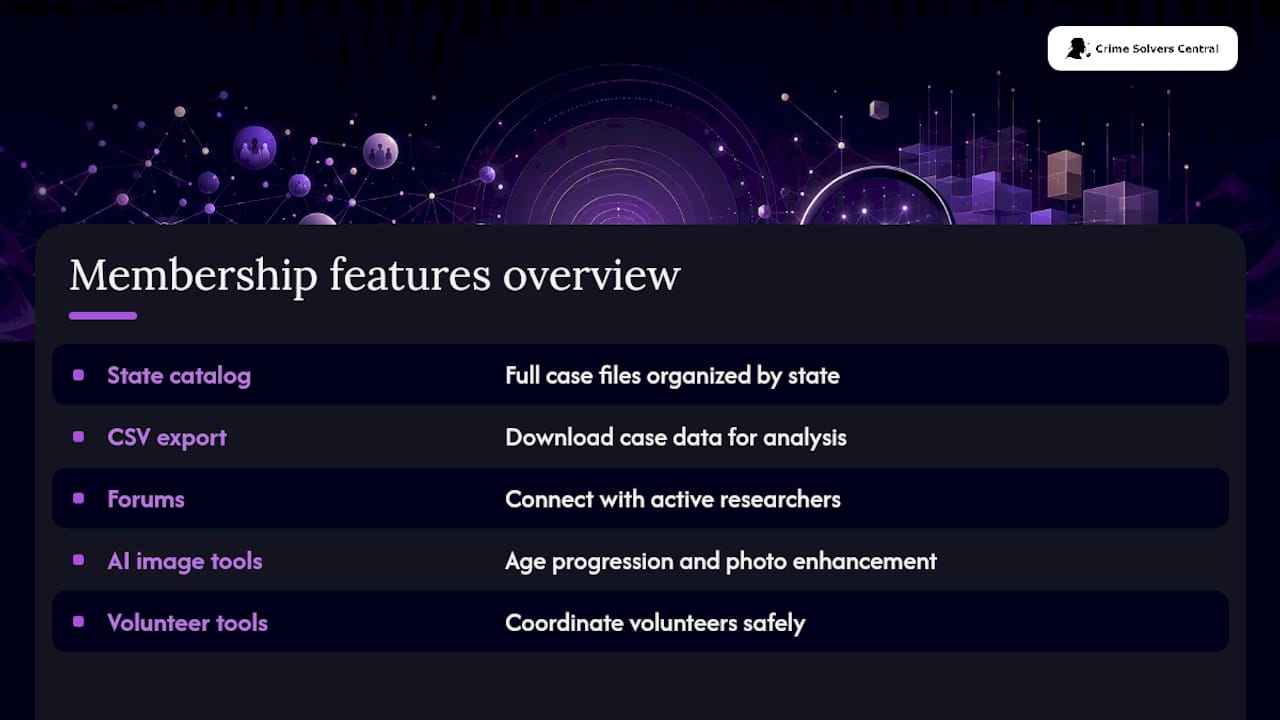
Membership unlocks access to a complete case catalog, organized state by state, along with CSV export tools, active forums, digital evidence boards, a flyer builder for spreading the word on a case, AI image tools for age progression and photo enhancement, and volunteer coordination features designed to keep search efforts organized and safe. It’s built for the people doing the real work: families who need every available lead, researchers cross-referencing patterns across jurisdictions, and advocates who want to contribute time or resources without duplicating effort law enforcement has already covered. If you’re ready to move past summaries and into the full record, visit the Cold Case Database by State to search by location and start a membership.
Sources
For deeper verification, go straight to the primary sources. NamUs documents its own services and search functions in detail. Colorado’s Cold Case Files help page explains its export tools directly. The Department of Justice’s Missing Persons guide covers reporting procedures and NCIC entry requirements. For a state-by-state breakdown of records and search filters, see our own guide to unsolved murders by state.
- National Missing and Unidentified Persons System | National Institute of Justice
- Colorado Cold Case Files - Cold Case Help
- Missing Persons, Second Edition (COPS/DOJ)
- NamUs advanced searching user guide
FAQ
Is There a Waiting Period to Report Someone Missing?
No. Families can file a missing-persons report immediately, and there’s no mandated waiting period before law enforcement will accept it.
What’s the Difference Between NamUs and a State Cold Case Database?
NamUs is a national system covering missing, unidentified, and unclaimed persons with free forensic support services, while state databases like Colorado’s or Virginia’s focus on records specific to that jurisdiction, often with their own export tools.
Can the Public Submit Information to NamUs?
Yes, public users can enter and search cases in NamUs, though submitted information is vetted against records held by the investigating agency before it’s treated as confirmed.
How Do I Know if a Loved One’s Case Is Entered Into NCIC?
Ask the investigating law enforcement agency directly. NCIC entry is mandated for missing children in appropriate circumstances, and families should confirm entry rather than assume it happened automatically.
Does Crime Solvers Central Replace Law Enforcement Involvement?
No. Crime Solvers Central’s database and community tools are built to support families and researchers alongside law enforcement, not to substitute for filing an official report or working with investigators directly.