

Vet Cold Case Sources for Researchers: NamUs, ViCAP, FOIA Limits

Start with four public repositories: NamUs for missing and unidentified persons, FBI ViCAP for violent-crime pattern data, the Civil Rights Cold Case Records Review Board portal for historic cases, and the National Archives for federal case files. Families can search NamUs directly or submit a case; anyone with new information should contact the local cold-case unit the same day.
TL;DR:
- Family searches should prioritize NamUs for missing persons and unidentified remains before considering FOIA requests, which are limited for active investigations.
- For pattern recognition in violent crimes, law enforcement must flag cases to ViCAP, but detailed investigative data are restricted to authorized personnel.
- For civil rights-era cases, the Civil Rights Cold Case Records Review Board provides public access to records from 1940 to 1979, with new information submitted directly to the Department of Justice.
- DNA searches using CODIS require existing suspect profiles, and forensic genetic genealogy is only used after CODIS fails, with lengthy timelines and strict regulation.
- Organizing evidence and tips beforehand with documents, timelines, and media improves chances of effective investigation contact and reduces the risk of compromising cases.
Table of Contents
- National repositories that cover missing persons and unsolved homicides
- What FOIA can and cannot get you from an open case
- How DNA technology and federal policy shape what’s possible
- A practical checklist before you submit a tip
- How Crime Solvers Central fits alongside official databases
- Knowing when to call investigators versus when to keep researching
- Getting started with a Crime Solvers Central membership
- FAQ
- Sources
National repositories that cover missing persons and unsolved homicides
Each federal repository serves a different purpose, and picking the right one saves time. NamUs is the broadest starting point because it is free, public, and searchable by anyone, not just law enforcement. It covers missing persons, unidentified remains, and unclaimed persons, and its Analytical Division provides forensic services such as odontology, fingerprint comparison, and DNA testing support at no cost to families or investigating agencies.
ViCAP works differently. It is a law-enforcement investigative repository built to find patterns across jurisdictions in homicides, sexual assaults, and unidentified remains cases. The FBI describes ViCAP as its largest national investigative resource for violent crime, and while some case listings are public-facing, the detailed fields investigators use for pattern matching are restricted to law enforcement.
For cases tied to the civil-rights era, the Civil Rights Cold Case Records Review Board portal is the right destination. It was created to speed the release of records from 1940 to 1979 and gives the public a direct channel to submit new information to the Department of Justice.
Use each tool based on what you are researching:
- Missing person or unidentified remains: search NamUs first and consider submitting a case if none exists.
- Pattern across multiple violent crimes: check whether local police have flagged the case to ViCAP.
- Civil-rights-era case (1940 to 1979): search the Civil Rights Cold Case Records Review Board portal and contact DOJ through its listed channels.
- Federal agency records generally: search the National Archives catalog before filing any formal request.
What FOIA can and cannot get you from an open case
Freedom of Information Act requests are useful, but they have real limits on active investigations. Federal and state law frequently allow agencies to withhold investigatory records under exemptions meant to protect ongoing enforcement work, and age alone does not force disclosure. Appeal decisions on investigatory-record exemptions show that courts and review boards often side with agencies when they can demonstrate a case remains open.
A smarter approach starts before you file anything:
- Search the National Archives catalog first. Some records are already public and require no request at all.
- Identify the specific agency that holds the record, since FOIA requests sent to the wrong office cause delays.
- Narrow your request to exact documents: case numbers, date ranges, named reports, rather than “everything about this case.”
- State plainly why you believe the records are releasable, for example if the case has been publicly closed or inactive for years.
- If denied, escalate through the agency’s appeals process, then the relevant state open-records office or an inspector general.
Pro Tip: A request for “the full investigative file” almost always gets denied; a request for a named autopsy report or a specific incident number has a far better chance.
For civil-rights-era cases, the Department of Justice Civil Rights Division is a direct escalation point once the records portal process stalls.
How DNA technology and federal policy shape what’s possible
Two DNA tools get confused constantly, and the difference matters for what a family can expect. CODIS relies on STR profiles and only returns a match when a suspect’s profile is already in the system. Forensic genetic genealogy (FGG) uses SNP-based profiles run through genealogy databases to generate leads when CODIS turns up nothing, but it comes with strict guardrails.
The Department of Justice’s interim policy on forensic genetic genealogy requires that FGG only be used after CODIS searches fail, and it requires documentation and prosecutor sign-off before an agency moves forward. That policy exists because FGG results are leads, not courtroom-ready matches, and agencies are expected to confirm any hit with a direct comparison before naming a suspect.
Funding priorities reinforce this process. The Bureau of Justice Assistance’s COLD program prioritizes cases that already have a suspect DNA profile on file, which means prosecution support tends to flow toward cases closer to resolution rather than cases still searching for a first lead.
If you are talking with investigators about FGG on a family case:
- Ask whether CODIS has already been exhausted, since that is a prerequisite, not a formality.
- Expect a long timeline; vendor lab work and prosecutor review take months, not weeks.
- Avoid pushing for details on genealogy matches before law enforcement confirms them, since premature disclosure can compromise a case.
A practical checklist before you submit a tip
Good information gets lost when it arrives disorganized. Before contacting anyone, gather what you have and put it in a form an investigator can actually use.
- Collect documents: police reports you already possess, court records, obituaries, and any correspondence tied to the case.
- Build a timeline with dates, locations, and names, even if some details are uncertain.
- Save photographs and note exactly where and when each one was taken.
- Pull media citations: news articles, broadcast segments, or podcast episodes that reference the case, with publication dates.
- Decide where the tip belongs: a local cold-case detective or unit for case-specific leads, a NamUs submission for a missing or unidentified person, or the FBI tip line at 1-800-CALL-FBI for federal-level violent crime.
- Timestamp your own submission (save a copy of the email or form confirmation) so you can follow up with a reference point.
- Give the agency time before following up. Cold-case units handle large backlogs, and a second contact after a few weeks is reasonable; weekly calls are not.
Watch for red flags along the way. Be cautious of online groups that share victim or family photos without consent, anyone offering to “solve” a case for payment, and any plan that risks identifying a private individual before law enforcement has done so. Privacy matters as much as persistence here.
How Crime Solvers Central fits alongside official databases
Crime Solvers Central organizes a large national database of cold cases, categorized by state and case type, which makes it easier for researchers to narrow a search before turning to federal tools. It is built to sit alongside NamUs and ViCAP, not replace them.
Members and visitors get access to different layers of research support:
- Free, state-by-state case indices for browsing missing persons and unsolved homicide cases.
- Deeper case files, including sourced details and media, available to members.
- Community forums and digital evidence boards for organizing research and discussion.
- Flyer-building tools and AI image tools that help generate age-progressed or public-awareness images.
None of this replaces investigative authority. Law enforcement agencies control evidence, custody of case files, and any decision to pursue charges. What a platform like this adds is organization: a place to track case details, connect with others researching the same case, and surface information that might otherwise sit buried in local archives.
Knowing when to call investigators versus when to keep researching
New physical evidence or a witness identification means one call: the investigating agency, immediately. Independent research earns its value elsewhere, in old newspapers, genealogy records, and historical archives that investigators rarely have time to revisit. The line to watch is simple: never take an action that could tip off a suspect or add to a family’s grief.
— Crime
Getting started with a Crime Solvers Central membership
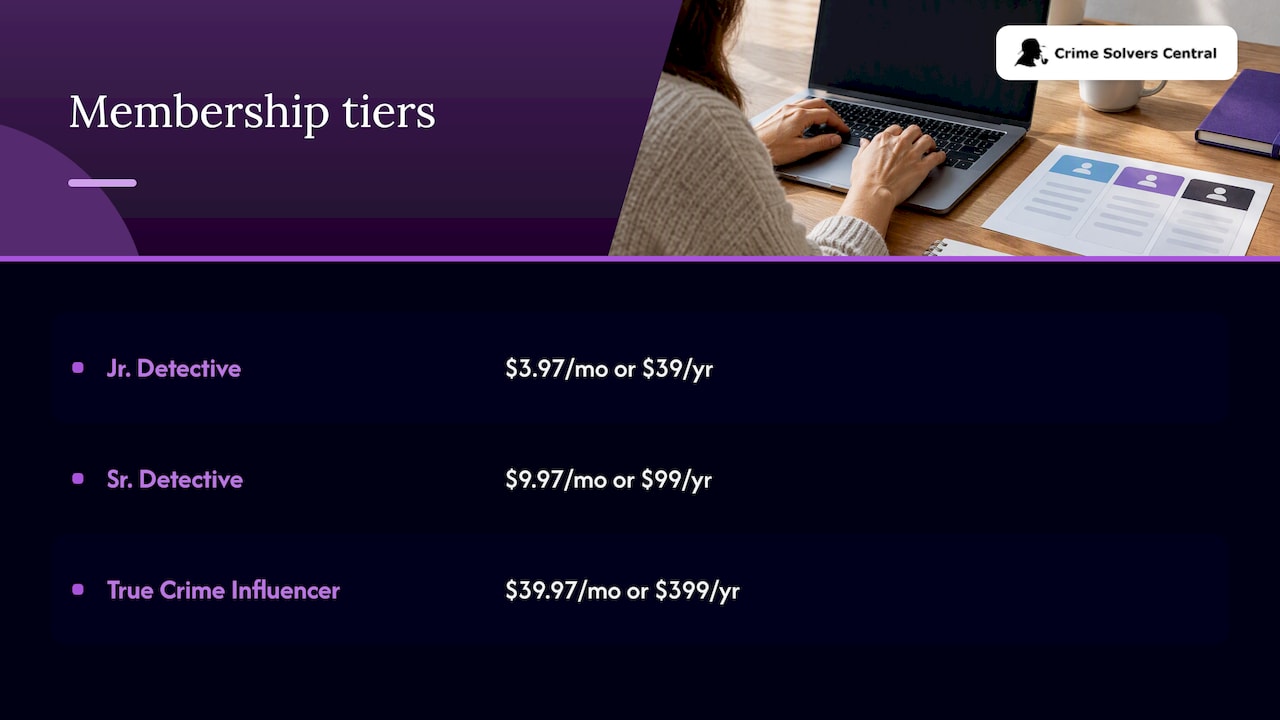
A membership on Crime Solvers Central unlocks the deeper layer of research that free browsing does not: full case files, member forums, digital evidence boards, and the flyer and AI image tools researchers use to keep public attention on a case. The Jr. Detective plan runs $3.97 per month or $39 per year, Sr. Detective runs $9.97 per month or $99 per year, and True Crime Influencer runs $39.97 per month or $399 per year, each tier opening more case detail and community access.
If you already have a specific case in mind, browse the Cold Case Database by state to see what is already documented before you start your own search. For readers wanting to compare testing options mentioned elsewhere in this guide, background on DNA testing reliability is worth a look, and families carrying the weight of a long-unsolved case may find support through grief and remembrance resources.
Crime Solvers Central is a research and advocacy tool. The authority to investigate, confirm leads, and bring charges stays with law enforcement, and nothing here changes that.
FAQ
Is there a free way to research cold cases online?
Yes. NamUs is free and public for searching missing and unidentified persons cases, and the Civil Rights Cold Case Records Review Board portal is free for civil-rights-era records. Local police cold-case pages and the National Archives catalog are also free starting points.
What is the most famous cold case of all time?
Fame in cold cases tends to track media coverage rather than any official ranking, and no federal repository designates a “most famous” case. Long-running civil-rights-era cases covered by the Civil Rights Cold Case Records Review Board portal are among the most documented historically.
Are cold case files available to the public?
Some are, but many are not, especially while an investigation remains active. Agencies can withhold investigatory records under FOIA and state open-records exemptions, and NARA’s FOIA guidance explains what is searchable without a formal request versus what requires one.
What are the latest updates on cold case investigative tools?
Forensic genetic genealogy has become a more common investigative lead source, though the DOJ’s interim policy requires it be used only after CODIS searches fail and with prosecutor approval. Federal funding through the BJA’s COLD program also now prioritizes cases that already have a suspect DNA profile on file, which shapes which cases move toward prosecution first.