

How to Find Missing Persons Cases in the U.S.: A Practical Guide

Start with NamUs, the national clearinghouse for missing, unidentified, and unclaimed persons. Then check your state’s own missing person database and the FBI’s public unidentified persons listings. Together these cover most public case records in the country. Every one of them is free to search, and we explain below how to use each, what to have ready, and what to do when you find a match.
This guide is for families looking for a relative, volunteers who want to help with cold cases, and students who need to know where case records live.
TL;DR
- NamUs is the only national database for missing, unidentified, and unclaimed persons that gives the public limited access. Search it first.
- Add your state’s missing person search and the FBI’s ViCAP unidentified persons page, because no single list holds every case.
- If you recognize someone or have a tip, contact the investigating agency listed on the record. Do not act on your own.
- If someone is missing right now, call local law enforcement first. For a child, also call 800-THE-LOST (800-843-5678).
- Our own catalog and member tools can help you organize what you find after you have searched the official sources.
Table of Contents
- Start with NamUs, the national database
- Check your state’s missing person database
- Search federal resources beyond NamUs
- What to have ready before you search or report
- Share a tip the safe way
- If you think a missing adult does not want to be found
- Organize your search with Crime Solvers Central
- FAQ
- Sources
Start with NamUs, the national database
The National Missing and Unidentified Persons System is run through the Office of Justice Programs’ National Institute of Justice. NamUs is the only national database of its kind that allows limited public access, and 17 states require law enforcement to enter case information into it. That last point matters: a missing person’s case may not appear in NamUs at all if the agency in charge never entered it.
The NamUs home page describes a centralized repository and resource center, and lists free services that go beyond searching: forensic odontology, fingerprint examination, forensic anthropology, DNA analysis, no-cost family DNA collection kits, investigative support, and training and outreach, including Missing Person Day events.
The three databases inside NamUs
The New York City Office of the Chief Medical Examiner explains that NamUs contains three databases the public can search:
| Database | What it holds | Who enters the cases |
|---|---|---|
| Missing Persons | People reported missing | Law enforcement and the public |
| Unidentified Persons | Remains of people who have not been named, including from Guam and Puerto Rico | Medical examiners and coroners |
| Unclaimed Persons | Deceased people who have a name but whose family has not been found | Medical examiners and coroners |
If you are looking for a relative, search all three. A person may be listed as missing in one place and sit in another as an unidentified case under no name at all.
For a screen-by-screen walkthrough, see our NamUs database search family guide.
How to narrow a NamUs search
NamUs lets you filter, and filters can mislead you if you set them too tightly. The Harris County Institute of Forensic Sciences advises that you should not rule out a possible match on a strict comparison with age estimates. Its example: a missing person who is 38 should not be excluded from a case estimated at 40 to 60 years old. Estimates for unidentified remains are ranges, and they can be off.
Some practical habits:
- Search by state and county where the person was last seen, then widen to neighboring states.
- Use broad age, height, and weight ranges.
- Search on features that last longer than a description of clothing: tattoos, scars, dental work, and medical devices.
- Repeat the search every few months. New cases are added and existing records are updated.
Public users also search by agency. The Marin County Sheriff’s Office tells the public to open Case Information, click Contacts, and enter the investigating agency’s name. That works well when you know which department took the report.
Check your state’s missing person database
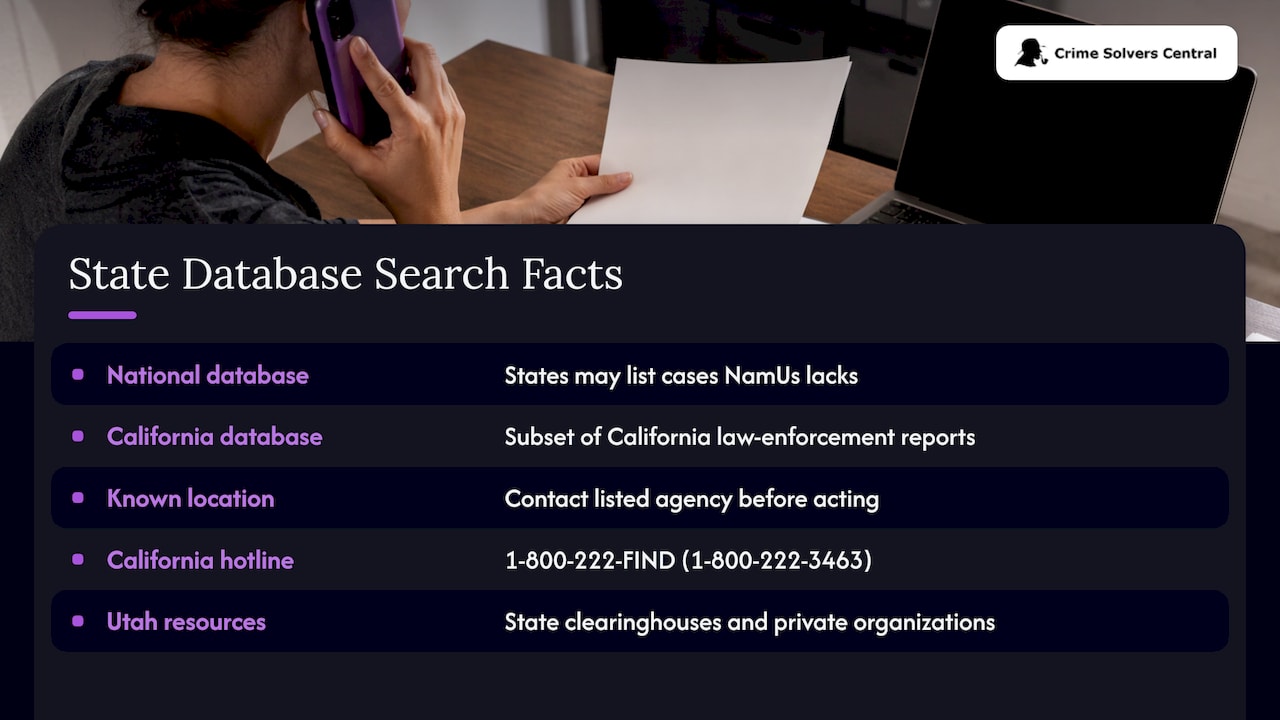
NamUs is national, but states keep their own lists, and some of those lists include cases that NamUs does not. The California Department of Justice runs a public Missing Person Search. It notes that the database is a subset of all persons reported missing by law enforcement in California, so it is not complete either.
The same page gives a rule worth following wherever you search. If you think you know where a person is, contact the law enforcement agency listed in the record before taking any action. In California you can also call the Department of Justice hotline at 1-800-222-FIND (1-800-222-3463).
The Utah Department of Public Safety lists state clearinghouses and private organizations that families can contact, which is a useful pattern to copy. Search your state attorney general, state police, or bureau of investigation site for “missing persons” or “unsolved cases.” Many state bureaus also publish unsolved homicide and unidentified remains pages.
We keep a full guide to missing persons databases for families who want to compare these sources side by side.
Search federal resources beyond NamUs
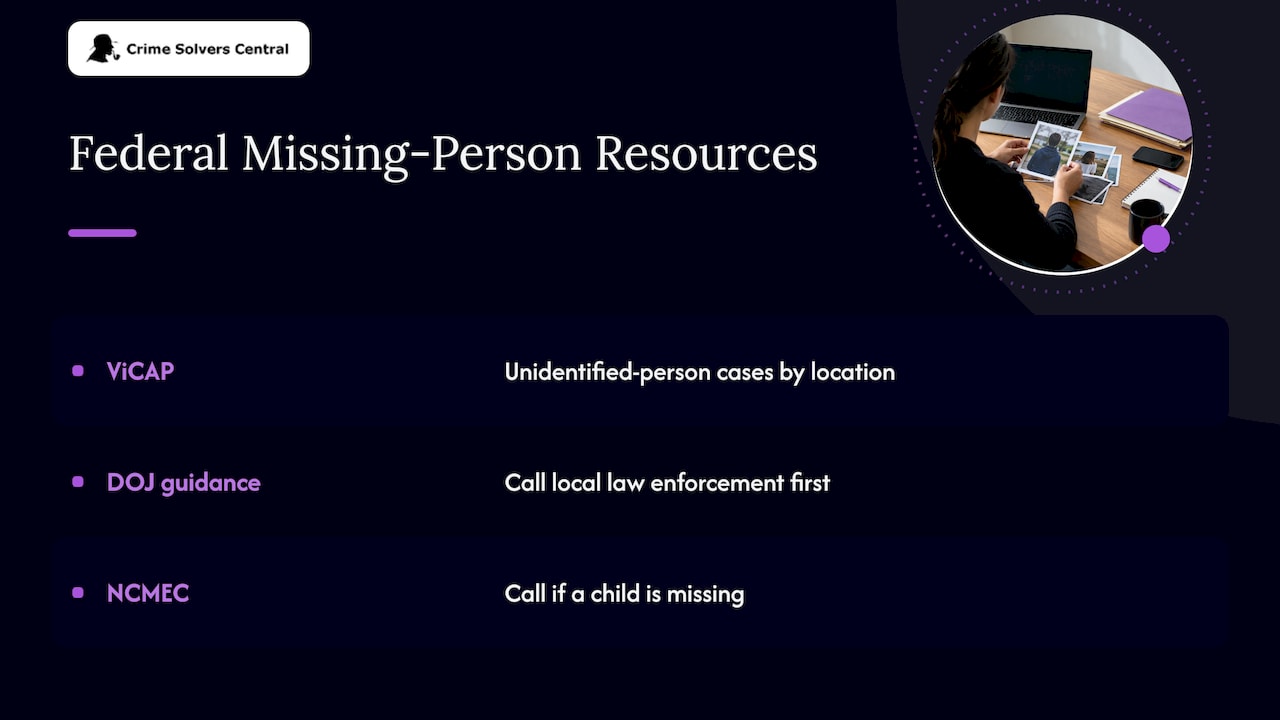
The FBI’s Violent Criminal Apprehension Program, known as ViCAP, maintains the largest investigative repository of major violent crime cases in the U.S.. It covers homicides, sexual assaults, missing persons, and other violent crimes involving unidentified human remains. The FBI publishes a public ViCAP Unidentified Persons page that lists Jane and John Doe cases by location.
The Department of Justice’s Report and Identify Missing Persons page sends people the same way. Call local law enforcement first. If a child is missing, then call the National Center for Missing & Exploited Children at 800-THE-LOST (800-843-5678). If you recognize any missing person featured on the linked sites, contact law enforcement.
Our article on three federal resources and what families can share goes deeper on how to use these together. If your search involves remains that have not been named, read why unidentified persons searches should go beyond NamUs.
Homicide and unclaimed cases
Not every case you want to find is a missing person case. If you are tracking an unsolved homicide, our murder victim database guide walks through NamUs, ViCAP, and community leads. For people who died with a known name but no family to claim them, see our unclaimed bodies database steps. If you only have a name, our guide to searching cold cases by name lays out six steps from NamUs to a national index.
What to have ready before you search or report
Searching is faster when you can describe the person the way a case record does. The NamUs User Guide says a case needs complete information in 18 data fields before it can be verified and published. They include:
- First and last name, sex, date of birth, and race or ethnicity
- Height, weight, hair color, and eye color
- Date of last contact, and the city and state where the person was last seen
- Circumstances of the disappearance
- Whether the person went missing from tribal land
- The investigating agency’s name, case number, and contact
Collect these before you call anyone. If you are searching for a relative and the record is missing details, tell the investigating agency, since they are the ones who can update it.
The same guide says NamUs resources give the most benefit to cases that have been active more than 180 days, unless someone faces imminent risk of bodily harm or death. That is a reminder that NamUs is built for long-term cases. The National Institute of Justice describes it as a complement to the FBI’s National Crime Information Center for cases that have exhausted other means. Each case is managed by a regional system administrator who works with the submitting agency to confirm details.
Reporting someone missing now
If the person is missing right now, do not start with a database. Call law enforcement.
- The Utah Department of Public Safety states there is no waiting period to report a missing person. Law enforcement must take the report immediately and enter missing persons under 21 into NCIC within 2 hours. It also says there are no federal or state laws regarding reports on adults.
- The Aberdeen Police Department says Maryland law permits immediate reporting for adults and children alike, and stresses that the first 24 hours are crucial.
- The same department advises you to tell police about special circumstances, such as a child, an elderly person, or someone on life-dependent medication. Keep a record of everyone you speak with. Do not clean the missing person’s room. Keep your own phone number off public posters, to avoid hoaxes and harassment.
- The Office for Victims of Crime says to contact law enforcement immediately about a missing adult if you have not already, and describes NamUs as a free clearinghouse that medical examiners, coroners, police, and the public can search.
Also report any tip or request for money to the investigators. People sometimes try to take advantage of families.
Share a tip the safe way
Finding a case often leads to the next question: you think you know something. The record almost always names an investigating agency. Contact that agency, and give what you know without confronting anyone yourself.
Several federal channels take tips and protect the tipster:
- The Bureau of Indian Affairs takes tips on missing or murdered cases in Indian Country by text to 847411 with the word BIAMMU, by phone at 1-833-560-2065, or by email. Rewards go up to $5,000 per award, and each tipster gets a number to keep confidentiality and check status.
- The U.S. Marshals Service runs a tips app for critically missing children and wanted fugitives. The tipster gets a unique tip number, and stays anonymous unless they give their identity.
- Local Crime Stoppers programs take anonymous tips too. The Marin County Sheriff’s Office points to Bay Area Crime Stoppers at (800) 222-TIPS (800-222-8477) for anonymous tips and possible cash rewards.
If you think a missing adult does not want to be found
Families ask this often, and it is hard. An adult can leave for their own reasons. Because the Utah Department of Public Safety notes that no federal or state laws govern reports on adults, the practical step is to report anyway and let the agency decide how to proceed. Give them every detail you have, including why you think the person left on purpose.
If you find a current address or a lead, pass it to the investigating agency and do not go there yourself. The California Department of Justice gives the same instruction: contact the listed agency before taking any action. Police can check on a person’s welfare and, where appropriate, tell you that the person is safe without sharing where they are. If you think the person may be in danger, say that plainly in your report so it is treated accordingly.
Perspective
We built Crime Solvers Central because official databases are essential but they leave families with a problem: the records are scattered. A relative may appear in one state list, a federal listing, and a national clearinghouse, each with different details and no connection between them.
Our answer is a single national catalog of more than 264,000 cases, organized by state and by situation: missing persons, unsolved homicides, and unidentified or unclaimed remains. We believe families should start with NamUs and law enforcement, because those hold the official record. Then they need a place to bring the pieces together.
That is where our member tools come in: full case details and sources, digital evidence boards, a flyer builder, A.I. image tools, forums, and volunteer coordination. Our testimonials from members show what happens when more people can see a case clearly and share what they know with investigators.
Cold cases get solved when someone notices a detail. We are here to make more details visible to more people.
Crime
Organize your search with Crime Solvers Central
Once you have searched the official sources, you may want to keep track of leads, study similar cases, or build a flyer. Crime Solvers Central offers three membership plans: Jr. Detective at $3.97 per month or $39 per year, Sr. Detective at $9.97 per month or $99 per year, and True Crime Influencer at $39.97 per month or $399 per year. If you need a flyer for a case, our flyer builder is ready to use. Start from our home page to browse the catalog by state. Families registering with NamUs can also read how to connect with other families in similar cold cases, and our guide to how families use NamUs together with our catalog explains the two side by side.
FAQ
Is there a missing person database anyone can search?
Yes. NamUs allows limited public access and includes missing, unidentified, and unclaimed persons. Many states, such as California, also publish their own public search. No single database holds every case, so check NamUs, your state, and the FBI’s unidentified persons page.
Can I get a list of unidentified people?
Yes. NamUs has a public Unidentified Persons search that you can narrow by state and county. The FBI also publishes a ViCAP Unidentified Persons page that lists Jane and John Doe cases by location. Use wide age ranges, since estimates for remains are often approximate.
What should I do if I recognize a missing person in a database?
Contact the law enforcement agency named on the record, or the state hotline if one is listed. Do not try to locate or approach the person yourself. Share what you know and how you know it, and ask the agency for a tip number if one is offered.
How long do I have to wait before reporting someone missing?
There is no waiting period. Utah’s Department of Public Safety says law enforcement must take reports immediately. Call local police right away, and if a child is missing, also call 800-THE-LOST (800-843-5678).
Sources
- National Missing and Unidentified Persons System, National Institute of Justice
- NamUs home page
- NamUs User Guide
- NamUs, NYC Office of the Chief Medical Examiner
- Unidentified Persons, Harris County Institute of Forensic Sciences
- Missing & Wanted Persons, Marin County Sheriff
- Missing Person Search, California Department of Justice
- Missing Persons Resources, Utah Bureau of Criminal Identification
- ViCAP Unidentified Persons, FBI
- Report and Identify Missing Persons, U.S. Department of Justice
- Missing Persons Reporting, Aberdeen Police Department
- Locating missing adults, Office for Victims of Crime
- Submit a Tip or Case Information, Indian Affairs
- USMS Tips App Helps Recover Missing Child, U.S. Marshals Service