

How to Build a Missing Person Case File in 2026

A missing person case file is the complete, organized record of identity, physical, medical, and administrative data compiled to support law enforcement and investigative efforts. Building this file correctly from the first hour is the single most important thing a family or advocate can do. Federal law prohibits waiting periods before filing reports, and national systems like the National Crime Information Center (NCIC) and the National Missing and Unidentified Persons System (NamUs) depend entirely on the accuracy and completeness of what you submit. Crimesolverscentral catalogs over 264,913 cases and consistently shows that the strongest ones share one trait: thorough, well-organized documentation from day one.
What should you include when you build a missing person case file?
The foundation of any effective case file is identity documentation. Start with the person’s full legal name, all known nicknames or aliases, date of birth, Social Security number, and current address. These fields are not optional. They are the anchors that allow NCIC and NamUs to match records across agencies and states.
Physical description goes far beyond height, weight, and eye color. Documenting handedness, shoe size, medical conditions, and distinguishing marks like tattoos, scars, or dental work gives investigators and the public specific identifiers that generic descriptions miss. A scar above the left eyebrow or a distinctive tattoo on the forearm can be the detail that closes a case years later.

Medical history belongs in every case file. List all diagnosed conditions, current medications with dosages, the name of the person’s primary care physician, and any recent hospitalizations. This information matters for two reasons: it helps assess risk level for NCIC classification, and it can narrow identification if the person is found unresponsive or unable to communicate.
Vehicle information is frequently overlooked. If the missing person had access to a car, document the make, model, year, color, license plate number, and Vehicle Identification Number (VIN). Law enforcement can enter vehicle data into NCIC separately, which triggers alerts at traffic stops nationwide.
Biological evidence is the long-term insurance policy for any case. Families should preserve biological evidence like toothbrushes, hairbrushes, or medically obtained blood cards for DNA profiling. New York’s Division of Criminal Justice Services specifically highlights these items as critical for forensic matching in long-term investigations. Store them in sealed paper bags, not plastic, and label each item with the date collected.
Pro Tip: Take a high-resolution photo of the missing person within the last 30 days, with no filters, good lighting, and a clear view of the face. Investigators and the public need to recognize this person in real life, not in an edited image.
The documentation checklist for a complete case file includes:
- Full legal name, aliases, and date of birth
- Social Security number and government ID numbers
- Detailed physical description including handedness, shoe size, and distinguishing marks
- Recent unfiltered photo (front-facing, high resolution)
- Medical history, medications, and treating physician contact
- Vehicle details including VIN and license plate
- Biological samples stored in paper bags with collection dates
- Last known location, time, and who last saw the person
How do you file a missing person report with law enforcement and national databases?
File a report with local law enforcement immediately. There is no legal waiting period. This is one of the most persistent myths in missing persons cases, and it costs critical hours. Federal standards prohibit agencies from requiring families to wait 24 or 48 hours before accepting a report.
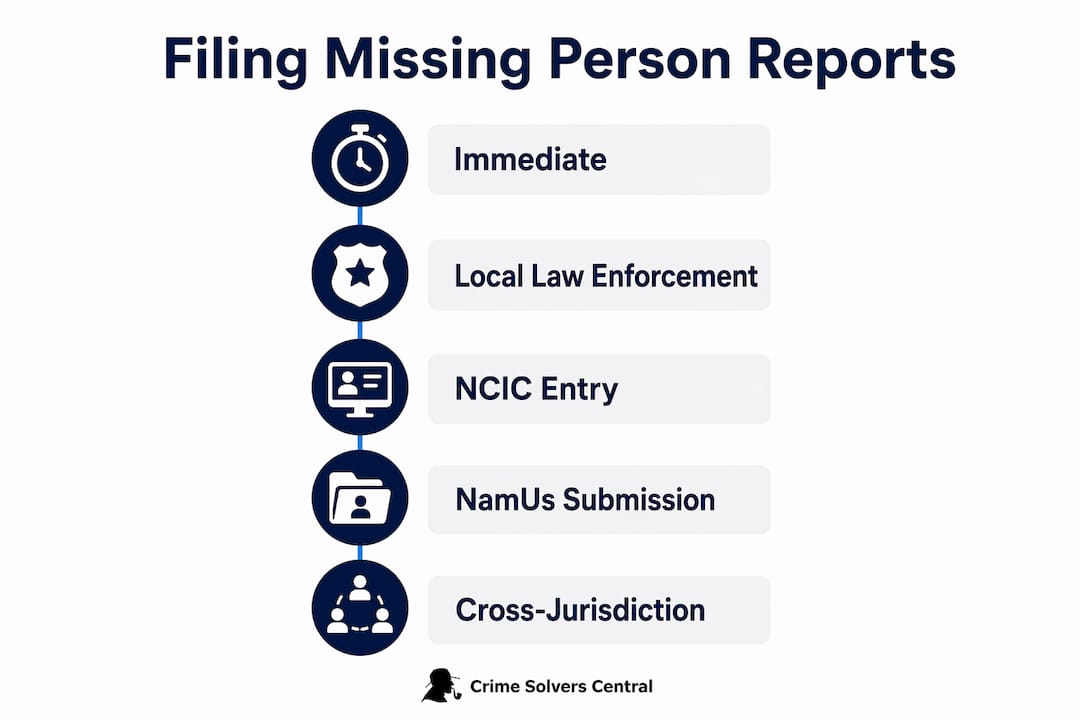
Once you file, law enforcement must enter the case into NCIC on a strict timeline. Under California Penal Code Section 14205(b), agencies must enter data within 4 hours for children under 12 or individuals classified as “at risk,” and within 2–4 hours for adults. Most states follow comparable standards. That timeline means your report needs to be complete and accurate before you leave the police station.
NamUs operates separately from NCIC and requires its own submission. The process for getting a case published on NamUs follows these steps:
- Contact your local law enforcement agency and request that they submit the case to NamUs.
- Confirm that all 18 mandatory data fields are completed, including the person’s name, date of birth, physical traits, the agency name, the case number, and a contact email for verification.
- Wait for the NamUs administrator to verify and approve the submission before it goes public.
- Follow up with the assigned investigator within 48 hours to confirm the case is published, not sitting in draft status.
- Request that any updates, such as new photos or changed physical details, be entered into NamUs within 24 hours to keep NCIC and NamUs synchronized.
Pro Tip: Ask the investigating officer directly: “Has this case been entered into both NCIC and NamUs?” Officers sometimes enter one and not the other. Both systems serve different audiences and both matter.
The table below summarizes the key filing requirements families and advocates should track:
| System | Entry Deadline | Who Submits | Key Requirement |
|---|---|---|---|
| NCIC | 2–4 hours (risk-based) | Law enforcement only | Complete identity and physical data |
| NamUs | Within 24 hours of updates | Law enforcement or advocate request | 18 mandatory fields completed |
| Local agency | Immediately upon report | Family or advocate | No waiting period permitted |
For cases involving individuals who cross state lines or go missing near jurisdictional borders, file reports in every relevant jurisdiction. Each agency must enter the case independently. Do not assume that one filing automatically shares data with neighboring counties or states.
How do you coordinate across jurisdictions for a missing person case?
Jurisdictional gaps are the leading structural reason cases go cold. A person who disappears near a county line may fall between two agencies, with neither taking clear ownership. Requesting case entry into NamUs bridges local, tribal, and federal law enforcement databases, making the case visible to investigators across the country regardless of which agency originally filed.
Families and advocates can take direct steps to push coordination forward:
- Ask the lead investigator to contact neighboring jurisdictions and confirm whether a parallel report is needed.
- Request that the case be shared with the FBI’s Violent Criminal Apprehension Program (ViCAP), which cross-references missing persons with unidentified remains and violent crime patterns nationally.
- Contact your state’s missing persons clearinghouse. Every state has one, and they exist specifically to coordinate between local agencies.
- For cases involving Native American or Alaska Native individuals, request involvement from the Bureau of Indian Affairs (BIA) Missing and Murdered Unit, which has tribal liaison roles designed to close the gap between tribal and federal systems.
- Use Crimesolverscentral’s national cold case database to check whether related cases or unidentified persons in neighboring states may be connected.
Jurisdictional gaps cause many cases to go cold. National systems like NamUs are the primary tool for overcoming these gaps, but they only work when families actively push agencies to use them. Passive waiting is the worst strategy.
Rural and tribal cases face compounding challenges. Limited agency staffing, geographic isolation, and inconsistent database access all slow the process. In these situations, connecting with state-level advocates and federal liaisons is not optional. It is the only reliable path to getting the case seen by the right investigators.
What are the most common mistakes when building a missing person case file?
The most damaging mistake is submitting an incomplete NamUs entry. Incomplete NamUs submissions with missing mandatory fields remain unpublished, meaning the case is invisible to every investigator and database user outside the original filing agency. A case stuck in draft status is functionally a cold case before the investigation even starts.
Poor photo quality is the second most common failure. A blurry, filtered, or outdated photo makes public identification nearly impossible. Missteps like poor photo quality delay case progress and reduce the effectiveness of both law enforcement and public assistance. Use the most recent clear photo available, and update it in the case file if a newer one surfaces.
Families must also protect digital evidence. During the first 48 hours, investigators rely on digital traces more than financial records. Do not delete voicemails, text threads, social media messages, or call logs from the missing person’s accounts or your own. Screenshot and back up everything before handing devices to law enforcement.
Pro Tip: Create a dedicated folder, physical and digital, for every document, photo, and communication related to the case. Date-stamp every entry. This discipline makes it far easier to spot gaps and hand off information to new investigators.
Additional best practices for maintaining a strong case file include:
- Report any new information to the lead investigator immediately, no matter how minor it seems.
- Request written confirmation that updates have been entered into NCIC and NamUs.
- Avoid conducting home searches without guidance. Methodical third-party searches for personal items differ from family searches and can reveal clues that untrained searchers overlook or accidentally disturb.
- Review the common mistakes in missing persons searches that delay investigations, and share that resource with anyone helping coordinate the case.
Key Takeaways
A complete, accurate missing person case file submitted immediately to both NCIC and NamUs is the most effective way to accelerate investigation and prevent a case from going cold.
| Point | Details |
|---|---|
| No waiting period exists | File a report with law enforcement immediately. Federal law prohibits agencies from requiring a delay. |
| NCIC entry is time-sensitive | Law enforcement must enter data within 2–4 hours based on age and risk classification. |
| NamUs needs 18 fields | Incomplete submissions stay unpublished. Confirm all mandatory fields are complete before leaving the agency. |
| Biological evidence matters | Preserve toothbrushes, hairbrushes, or blood cards in paper bags for long-term DNA matching. |
| Coordination requires action | Families must actively push agencies to share cases across jurisdictions and enter data into NamUs. |
What I’ve learned from watching cases succeed and fail
The cases that move fastest share one characteristic: someone in the family or advocate circle refused to accept a passive role. They called the investigator every 48 hours. They confirmed database entries. They pushed for NamUs submission when the agency stalled. That persistence is not interference. It is the mechanism that keeps a case alive.
The cases that stall almost always have the same early failure. The initial report was filed, but the follow-through stopped there. No one confirmed NCIC entry. No one checked whether NamUs was published or sitting in draft. Weeks passed before anyone realized the case was invisible to every investigator outside the original county.
The emotional weight of this situation is real, and I do not minimize it. But clear documentation is one of the few things families can control when everything else feels out of reach. A well-organized file with accurate photos, preserved evidence, and confirmed database entries gives investigators something concrete to work with. It also gives families a structured way to channel their energy into something that directly helps.
Working with law enforcement productively means being specific, not emotional, in every interaction. Ask precise questions: “Has this been entered into NamUs? What is the case number? Who is the assigned investigator?” Those questions get answers. Vague appeals for urgency rarely do. Understanding how to preserve evidence at home before law enforcement arrives is one of the most practical steps any family can take in the first hours.
— Crime
Crimesolverscentral: a resource for families and advocates
Crimesolverscentral maintains a national missing persons database with over 264,913 cases organized by state and situation. Families can search for existing cases, check whether a loved one’s file is visible in the system, and connect with community members who have navigated the same process. The platform also supports advocates working across jurisdictions by providing case visibility that local agency databases often cannot match. If you are building a case file and want to understand how national databases work together, Crimesolverscentral is a practical starting point. Community membership, fundraising tools, and health and safety initiatives are all available through the site.
FAQ
Is there a waiting period before filing a missing person report?
No waiting period exists under federal law. Law enforcement agencies are prohibited from requiring families to wait 24 or 48 hours before accepting a report.
What are the 18 mandatory NamUs fields?
NamUs requires fields including the missing person’s name, date of birth, physical traits, the reporting agency’s name and case number, and a contact email for administrative verification. All 18 fields must be complete for the case to be published.
How do I know if my loved one’s case is in NCIC?
Ask the investigating officer directly for written confirmation that the case has been entered into NCIC and for the assigned case number. You can also request confirmation that the entry was completed within the required 2–4 hour window.
What biological evidence should families preserve?
Families should preserve toothbrushes, hairbrushes, and any medically obtained blood cards in sealed paper bags labeled with the collection date. These items support DNA profiling for long-term forensic identification.
What should I do if agencies in different jurisdictions are not coordinating?
Contact your state’s missing persons clearinghouse and request that the case be entered into NamUs, which bridges local, tribal, and federal databases. For cases involving Native communities, contact the Bureau of Indian Affairs Missing and Murdered Unit directly.