

AI Image Enhancement for Cold Case Evidence: What Actually Works
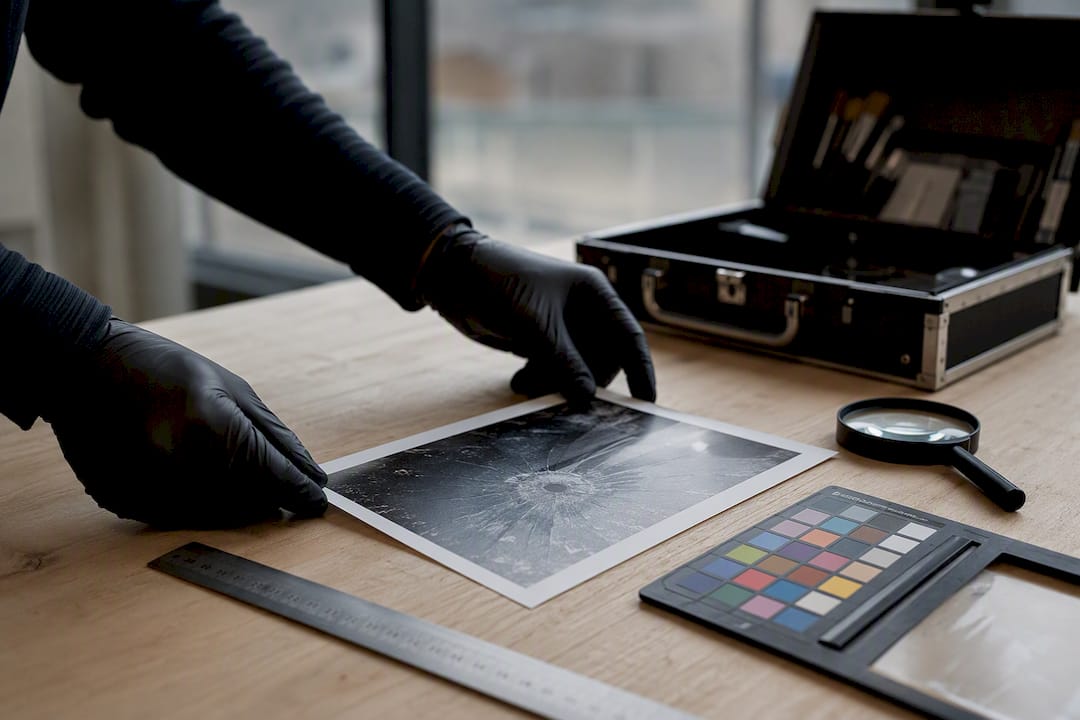
Use restoration only, never generation, and touch nothing before you preserve it. Secure the original file, compute a SHA-256 hash, and work exclusively on copies. Denoising, deconvolution, and contrast correction can legitimately recover detail; generative “AI upscaling” and inpainting invent pixels that were never there and should never be treated as evidence.
TL;DR:
- Enhancing evidence images requires strict preservation, documentation, and processing steps to ensure admissibility in court.
- AI methods based on data already in the image, such as denoising and deconvolution, are legally defensible, unlike generative techniques that invent details.
- Enhancement results must be reproducible, well-documented, and validated against known data, especially before critical identifications like faces or plates.
- Improvements are limited by the original sensor data quality and physics, meaning detail below a certain pixel threshold cannot be truly recovered.
- Use AI enhancement mainly for initial leads; complex case images should be submitted to accredited labs for verification and legal validation.
Table of Contents
- How Does AI Image Enhancement Work for Evidentiary Photos?
- Why Can’t AI Recover Every Detail in a Blurry Photo?
- Which AI Enhancement Methods Are Safe for Forensic Use?
- What Documentation Makes an Enhanced Image Defensible?
- How Do You Verify an AI Enhancement Isn’t a Hallucination?
- How Should Forensic AI Models Be Trained on Case Imagery?
- Have AI Enhancements Actually Cracked Real Cases?
- Crime Solvers Central’s Take on Community Enhancement Work
- Get More Support Through Crime Solvers Central Membership
- Sources
- FAQ
How Does AI Image Enhancement Work for Evidentiary Photos?
AI image enhancement for case work follows a strict order: preserve, copy, process, log, verify. Skip a step and you risk turning a potentially useful lead into evidence a defense attorney or a skeptical detective can dismiss in five minutes.
Here’s the sequence that holds up:
- Secure the original. Hash the file with SHA-256 the moment you receive it. Store it write-protected, note who accessed it and when, and never open the original file directly in an editor.
- Create a versioned working copy. Name it with a timestamp, not “final_v2_edited.” You’ll thank yourself later when three volunteers have touched the same photo.
- Run the pipeline in order: denoise first, then correct exposure and contrast, then deblur through deconvolution if the blur is motion or focus related, then apply conservative sharpening. Reverse that order and you’ll amplify noise instead of detail.
- Reserve multi-frame super-resolution for actual multi-frame data. If you only have one still, don’t fake multiple frames with a single-image AI model that guesses the rest.
- Log everything. Software name, version number, every parameter you touched, and a one-line reason for each step.
- Know your stopping point. If the image still can’t support the claim you want to make, that’s your answer. Overprocessing to force a face or plate to “appear” is how good leads get thrown out.
Pro Tip: If a face, tattoo, or plate genuinely might identify someone, stop after basic restoration and send the file to an accredited forensic lab rather than pushing it further yourself. A clean, honest “we improved legibility but couldn’t confirm identity” holds more weight than an over-enhanced image that collapses under scrutiny.
The Interpol review of forensic image and video analysis draws the same line: restoration-focused AI and classical image-science techniques remain the backbone of admissible work, while generative methods belong in lead-generation, not courtrooms.
Why Can’t AI Recover Every Detail in a Blurry Photo?
Physics sets a hard ceiling on what any enhancement, AI or otherwise, can pull out of a photograph. The Nyquist sampling limit means that if a feature (a partial license plate character, a facial scar) was captured across fewer than roughly two pixels, that information was never recorded in the first place. No algorithm, however advanced, can retrieve data that was never captured. It can only guess, and a guess is not a fact.
Two blur types behave differently:
- Motion blur (a moving subject or camera) often responds well to deconvolution because the blur follows a mathematically predictable path.
- Out-of-focus blur is harder to reverse because the information loss is more uniform and less directional, giving deconvolution less to work with.
Compression adds a second layer of risk. AI-based codecs designed to make images “look better” can quietly alter or invent detail. A study of six AI compression codecs found cases where color and shape were altered outright, and biometric recognition recall dropped for already low-quality images. The image looked cleaner. It was less accurate.
The same failure shows up with AI-generated content colliding with authentication tools. One peer-reviewed evaluation found that source-camera identification checks produced high false-positive rates for some AI image generators when measured against smartphone sensor fingerprints. Center-cropping reduced those false positives without hurting true-positive detection, but the underlying lesson stands: AI-touched images can fool the very tools meant to authenticate them.
Which AI Enhancement Methods Are Safe for Forensic Use?
Restoration-focused techniques are defensible because they work with the information already present in the file instead of inventing new content. Contrast stretching pulls out detail hiding in shadows and highlights. Non-generative denoising removes sensor noise without fabricating texture. Deconvolution reverses predictable blur patterns mathematically. Multi-frame super-resolution combines several real frames capturing tiny sub-pixel shifts into one sharper composite, which is legitimate precisely because the extra detail came from actual captured data.
Learning-based single-image “super-resolution” and inpainting work differently, and that difference matters enormously for evidentiary use. These models fill gaps using patterns learned from millions of training images, not from your specific photo. Research on face restoration methods found that while restored images looked visually sharper, automated recognition performance didn’t reliably improve, and the restoration process sometimes introduced generated features that changed how faces were recognized. Prettier is not the same as truer.
When evaluating any tool, check for:
- Reproducibility — does running the same file through the same settings twice give you the same result?
- Documented algorithms — can you name exactly what method (deconvolution, wavelet denoising, and so on) it applies?
- Version control — does it log which software build and settings you used?
- Exportable intermediate files — can you save each processing stage separately, not just the final output?
Pro Tip: If a tool can’t show you what it changed and why, treat its output as a lead, not evidence. Save the truly high-stakes images, like a possible face or identifying mark, for an accredited lab with certified forensic software rather than a general-purpose AI enhancer.
What Documentation Makes an Enhanced Image Defensible?
An enhanced image without a paper trail is just an opinion in pixel form. The SWGDE Guidelines for Forensic Image Analysis require preserving the original, producing working copies, and documenting every processing step so the strategy is justifiable to someone who wasn’t in the room.
Build your audit trail this way:
- Hash the original file (SHA-256) before touching anything, and store a write-protected copy with an access log.
- Record every processing step: software name and version, each parameter, the operator’s name, the timestamp, and a short reason for the step.
- Keep every intermediate file rather than overwriting them, so someone can trace exactly how the final image was reached.
- Export a parameter list or “replay” script that lets another analyst reproduce your result exactly.
That last point matters more than most people realize. Standards bodies increasingly describe this as a chain of custody for pixels: if you can’t explain and replicate a step, it’s presumptively unreliable.
When you present findings, show the original and the enhanced image side by side, and state the pixel dimensions and estimated spatial resolution of the source. A jury or detective needs to see what you started with, not just the polished result.
How Do You Verify an AI Enhancement Isn’t a Hallucination?
Run the enhancement twice with slightly different parameter seeds and compare the outputs. If a feature (a facial contour, a digit on a plate) appears consistently across both runs, it’s more likely grounded in the actual data. If it shifts or appears only once, that’s a hallucination artifact, not a recovered detail.
Word your findings carefully. Say “improvement in legibility of the rear plate character” instead of “identified the plate.” Say “insufficient resolution for positive identification” when that’s the honest answer. Treat every AI-assisted enhancement as hypothesis-forming, a lead worth chasing, not primary proof of identity.
- Check codec history and any pre-processing the camera or platform already applied before you enhance further.
- Escalate anything tied to a potential identification, whether facial, plate, or tattoo, to an accredited forensic lab or your local law-enforcement evidence unit.
- Never submit a solely AI-generated enhancement as courtroom evidence without independent lab validation.
How Should Forensic AI Models Be Trained on Case Imagery?
Models built or fine-tuned for cold case work need forensic-specific training data, not generic photo libraries. A model trained mostly on smartphone selfies and stock photography learns priors that don’t match degraded surveillance footage, decades-old film scans, or low-light body-cam frames, which is exactly why generic “photo enhancer” apps perform so poorly on this kind of material.
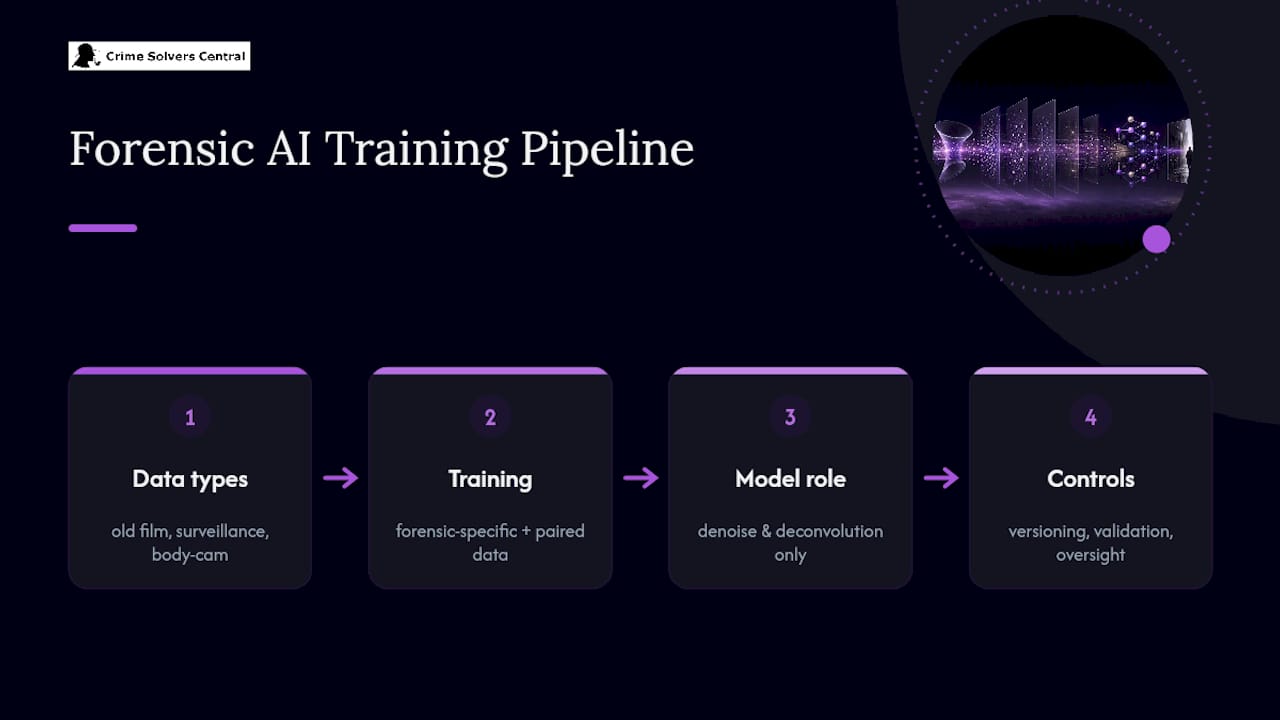
Calibration should lean on paired data: a genuinely degraded image alongside its verified ground truth, when such pairs exist, so the model’s output can be measured against something real rather than judged purely by eye. Where ground truth doesn’t exist (most cold case photos), the model’s role should shrink to conservative, well-understood operations like denoising and deconvolution rather than generative guesswork.
Any model used on case imagery needs version control the same way processing software does. If a lab updates its model, older enhancements should stay tied to the model version that produced them, since a later version might interpret the same blur differently. Regular validation against known test images, images where the true content is already established, helps catch model drift before it corrupts a live case.
This is also where independent oversight matters. Groups like ENFSI have pushed for forensic AI tools to meet documented validation and best-practice standards before adoption, rather than being trusted on vendor claims alone. Community investigators rarely have access to model training infrastructure themselves, which is exactly why leaning on tools built with forensic calibration in mind, rather than repurposed consumer apps, matters so much here.
Have AI Enhancements Actually Cracked Real Cases?
Multi-frame super-resolution has helped investigators pull a legible plate character out of grainy traffic camera footage when several consecutive frames captured slightly different sub-pixel positions of the same object. That’s a legitimate win because the extra clarity came from combining real captured data, not from a model inventing texture.
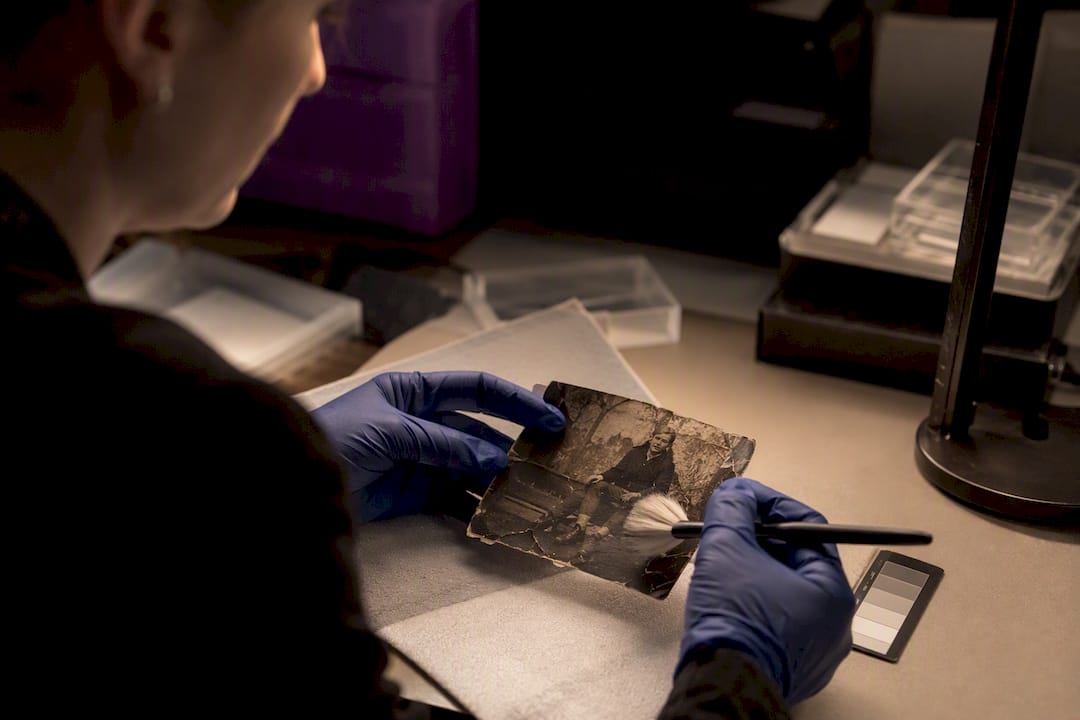
Restoration techniques have also helped with badly degraded film-era case photos, decades-old Polaroids and negatives scanned at low quality, where contrast correction and denoising recovered facial structure that had simply been buried under grain and fading, not erased. In those cases, the enhancement supported a renewed identification effort rather than serving as standalone proof.
The pattern across genuinely successful cases is consistent: enhancement narrowed the field of possibilities and generated a lead worth pursuing with fingerprint analysis, DNA, dental records, or witness confirmation. It rarely closed a case by itself. The failures follow an equally consistent pattern, cases where an over-enhanced or generatively “completed” image was treated as confirmation, only to fall apart once a lab reviewed the original file. The lesson holds across every success story: enhancement earns its value by pointing investigators toward the right question, not by pretending to answer it.
Crime Solvers Central’s Take on Community Enhancement Work
We built our database of more than 264,913 cases because families and amateur sleuths do real work that moves cases forward, but that work only counts if it survives contact with law enforcement and the courts. Our member tools, image tools, case boards, and forums exist to help you organize and share leads responsibly, not to replace an accredited lab when a submission needs to hold up formally. Secure your files, document every step you take, and use the platform to connect with people who’ve handled this before. Careful process is what turns a hunch into a case that actually moves.
— Crime
Get More Support Through Crime Solvers Central Membership
DIY enhancement gets you a defensible lead. It doesn’t get you a case file, a network of people who’ve solved similar cases, or a place to organize what you find. That’s where Crimesolverscentral fits in. Membership unlocks full case details across our national database, plus the image tools, digital evidence boards, and forums that let you work alongside other investigators and family members instead of alone at a kitchen table. When your enhanced image points toward something real, a possible identification, a fresh angle on a plate or timeline, you need people who can help you take the next step, not just software. Our platform connects you with that community while being upfront that formal evidentiary submissions still belong with an accredited forensic lab. Start by exploring the Cold Case Database and see which open cases match what you’re working on.
Sources
The SWGDE Guidelines for Forensic Image Analysis back every hashing, working-copy, and processing-log recommendation in this piece. The Interpol review of forensic image and video analysis supports the restoration-versus-generation distinction. Studies on AI compression’s forensic impact, source camera identification pitfalls, and face restoration’s effect on recognition support the hallucination and biometric-risk warnings throughout. For preserving digital evidence before enhancement even begins, see our guide on how to preserve missing person evidence at home.
This article is general information, not a substitute for advice from a qualified lawyer. Consult a qualified legal professional about your own circumstances before acting on anything here.
- Guidelines for Forensic Image Analysis
- Boon or Bane: Source Camera Identification meets AI-generated images
- Polished pixels: impact of AI compression on image-based evidence
- Effects of face image restoration on forensic face recognition (2024)
FAQ
Is AI Image Enhancement Admissible in Court?
Only when the original is preserved, every processing step is documented and reproducible, and restoration methods (not generative AI) were used; even then, an accredited lab typically needs to validate the result.
Can AI Restore a Face That’s Too Blurry to Recognize?
It can improve legibility within the limits of what the sensor actually captured, but the Nyquist sampling limit means detail below a certain pixel threshold was never recorded and can’t be truly recovered.
What’s the Difference Between Restoration and Generative AI Enhancement?
Restoration works only with data already in the image (denoising, deconvolution, contrast correction), while generative AI invents plausible-looking pixels based on training data, which creates hallucination risk unacceptable for evidence.
Should I Enhance Case Photos Myself or Send Them to a Lab?
Basic restoration steps like denoising and contrast correction are reasonable to attempt yourself if you document everything, but any image tied to a possible identification should go to an accredited forensic lab or law enforcement evidence unit.
Does Crime Solvers Central Provide AI Enhancement Tools?
Crimesolverscentral offers member image tools and digital evidence boards to help organize and share leads, alongside guidance to route formal evidentiary work through accredited forensic labs.