

Analyzing Cold Cases: A 2026 Expert-Backed Guide

What does analyzing cold cases actually involve?
Analyzing cold cases means systematically reviewing unsolved criminal investigations by testing every plausible hypothesis against all available evidence, without committing to any single theory prematurely. The goal is not to prove a suspect guilty. It is to map what the evidence actually supports.
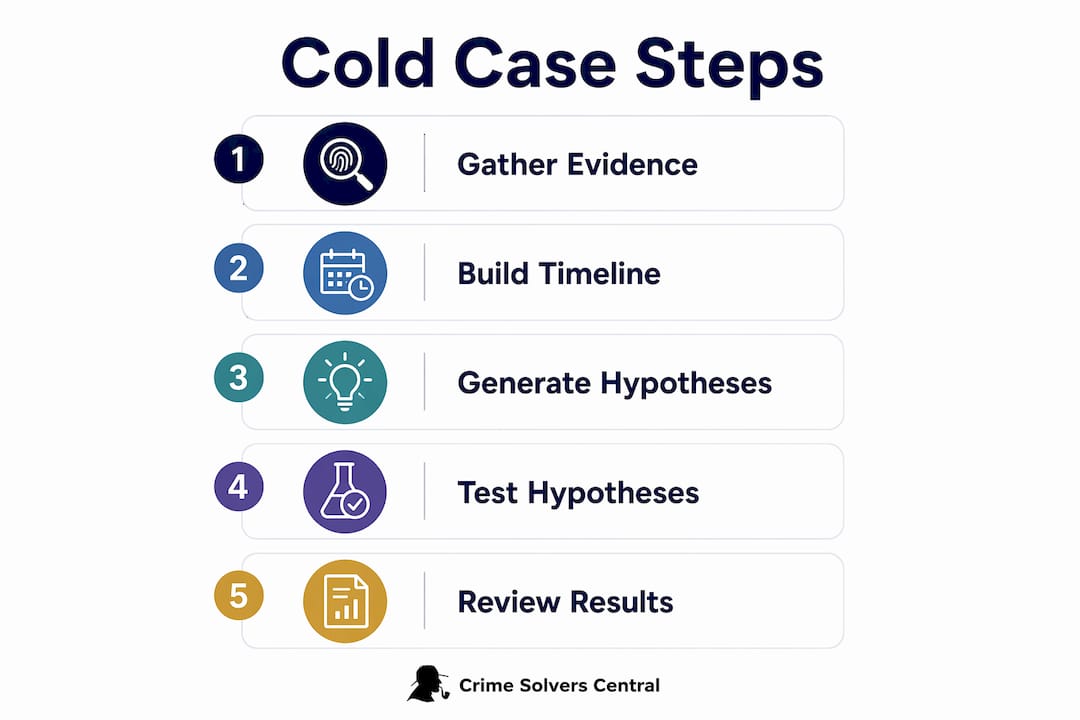
The process has three core components: a thorough case file review, structured hypothesis testing, and evidence management that accounts for modern forensic capabilities. One framework stands above the rest for keeping investigators honest: the Analysis of Competing Hypotheses (ACH), developed for intelligence analysis and now widely adopted in major crime reviews. ACH forces you to list every viable hypothesis and score each piece of evidence against all of them simultaneously, rather than hunting for confirmation of the theory you already favor.
Key components of any cold case review include:
- Comprehensive case file audit to identify gaps and outdated documentation
- Evidence inventory with assessment of which items could benefit from modern forensic testing
- Hypothesis mapping using ACH or a comparable structured framework
- Timeline construction to surface contradictions and missing information
- Coordination with law enforcement or forensic experts where appropriate
Key methodologies for investigating unsolved crimes
Timeline construction is the backbone of any serious cold case review. A well-built timeline does more than list dates. It exposes contradictions between witness statements, flags gaps where information should exist but does not, and often reveals the most promising investigative angles hiding in plain sight.
Pro Tip: Keep your timeline and your hypothesis list in separate documents. Mixing them encourages you to unconsciously shape the timeline to fit your theory rather than letting the facts speak.

Structured hypothesis testing using ACH prevents the single biggest error in cold case work: confirmation bias. Instead of asking “does this evidence support my theory?”, ACH asks “which hypothesis does this evidence most strongly support or contradict?” The difference sounds subtle. In practice, it changes everything about how you read a case file.
Annual evidence audits are standard practice in professional cold case units and should inform citizen research too. Reviewing what evidence still exists, what has degraded, and what might now be testable with updated technology is not a one-time task. Cases evolve as science does.
Additional methods worth building into your process:
- Cross-referencing multiple independent sources before accepting any fact as established
- Reviewing original pathology reports with an eye toward what modern DNA techniques could now extract
- Documenting every source, date, and version of information you consult
- Separating verified facts from inference in your notes, always
Common challenges that stall cold case investigations
Approximately a substantial portion of homicides in the United States remain unsolved, creating a backlog that strains both law enforcement resources and the families waiting for answers. That figure alone explains why cold case work demands a disciplined approach rather than enthusiasm alone.
The most common obstacles investigators face:
- Evidence degradation: Physical evidence collected decades ago may be partially destroyed, mislabeled, or stored under conditions that compromise its integrity
- Confirmation bias: The tendency to seek evidence that supports an existing theory while discounting contradictory data is the leading cause of investigative tunnel vision
- Incomplete documentation: Older case files frequently lack chain-of-custody records or omit details that were considered unimportant at the time
- Misinformation: Media coverage, online speculation, and memory distortion in witness accounts all introduce noise that must be filtered carefully
- Emotional toll: Sustained exposure to traumatic case material affects judgment. Researchers who ignore this risk compromising their own analysis. Grief counseling resources exist specifically for people doing this kind of work
Avoiding these pitfalls requires building verification habits into your workflow from day one, not as an afterthought.
How modern tools are changing cold case outcomes
Forensic technology has transformed what is possible in cold case reviews. The most consequential advances:
| Tool | Purpose | Impact on Cold Cases |
|---|---|---|
| Forensic DNA analysis | Identify suspects from biological material | Reopens cases with no prior suspect |
| Forensic genealogy | Build family trees from partial DNA profiles | Identifies remains and unknown suspects |
| CODIS database | Match DNA profiles across cases nationally | Links crimes across jurisdictions |
| NamUs | Track missing persons and unidentified remains | Centralizes data for cross-referencing |
| OSINT techniques | Gather intelligence from public digital sources | Adds a digital layer to legacy investigations |
| Geofencing data | Place devices at locations during a time window | Corroborates or contradicts alibis |
Forensic genealogy has been particularly transformative, expanding identification possibilities through distant genetic relationships that standard DNA matching would never reach. The DNA Doe Project has applied this approach to over 250 cases.
OSINT techniques now complement physical-world investigation in almost every modern case. Social media archives, digital maps, public records databases, and geolocation data all represent investigative territory that simply did not exist for original investigators working cases from the 1970s through the 1990s.
Re-testing old evidence is also worth considering even when prior results seemed definitive. DNA analysis capabilities have improved substantially over the past decade, and a sample that yielded only mitochondrial DNA eight years ago may now produce a full nuclear profile.
How to use public databases and cold case communities responsibly
Crimesolverscentral hosts over 264,913 cold case records organized by state and case type, making it the largest publicly accessible national cold case database available. For researchers trying to locate a specific case or identify patterns across a region, that level of organization matters. You can leverage national databases to cross-reference cases, track case status, and identify geographic clusters.
NamUs, maintained by the National Institute of Justice, is the other essential public resource. It catalogs active missing persons and unidentified remains cases and is directly integrated with law enforcement systems. Volunteers supporting cold cases use NamUs extensively, but effective contribution requires coordination with established forensic bodies to maintain data integrity and legal admissibility.
Responsible participation means:
- Starting with low-risk tasks like public records research before advancing to sensitive case coordination
- Never contacting persons of interest, witnesses, or victims’ families without explicit authorization
- Verifying every fact from at least two independent sources before sharing it anywhere
- Treating case information with the same discretion you would want applied to your own family
The citizen detective training community has developed structured intake processes for exactly this reason. Volunteers who demonstrate reliability with public data earn access to more sensitive coordination roles over time.
Cold case resolutions that changed investigative practice
The John Wayne Gacy identification project is one of the clearest examples of what structured forensic review can accomplish. Investigators used detailed skeletal analyses, dental records, and exhumations to obtain biological material for DNA testing on victims whose remains had been recovered decades earlier. The combination of meticulous documentation and modern forensic science produced identifications that the original investigation could not.
The Golden State Killer case demonstrated forensic genealogy at scale. Investigators uploaded a partial DNA profile to a public genealogy database, built a family tree from distant matches, and narrowed the suspect pool to a single individual. That methodology is now standard practice in cases with unidentified DNA.
Both cases share a lesson: the evidence was always there. What changed was the technology and the willingness to reexamine old material with new questions. Cold case audits consistently surface leads that original investigators missed, not because those investigators were careless, but because the tools to recognize certain evidence patterns did not yet exist.
Crimesolverscentral gives you a real starting point
Most researchers spend weeks just trying to locate a case and verify basic facts. Crimesolverscentral cuts that directly by giving you access to over 264,913 organized, state-categorized records covering missing persons and unsolved homicides across the United States. Every case in the database is searchable, which means you can move from curiosity to actual research in minutes rather than days.
Beyond the database, the platform connects researchers with a community of people doing the same work, including fundraising efforts and health and safety initiatives that support families still waiting for answers. If you are serious about cold case research, start with the national cold case database and see what is waiting to be found in your state.
Key Takeaways
Effective cold case analysis requires structured hypothesis testing, modern forensic tools, and disciplined bias management applied consistently across every review.
| Point | Details |
|---|---|
| ACH framework reduces bias | Mapping all hypotheses against evidence prevents tunnel vision and confirmation bias. |
| A substantial portion of homicides go unsolved | The national backlog makes structured, methodical review more urgent than ever. |
| Forensic genealogy changes outcomes | Distant DNA matches now identify suspects and remains that standard testing cannot reach. |
| Documentation is non-negotiable | Annual evidence audits and verified timelines surface leads that original investigations missed. |
| Crimesolverscentral | a very large number of state-categorized records give researchers an organized, accessible starting point. |
FAQ
What is the ACH framework in cold case analysis?
The Analysis of Competing Hypotheses (ACH) is a structured method that maps every plausible hypothesis against all available evidence to identify which theory the evidence best supports. It prevents investigators from focusing only on confirming a single theory.
How do citizen researchers contribute without interfering in active investigations?
Responsible citizen researchers start with low-risk public records tasks, verify all facts from multiple sources, and coordinate with established organizations rather than contacting witnesses or persons of interest directly.
What public databases are available for cold case research?
NamUs (National Missing and Unidentified Persons System) and Crimesolverscentral are the two most accessible national resources, with Crimesolverscentral cataloging over 264,913 cases organized by state and situation.
Why do approximately a substantial portion of homicides remain unsolved?
Evidence degradation, limited forensic resources at the time of the original investigation, and inadequate documentation all contribute. The NIJ identifies these as the core factors driving the national cold case backlog.
Can old DNA evidence still produce useful results?
Yes. Forensic capabilities have improved enough that evidence yielding only partial profiles years ago may now produce full nuclear DNA profiles, making retesting a standard recommendation in active cold case reviews.