

Amplify Overlooked Cold Case Victims: 2026 Guide

Amplifying overlooked cold case victims is defined as the deliberate, sustained effort to keep forgotten victims visible through public storytelling, forensic tools, and structured community campaigns until justice is achieved. Most cold cases go cold not because evidence disappears, but because public attention does. Organizations like the Reopen the Case Foundation and campaigns like Justice for Melanie prove that focused, repeated outreach converts faded memories into fresh leads. This guide gives advocates, families, and community members the exact methods, tools, and frameworks to generate real investigative momentum in 2026.
How to amplify overlooked cold case victims through visibility campaigns
The most effective strategy to sustain unsolved case awareness is investigative storytelling combined with structured, repeated calls for information. A single press release does not move a cold case forward. A coordinated, multi-channel campaign does.
The Reopen the Case Foundation uses investigative storytelling, media partnerships, public conversations, outreach events, and awareness campaigns to maintain visibility for unsolved homicides, suspicious deaths, and missing persons cases. That model works because it treats visibility as an ongoing operation, not a one-time announcement.
Here are the core tools every advocate should deploy:
- Investigative storytelling: Partner with local journalists, true-crime podcasters, or documentary producers to tell the victim’s story in depth. Narrative formats hold audience attention longer than news briefs.
- Media collaborations: Pitch anniversary stories to local TV stations, newspapers, and online outlets. Editors respond to date-specific hooks.
- Community awareness events: Walks, vigils, and public memorials keep victims emotionally present in their communities. The annual “Thaw the Cold Cases” walk in the Dallas-Fort Worth area is a proven model.
- Structured tip channels: Every campaign must include a clear, easy path for the public to submit information. Link directly to law enforcement portals, the FBI tip line, or anonymous services like Crime Stoppers.
- Anniversary-based campaigns: Tie public prompts to specific dates. Anniversaries anchor memory and give media a reason to cover the story again.
Pro Tip: When you launch a tip campaign, list at least three ways to submit information: an online form, a phone number, and an anonymous option. Reducing friction increases the number of tips received.
The goal of every visibility effort is conversion. Awareness alone does not solve cases. Awareness linked to a clear request for information does.

How does forensic DNA technology help restart cold investigations?
DNA technology is the most powerful forensic tool available to cold case advocates in 2026, but its limits are as important to understand as its capabilities.
The FBI’s CODIS database returns results within 24 hours after DNA receipt. That speed is useful when a suspect’s profile already exists in the system. When no match exists, CODIS hits a wall.
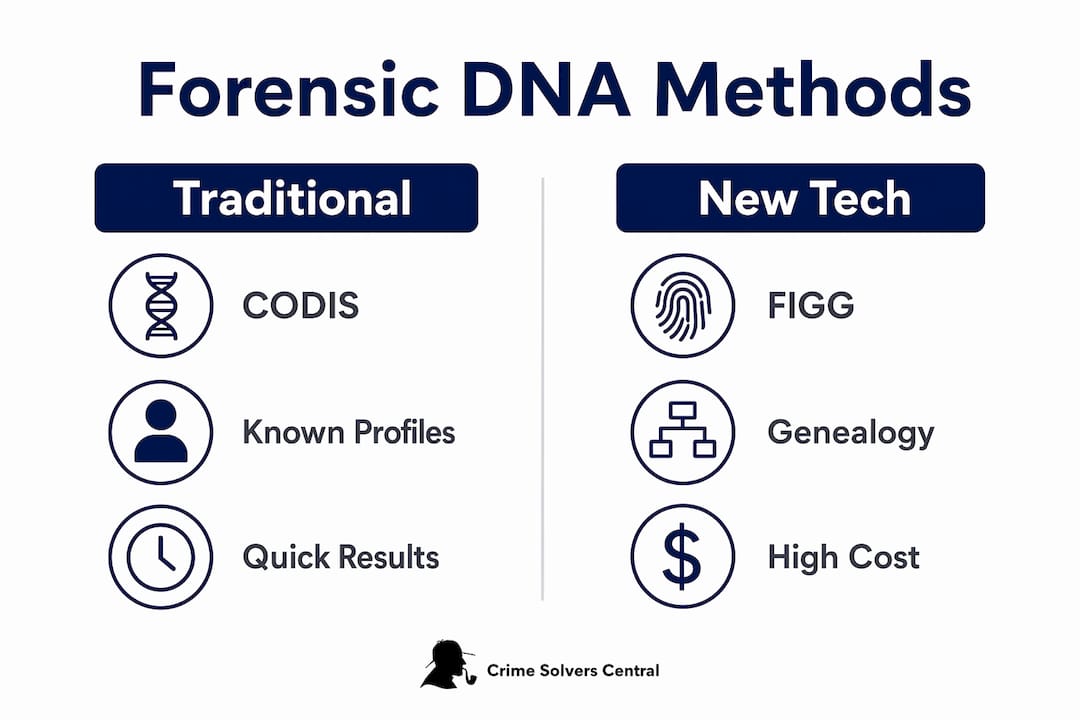
Forensic Investigative Genetic Genealogy (FIGG) fills that gap. FIGG uses consumer genealogy databases to triangulate potential suspects through shared DNA relatives. It does not produce an arrest on its own. Officials warn that FIGG is a triage step that must be followed by traditional investigative work: interviews, surveillance, and warrants. Think of FIGG as a compass, not a conviction.
| Method | Best Use Case | Key Limitation |
|---|---|---|
| CODIS | Matching known offender profiles | Requires existing profile in database |
| FIGG | Generating leads when CODIS fails | Needs corroboration through investigation |
| Traditional DNA | Confirming suspect identity | Requires a suspect to test |
Cost is the biggest barrier to FIGG. A single FIGG analysis can run tens of thousands of dollars. Nonprofits are solving this problem directly. The nonprofit started by Kaylee Goncalves’s parents funds DNA work and forensic genealogy by partnering with labs nationwide. That model gives families without law enforcement support a path forward. You can replicate it by partnering with existing forensic nonprofits or launching a targeted fundraising campaign with a specific DNA testing goal.
Pro Tip: Before funding FIGG testing, confirm with the investigating agency that they will act on the leads it generates. FIGG without law enforcement follow-through produces leads that go nowhere.
What are best practices for community awareness events?
Community events are the emotional infrastructure of any cold case campaign. They remind the public that a real person is waiting for justice and that the community has not forgotten.
The “Thaw the Cold Cases” annual walk brings families and neighbors together to honor unsolved victims alongside Cold Case Task Forces. Families bring photos and posters. Law enforcement attends. Media covers it. That combination creates a feedback loop of attention and accountability.
Follow these steps to organize an effective awareness event:
- Choose a meaningful date. The victim’s birthday, the anniversary of their disappearance, or a nationally recognized day like National Missing Persons Day (May 25) gives media a reason to show up.
- Prepare visual materials. Large printed photos, banners with tip line numbers, and flyers with case details make the event photographable and shareable on social media.
- Invite law enforcement. A detective or cold case unit representative attending signals that the investigation is still active. Their presence also reassures the public that tips will be acted on.
- Partner with a nonprofit. Organizations like the Reopen the Case Foundation can co-sponsor events, provide logistical support, and extend your reach to their existing networks.
- End with a concrete ask. Close every event with a specific call for information. Read the tip line number aloud. Display it on every printed material. Give attendees one clear action to take.
Families who attend these events consistently report that the communal support reduces isolation and sustains their motivation to keep pushing. That emotional resilience is not a side benefit. It is what keeps long-term campaigns alive.
You can also use public records research to prepare detailed case summaries for event attendees, giving the public specific, verifiable details that sharpen their memories.
How can anniversary campaigns and podcasts generate real leads?
Anniversary campaigns and media storytelling are the two most reliable pipelines for generating witness cooperation in cold cases. Used together, they create compounding momentum.
The Justice for Melanie campaign, run by Avon and Somerset Police, demonstrates exactly how this works. The campaign leverages the 30th anniversary of Melanie Hall’s disappearance with local ads, public venue placements, and a specific historical anchor: Euro 96. By asking the public to recall what they were doing during that tournament, investigators anchor memory to a specific, emotionally vivid time period. That technique dramatically improves tip quality.
Law enforcement also applied new forensic technologies to Melanie Hall’s case archives as part of the campaign. Refreshing old evidence with current tools signals to the public that the investigation is genuinely active, not just ceremonial.
Podcasts operate on a similar principle but reach a national audience. The Who Killed Roxanne? podcast led to new evidence and arrests in a 1982 cold case. The podcast did not just tell the story. It repeatedly requested tips and information across multiple episodes, building an evidence pipeline over time. Successful cold case media projects treat tip solicitation as a recurring feature, not a one-episode ask.
Key tactics for anniversary and media campaigns:
- Set a specific date window. A 30-day campaign around an anniversary gives media multiple opportunities to cover the story.
- Use historical anchors. Connect the case to a public event the audience remembers: a sports championship, a local festival, a major news event from that year.
- Repeat the ask. Persistence and public cooperation are the primary drivers of cold case resolution. One request is not enough.
- Link every campaign to explicit tip channels. Structured, date-specific campaigns with clear police portal and anonymous tip options generate more usable leads than general awareness posts.
- Archive all media coverage. Build a press kit from each campaign cycle to use in future outreach and grant applications.
| Campaign Element | Purpose | Example |
|---|---|---|
| Anniversary date anchor | Triggers public memory recall | Justice for Melanie, 30th anniversary |
| Historical event tie-in | Sharpens memory specificity | Euro 96 reference |
| Podcast series | Builds national witness pipeline | Who Killed Roxanne? |
| Explicit tip channels | Converts awareness to leads | Police portal, Crime Stoppers |
Key takeaways
Sustained, structured visibility campaigns combined with forensic tools and community collaboration are the proven path to justice for overlooked cold case victims.
| Point | Details |
|---|---|
| Lead with storytelling | Partner with media and podcasters to build an ongoing evidence pipeline, not a one-time story. |
| Use FIGG strategically | Forensic genealogy generates leads but requires law enforcement follow-through to produce results. |
| Anchor campaigns to dates | Anniversary-based prompts with historical tie-ins sharpen public memory and improve tip quality. |
| Events need a concrete ask | Every awareness walk or vigil must end with a specific, easy-to-act-on tip submission request. |
| Persistence is the deciding factor | Repeated, coordinated outreach over months and years solves cold cases. Single efforts rarely do. |
What i have learned after years of watching cold cases move forward
The advocates who get results are not the loudest. They are the most organized. I have watched families pour enormous energy into a single viral post, get a week of attention, and then watch the case go cold again because there was no follow-up structure. The families who see real movement are the ones who treat their campaign like a project with a timeline, assigned roles, and quarterly milestones.
The DNA conversation needs a reality check. Forensic genealogy is genuinely powerful, but the expectation that it produces a quick arrest is a myth that sets families up for devastating disappointment. FIGG gives investigators a lead. That lead still requires months of traditional detective work. Families who understand this going in sustain their advocacy longer because they are not waiting for a single breakthrough moment.
The detail that surprises most people: one small, concrete memory from a witness can break a case open. A car color. A face at a bus stop. A conversation overheard at a bar. Campaigns that ask the public for small, specific details get better tips than campaigns asking for “anything you know.” Specificity is a strategy.
The collaboration piece is non-negotiable. Families’ persistence combined with community and law enforcement collaboration is what actually pushes cold cases forward. No single actor moves these cases alone. The families who build real coalitions, including advocates, journalists, forensic experts, and law enforcement contacts, are the ones who eventually get answers.
— Crime
How Crimesolverscentral supports your cold case advocacy
Crimesolverscentral is built specifically for advocates, families, and community members who refuse to let cases go cold. The platform hosts a national cold case database covering over 264,913 cases, organized by state and situation, so you can locate specific cases, identify patterns, and connect with others working on similar investigations. Every case in the database represents a family still waiting for answers. Crimesolverscentral also supports community members through membership options, fundraising tools, and health and safety initiatives. If you are building a visibility campaign or need to document a case for media outreach, start with the database. It is the most direct way to keep forgotten victims visible and connected to the resources that move investigations forward.
FAQ
What does it mean to amplify overlooked cold case victims?
Amplifying overlooked cold case victims means using sustained storytelling, public campaigns, and forensic tools to keep forgotten victims visible until new leads and justice emerge. It is an ongoing effort, not a single announcement.
How do podcasts help solve cold cases?
Podcasts like Who Killed Roxanne? build evidence pipelines by repeatedly requesting tips across multiple episodes, which has led directly to arrests in cases cold for decades.
What is FIGG and how does it help cold cases?
Forensic Investigative Genetic Genealogy (FIGG) uses consumer genealogy databases to generate investigative leads when CODIS finds no direct DNA match. It requires follow-up investigation before it can support an arrest.
How do anniversary campaigns generate better tips?
Anniversary campaigns tied to specific historical anchors, like the Justice for Melanie campaign’s use of Euro 96, prompt the public to recall precise memories from a defined time period, which improves the quality and specificity of tips received.
Can families fund their own DNA testing for cold cases?
Yes. Nonprofits like the one started by Kaylee Goncalves’s parents fund forensic genealogy testing by partnering with labs nationwide, giving families a path forward when law enforcement resources are limited.