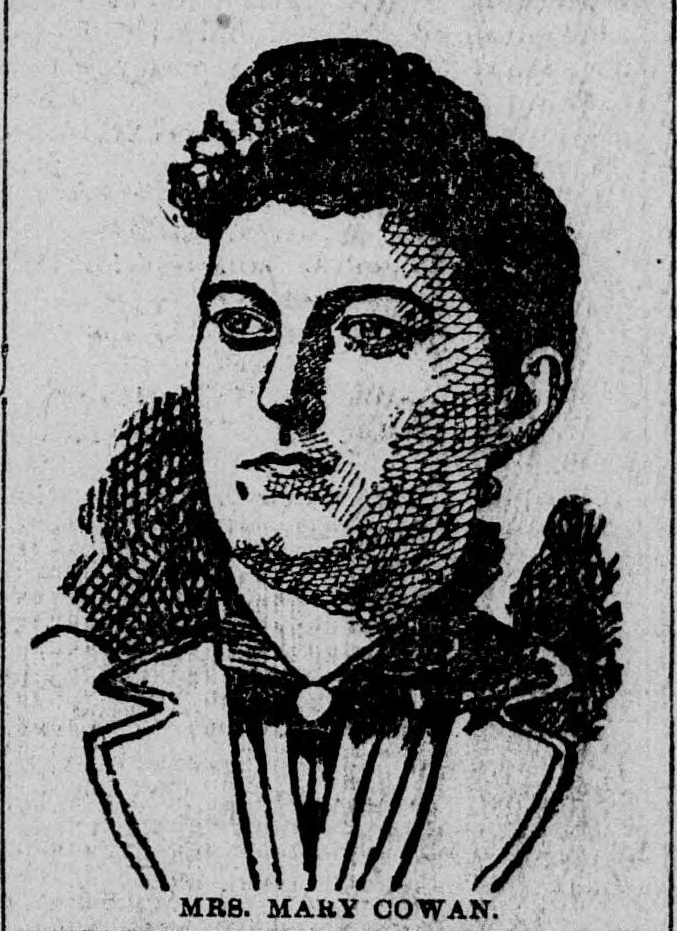
Mary Cowan: The "Borgia of Maine"
Overview
Mary A. Cowan, born Mary A. Knight in Plymouth, Maine, in 1863, became one of the most notorious suspected poisoners in nineteenth-century New England. Newspapers eventually called her the "Borgia of Maine," comparing her to the legendary reputation of the Renaissance Borgia family for poisoning. Between 1884 and 1894, three of Cowan's children, two of her husbands, and a stepson died under circumstances that later drew intense suspicion. Her third husband also became seriously ill but survived. Although later accounts routinely describe Cowan as a serial killer responsible for six deaths, an important distinction remains: she was prosecuted and convicted for only one murder, that of her eight-year-old stepson, Willis Cowan. The other five deaths were retrospectively attributed to or strongly suspected of involving her, but they were never proved against her in court.
Early Life and Marriage to Willis Bean
Mary was born Mary A. Knight on March 8, 1863, in Plymouth, Maine. As a young woman she married Willis W. Bean, a farmer from nearby Dixmont. The couple had three daughters, generally identified in later accounts as Gracie or Grace, Alice, and Mabel Bean. Willis reportedly hoped to become a physician, and Mary was said to have shared an interest in studying medicine. Their limited finances made that ambition difficult, and contemporary accounts later suggested that the responsibilities of raising three small children were viewed as another obstacle to their plans.
The succession of deaths that would eventually make Mary notorious began among those children. At the time, however, there was no criminal case against her. Rural Maine communities in the 1880s had far fewer forensic resources than would exist later, childhood mortality was significantly higher, and deaths that might attract immediate investigation today could pass without an autopsy or toxicological examination.
The Deaths of the Bean Children
In 1884, young Gracie Bean was found dead in bed. Historical accounts described the child as having been smothered. A neighbor was said to have discovered her and informed Mary, only to receive an unusually detached response indicating that Mary already knew the child had been dead for some time. Residents reportedly became suspicious, but no formal investigation established that Gracie had been deliberately killed.
Alice and Mabel Bean subsequently died after suffering what contemporary accounts called stomach complaints or peculiar stomach pains. Later histories place Alice's death in 1884 and Mabel's in 1885. Neither child's remains were subjected at the time to the kind of chemical examination that later proved decisive in the Willis Cowan case. As a result, it cannot be stated with the same certainty that arsenic caused their deaths. Their deaths became significant only years later, when another child in Mary's household died with similar symptoms and arsenic was actually detected.
The Death of Willis W. Bean
After the deaths of their daughters, Willis Bean continued pursuing his desire to enter medicine. Historical accounts state that he and Mary eventually traveled to Ohio to attend an institution where they hoped to obtain medical training or credentials. Before leaving Maine, arrangements had been made involving a farm purchased with assistance from Bean's parents. The deed was reportedly in Willis's name or under the couple's control, while a mortgage protecting the elder Beans' financial interest was never formally recorded.
In 1888, Willis Bean suddenly died in Ohio. His family learned of his death through a communication from Mary. Reports described the illness as a severe stomach disorder resembling the illnesses that had preceded the deaths of two of the Bean children. The surviving record does not establish a dependable exact calendar day for Bean's death, so the year 1888 is the most responsible date to use. No arsenic test from his remains is known to have established poisoning at the time.
Mary returned to Maine after Bean's death. According to later newspaper accounts, the unrecorded mortgage connected with the Bean family farm disappeared. Because Mary had legal control of the deed, she was able to sell the property for approximately $2,000, a substantial sum for the period. This financial episode later became part of the argument that several deaths surrounding Mary may have benefited her materially, although it was not itself proof that she had murdered Willis.
Marriage to George H. Taylor
Mary next married George H. Taylor, a Dixmont man who worked in the Lewiston area. Taylor belonged to the Independent Order of Odd Fellows. Their marriage was comparatively brief. In 1891, Taylor became violently ill with acute stomach pain and died after several days of suffering. The similarity to the gastrointestinal illnesses associated with members of the Bean family would appear increasingly ominous in retrospect.
It was apparently believed that Taylor carried benefits through his fraternal organization, but his dues had not been maintained and the expected insurance was unavailable. Members of the organization nevertheless raised several hundred dollars for his widow. Taylor's death was not prosecuted as a homicide, and no surviving forensic finding proves that he was poisoned. Nevertheless, once Mary's later crimes were investigated, Taylor became one of the five earlier deaths widely suspected of being part of the same pattern.
Marriage to Elias Cowan
Mary's third husband was Elias Cowan, a widowed farmer who had an eight-year-old son named Willis. After the marriage, additional unusual events reportedly surrounded the household. A group of farm buildings belonging to Elias was destroyed by fire. Neighbors who arrived during the emergency later claimed that some household belongings appeared to have been bundled and prepared for removal before the buildings burned. No murder conviction resulted from the fire, but the episode became another suspicious element in accounts of Mary's life.
More importantly, Elias himself became seriously ill with stomach symptoms resembling those that had preceded several earlier deaths. He survived. Later reports alleged that Mary had believed she would benefit from property owned by her husband, although questions concerning ownership and inheritance complicated that assumption. Elias's survival meant that no homicide charge could arise from his illness, but investigators later considered the episode highly suspicious.
The Murder of Willis Cowan
The death that finally brought Mary Cowan into the criminal justice system was that of her eight-year-old stepson, Willis Cowan. Historical newspaper accounts generally place his fatal illness and death in September 1894. Modern reconstructions commonly give September 14, 1894, as the beginning of his final illness and September 16, 1894, as the date of his death. An official Maine Attorney General's report later described the murder as having occurred in August 1894, creating a conflict in the surviving historical record. For that reason, September 1894 is the most cautiously stated period for his death, with September 16 being the date most often given in detailed modern accounts.
Willis reportedly became desperately ill after eating green apples. His symptoms included severe abdominal distress. A physician was called and initially expected the boy to recover, but his condition worsened and he died after a short illness. In isolation, such an episode could have appeared to be a natural gastrointestinal illness. Against the background of Mary's children and husbands repeatedly developing similar symptoms, however, the death produced much greater suspicion.
Authorities eventually exhumed Willis's body. His stomach and intestines were submitted for chemical examination associated with Bowdoin College in Brunswick, Maine. Unlike the earlier family deaths, this case produced physical evidence. Arsenic was detected in the boy's remains in an amount described by contemporary newspapers as extraordinarily large. The discovery transformed neighborhood suspicions about Mary Cowan into a murder prosecution.
Evidence Against Mary Cowan
The poisoning evidence was strengthened by testimony concerning Mary's conduct during Willis's illness. One story repeatedly reported after the trial concerned a neighborhood girl who allegedly saw Mary place a white powder into medicine that had been prepared for the boy. According to later accounts, the girl's father refused to allow her to testify because he feared what could happen if Mary were acquitted. Whether or not every detail of that later story can be independently reconstructed, the prosecution possessed enough evidence concerning arsenic and Mary's access to the child to convince a jury that Willis's death had been deliberate.
The suspicious illnesses surrounding Mary's previous families also created a powerful circumstantial background. Three daughters had died while very young. Her first husband had died after stomach trouble. Her second husband had died after another acute stomach illness. Elias Cowan had become similarly sick but survived. Finally, Elias's son died and arsenic was found in his remains. The previous deaths were not separate murder charges at her trial, but the pattern ensured that Mary's case attracted sensational newspaper attention.
Trial and Conviction
Mary Cowan was indicted for the murder of her stepson and tried in Penobscot County during the February 1895 term of court. The Maine Attorney General's official report recorded Willis as eight years old and identified Dixmont as the location of the murder. Mary was represented by attorneys Patrick H. Gillin and John F. Robinson.
Mary denied being a murderer, but the prosecution emphasized the arsenic discovered after Willis's exhumation and the circumstances under which the poison must have entered his body. On March 2, 1895, the jury returned a verdict finding Mary Cowan guilty of murder in the first degree. Her attorneys pursued post-trial proceedings, delaying the final resolution of the case. She was ultimately sentenced to imprisonment at hard labor for life.
The conviction was specifically for the murder of Willis Cowan. Mary was never convicted of murdering Gracie, Alice, Mabel, Willis Bean, or George Taylor. Later newspapers nevertheless treated those deaths as probable earlier victims and portrayed the Willis Cowan murder as the crime that finally exposed a decade-long pattern of poisoning.
Victims and Deaths Attributed to Mary Cowan
- Gracie "Grace" Bean — 1884 — Dixmont/Plymouth area, Maine: Mary's young daughter was found dead in bed and was described in historical accounts as having been smothered. Neighbors reportedly suspected Mary, but no homicide prosecution or forensic investigation established the cause as murder. The surviving sources support the year 1884 but do not provide a sufficiently reliable exact day of death.
- Alice Bean — 1884 — Maine: One of Mary's daughters, Alice died while still a small child after developing a severe or unusual stomach complaint. Her death was not investigated as poisoning at the time. Later accounts identified her as a suspected victim after the arsenic murder of Willis Cowan was uncovered. The year 1884 is reported, but a reliable exact day has not been established in the surviving sources reviewed.
- Mabel Bean — 1885 — Maine: Mary's daughter Mabel also died following stomach symptoms similar to those suffered by Alice. No toxicological examination connected her death to arsenic at the time. Later writers included her among Cowan's suspected victims. The year 1885 is reported, while a dependable exact date is not established.
- Willis W. Bean — 1888 — Ohio: Mary's first husband died suddenly while the couple was in Ohio pursuing medical studies or credentials. Reports stated that he suffered stomach trouble resembling the illnesses that preceded the deaths of two of their children. His death later became regarded as suspicious, particularly because Mary subsequently obtained control of valuable property. The historical record supports 1888, but the frequently mentioned January 6 date concerns the communication of his death to relatives and should not automatically be treated as his verified date of death.
- George H. Taylor — 1891 — Lewiston area, Maine: Mary's second husband became acutely ill and died after approximately four days of severe stomach pain. His Odd Fellows benefits had apparently lapsed, although members collected money to assist Mary after his death. Taylor was later considered a suspected poisoning victim. A reliable exact day of death has not been firmly established in the accessible historical record.
- Willis Cowan — September 1894, commonly reported as September 16, 1894 — Dixmont, Maine: Mary's eight-year-old stepson developed severe stomach pain and died after a short illness. His body was exhumed, and chemical testing discovered a lethal quantity of arsenic. This was the only death for which Mary Cowan was tried and convicted of murder. Modern accounts commonly place his death on September 16, although an official Maine Attorney General's report later described the murder as occurring in August 1894, leaving an archival discrepancy concerning the precise date.
Elias Cowan: The Surviving Suspected Victim
Elias Cowan, Mary's third husband and Willis's father, survived an illness that later generated accusations that Mary had attempted to poison him as well. He reportedly experienced the same general type of severe stomach trouble seen repeatedly in the other cases. According to later newspaper accounts, a local physician familiar with the deaths associated with Mary warned that another suspicious death would provoke an investigation. Elias eventually recovered.
The alleged motive described in contemporary reporting involved property. Mary was said to have misunderstood exactly how ownership of the Cowan farm would pass after a death. Young Willis possessed an important inheritance interest, creating a possible financial reason for eliminating the child after Elias survived. Motive evidence from nineteenth-century newspaper accounts must be treated carefully, but questions involving farms, deeds, inheritance, insurance, and financial contributions appeared repeatedly throughout Mary's relationships.
A Pattern of Poisoning
Arsenic was a particularly feared poison during the nineteenth century because it was readily obtainable and its symptoms could resemble naturally occurring gastrointestinal diseases. Abdominal pain, vomiting, weakness, and other digestive symptoms could initially be attributed to contaminated food or ordinary illness. In an era before routine toxicology, a poisoner operating within a household could exploit that uncertainty.
In Mary Cowan's case, however, arsenic was conclusively demonstrated only in the investigation of Willis Cowan. It is tempting to apply that finding backward to every earlier death, especially because several victims reportedly suffered similar stomach symptoms, but doing so would go beyond what the surviving forensic evidence proves. Her historical reputation as a six-victim serial killer is therefore based on one proven arsenic murder combined with five earlier deaths that contemporaries and later historians regarded as suspicious.
The "Borgia of Maine"
Once the case became public, newspapers transformed Mary Cowan from an obscure rural Maine woman into a nationally discussed murder defendant. The nickname "Borgia of Maine" reflected the nineteenth-century press tradition of comparing female poisoners to the infamous popular image of Lucrezia Borgia. Reports emphasized Mary's marriages, the deaths of her children, financial dealings after the deaths of her husbands, and the extraordinary quantity of arsenic detected in young Willis.
Later syndicated newspaper stories went even further, portraying the six deaths surrounding her as a single murderous career. One retrospective article published after Mary's own death openly acknowledged the uncertainty by presenting her as either an extraordinary murderer or the victim of an extraordinary chain of coincidences. What could no longer reasonably be dismissed as coincidence was the death of Willis Cowan: arsenic was found in his remains, prosecutors established deliberate poisoning to the satisfaction of a jury, and Mary was convicted of first-degree murder.
Life in Prison and Death
Mary maintained her innocence after conviction. She reportedly told journalists that evidence existed that could clear her and continued to hope that she might eventually be released. Those hopes were never realized. She was confined at the Maine State Prison in Thomaston under a life sentence.
By 1898, Mary's health had seriously deteriorated. The prison physician later reported that her illness had continued for more than a year. Efforts were made to obtain clemency so that she might spend her remaining time outside prison, but she remained incarcerated. Mary Cowan died at the Maine State Prison on September 17, 1898, at approximately thirty-five years of age. The prison's official annual report confirmed that she was one of two prisoner deaths during that reporting year.
Historical Assessment
Mary Cowan remains a disturbing example of how difficult nineteenth-century poisoning cases can be to reconstruct. Her reputation rests on a striking sequence: three children died, then a husband, then another husband; a third husband became gravely ill; and finally his eight-year-old son died with a large quantity of arsenic in his body. That final death provided the evidence that the earlier cases had lacked.
For historical accuracy, Mary Cowan should therefore be described as a convicted murderer and suspected serial poisoner associated with six deaths rather than simply treating every attributed victim as forensically confirmed. Willis Cowan was her proven murder victim. Gracie Bean, Alice Bean, Mabel Bean, Willis W. Bean, and George H. Taylor were deaths later attributed to or strongly suspected of having been caused by Mary, but no separate convictions established her responsibility for them. Even with that distinction, the sequence of suspicious deaths surrounding one household after another ensured that the woman remembered as the "Borgia of Maine" became one of the most infamous alleged poisoners in Maine history.