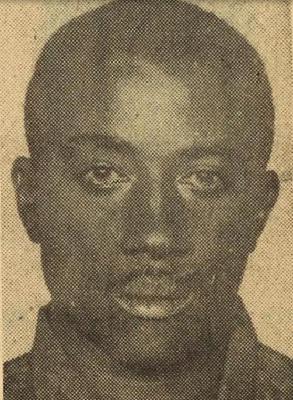
Alphonse Manning Jr., a 23-year-old Black / African American man, was killed on August 7, 1977, in the parking lot of East Towne Mall in Madison, Wisconsin. He was with 23-year-old Toni Schwenn when an encounter with another motorist abruptly turned deadly. The killings initially appeared to have grown out of a minor traffic confrontation, but years later investigators learned that the gunman was Joseph Paul Franklin, a violent white supremacist whose racial hatred was central to the attack.
According to Franklin's later confession, he had traveled to Madison intending to assassinate former Dane County Judge Archie Simonson because of Franklin's anger over a controversial court case involving Black defendants and a white female complainant. Franklin stopped at East Towne Mall, where Manning's white Oldsmobile Toronado backed into or across his path as the vehicles were leaving the parking area. Franklin claimed that he became irritated, sounded his horn, and watched as Manning stopped and began walking toward his vehicle. A police car was nearby, and Franklin was carrying stolen firearms as well as explosives connected to other crimes. Fearing that a confrontation might lead to his arrest and discovery of those items, Franklin decided instead to open fire.
Franklin used a. 357 Magnum and fired at Manning from his vehicle, striking him in the midsection. When Manning remained standing, Franklin got out and shot him again. He then approached the Toronado and fired through the closed window at Schwenn. After she got out or fell from the vehicle, Franklin returned and shot her again before fleeing the mall parking lot. Witnesses scattered behind vehicles as the gunfire erupted. One witness, Vicky Johnson, later recalled running toward the scene after initially mistaking the shots for firecrackers. She saw Franklin holding the gun and found herself standing near Manning, who was calling for help as he was dying.
The double homicide initially went unsolved. Police did not identify Franklin as a suspect in 1977, and after several years the investigation was closed. Investigators considered other possibilities, including Schwenn's former boyfriend, who became a prime suspect after he was found hours after the killings handling a revolver. He maintained that he had been aboard an airplane when the shooting occurred. Years later, investigators located other passengers and corroborated his account, clearing an important alternative suspect that had not been fully eliminated during the original investigation.
The case changed dramatically in 1984. Franklin was then imprisoned at the federal penitentiary in Marion, Illinois, serving multiple life sentences for the 1980 murders of two Black men in Utah. He contacted Madison authorities and offered to confess to the East Towne Mall killings. Two Madison detectives traveled to Marion in February 1984 and recorded a detailed statement from him. Franklin admitted killing Manning and Schwenn and described circumstances and injuries that prosecutors later argued contained information unavailable in published accounts. Authorities charged him with two counts of first-degree murder.
Because prosecutors anticipated that Franklin might withdraw his confession, investigators rebuilt the old case rather than relying solely on his statement. Madison investigator Ted Mell, working with assistance from federal agencies, traced Franklin's account of obtaining the weapon to an Alabama sporting-goods store where a firearm fitting his description had disappeared from inventory in 1977. Ballistics specialists determined that such a weapon could have produced the markings found on bullets recovered from the victims. Investigators also rediscovered Vicky Johnson, who had given police her name at the crime scene but inexplicably had not been formally interviewed during the original investigation. Seven years later, she identified Franklin as the gunman she had seen in the parking lot.
Additional evidence placed Franklin in Madison. A bank teller from Columbus, Ohio, identified him as the man who had robbed her bank shortly before he traveled to Wisconsin, corroborating portions of his confession concerning his movements and criminal activity. A handwriting expert also linked Franklin to a Madison motel registration made under the alias "John Wesley Harding." Investigators reviewed the earlier suspects and their alibis so the defense could not plausibly redirect suspicion toward someone who had already been ruled out.
Franklin was transferred from the federal prison in Marion to the Dane County Jail on November 6, 1985. He pleaded not guilty and was permitted to represent himself, with attorney William Olson appointed as standby counsel. His trial began February 10, 1986, and lasted five days. Franklin repudiated his confession, telling jurors that he had fabricated it in hopes of getting transferred out of the federal penitentiary. Prosecutors countered with the recording itself, Johnson's eyewitness identification, forensic evidence, the bank teller's testimony, handwriting evidence and details from the confession that they argued only the killer would have known. Franklin called no witnesses in his defense.
The Dane County jury rejected Franklin's recantation and found him guilty of two counts of first-degree murder. After deliberating for little more than an hour, jurors returned guilty verdicts for the killings of Manning and Schwenn. Judge William D. Byrne immediately imposed two consecutive life sentences, adding them to the life terms Franklin was already serving for other murders, and Franklin was returned to federal custody.
The convictions brought an end to nearly nine years of uncertainty for Manning's family. Franklin's own statements, eyewitness testimony and the reconstructed physical evidence established that the East Towne Mall shootings were not simply the unexplained result of a parking-lot disagreement. Prosecutors presented the killings as racially motivated violence committed by a man whose broader series of attacks repeatedly targeted Black people, Jewish people and interracial couples. Franklin was ultimately held criminally responsible in Dane County for both deaths and sentenced to spend two additional consecutive life terms in prison.