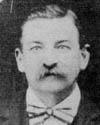
Page Campbell Marstiller, a 47-year-old White male, was serving as chief of police in Elkins, West Virginia, when a confrontation with Wilfred Davis ended in his death on April 11, 1902. Marstiller had only recently been chosen for the police post, and he and Davis already had a history. Years earlier, while Marstiller was working as a constable in the Hazlewood area, he had been involved in an incident that resulted in Davis being sent to the West Virginia Reform School.
By the spring of 1902, Davis was working in the timber industry near Davis, in Tucker County. A detailed local account states that Davis came to Elkins on April 10 after learning that Marstiller had become chief and that, by the following morning, he was drinking heavily and making statements about causing trouble if an officer tried to arrest him. The same account says he purchased a revolver and ammunition at a local hardware store and later fired shots into the air as his drinking continued.
As reports of Davis's behavior spread through Elkins, Mayor Woodford became concerned enough to arrange additional police assistance and warn Marstiller not to attempt an arrest without help. Late that morning, Marstiller encountered Davis and his brother Cowen near Griffith's Saloon in South Elkins. Marstiller informed Davis that he was under arrest after receiving information that he was carrying a weapon. Davis denied having a gun, and a search apparently failed to reveal one. Cowen offered to take his brother home, but Marstiller decided that placing Davis in the lockup was the safer course. Cowen and another person accompanied them toward the South Elkins jail. A contemporary newspaper account likewise reported that Davis initially appeared willing to accompany the chief and did not seriously resist until they reached the vicinity of the jail.
At the jail entrance, the situation abruptly changed. Davis refused to go any farther and warned Marstiller to release him. When Marstiller moved to compel him into custody, Davis produced a concealed revolver and fired at extremely close range. The bullet struck Marstiller in the head just above the left ear. One reconstruction of the killing says Marstiller had been reaching into his pocket, possibly for handcuffs, when Davis fired. Later testimony became important because Davis claimed that he had seen something bright in Marstiller's hand or pocket and believed the chief was drawing a weapon. The state's case rejected that explanation, and the evidence ultimately indicated that the object Marstiller was reaching for was a restraint used to complete the arrest.
Davis immediately fled from the jail area. Local accounts describe him moving south and then toward the railroad while officers and citizens organized a pursuit. Marstiller, meanwhile, was found badly wounded and bleeding. Dr. W. W. Golden attended him, and he was taken to his home on High Street, where he died at approximately 5:00 that afternoon. A posse followed Davis's tracks through fresh snow and eventually located him hiding beneath or near a sycamore. After shots were fired during the confrontation, he stopped attempting to escape and was disarmed. He was taken before Justice E. E. Taylor shortly before 2:00 p.m., where he reportedly maintained that he had been so intoxicated that he did not know what he was doing.
Davis's capture did not immediately end the danger. News of the shooting brought an enraged crowd into Elkins, and a contemporary report estimated that roughly 1,000 people surrounded the officers while demands were made to lynch the prisoner. Authorities moved quickly to prevent mob violence. Davis waived a preliminary hearing and was hurried to a train, then transported to Philippi and placed in jail there for safekeeping. The decision removed him from Elkins before the crowd could seize him and ensured that the killing would proceed through the courts rather than through vigilante retaliation.
Cowen Davis also came under suspicion in the immediate aftermath. Because Wilfred Davis had reportedly been searched before being taken to the jail yet somehow possessed the revolver when the shooting occurred, some people suspected that Cowen might have passed the weapon back to him during the walk or at the jail. Cowen was arrested and confined at Beverly while authorities investigated that possibility. Investigators, however, were unable to establish sufficient evidence that he had supplied the gun or participated in the killing, and he was released. The surviving online accounts do not show that Cowen was prosecuted or convicted in connection with Marstiller's death. Wilfred Davis remained the person formally charged and prosecuted for the homicide.
The case against Davis moved rapidly. He was convicted in Randolph County of first-degree murder, and the state execution record gives May 8, 1902, as the date of his sentence. The judgment called for death by hanging. His defense then appealed to the Supreme Court of Appeals of West Virginia, raising several arguments that went directly to what had happened on April 11. One was that his extreme intoxication should have prevented the jury from finding the deliberation and premeditation necessary for the highest degree of murder. Another challenged Marstiller's authority to make the arrest without a warrant. A third sought to support a theory of self-defense based on Davis's assertion that he thought Marstiller was reaching for a gun.
On December 6, 1902, the Supreme Court of Appeals rejected those arguments and affirmed the conviction. The court concluded that the evidence of Davis being publicly intoxicated and carrying a revolver provided grounds for an officer to arrest him without first obtaining a warrant. It also held that the circumstances did not reasonably support Davis's claim that he believed he was in danger of being shot by Marstiller. The court acknowledged evidence that Davis had been drinking but found no basis for overturning the jury's determination that the killing had been willful, deliberate and premeditated. With the conviction affirmed, the principal legal avenue for avoiding the death sentence had failed.
Several stays postponed the execution while further efforts were made on Davis's behalf, but those efforts ultimately failed. Local historical accounts state that Governor Albert B. White declined to grant further clemency. Davis was transferred to the West Virginia State Penitentiary at Moundsville, where the sentence was carried out on June 5, 1903. West Virginia's official execution records list Wilfred Davis as having been condemned in Randolph County for murder, sentenced on May 8, 1902, and executed by hanging on that date in June of the following year. Thus, the investigation into Marstiller's killing produced a rapid capture of the principal suspect, a temporary arrest of a second person who was released for lack of evidence, a first-degree murder conviction that survived appellate review, and the eventual execution of the convicted killer.