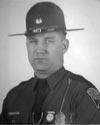
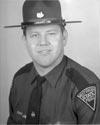
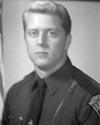
Senior Trooper Larry Gene Hacker, a 34-year-old White male, was a member of the West Virginia State Police whose final call began on the night of April 8, 1993, in rural Ritchie County. Although some records list April 8 as the date associated with his death, official memorial and legislative records place his end of watch on April 9, after he survived long enough to be transported to a hospital following the shooting. Hacker was assigned to the Harrisville detachment and was accompanied that night by Trooper S.J. Verdow, a recently graduated trooper whom Hacker was training.
The officers had been dispatched to an area near Pullman to investigate what initially appeared to be a relatively routine dispute between neighbors. Jack Langford had contacted authorities after his neighbor, Dennis Ferguson, reportedly parked a pickup truck on Ritchie County Route 9-9 in a manner that blocked Langford from reaching his home.
Authorities were already familiar with tensions between Ferguson and the Langford family. Ritchie County officials said there had been an ongoing feud between the neighbors, with previous complaints involving Ferguson allegedly entering the Langfords' property, firing weapons and at times blocking the roadway leading to their residence. On the day of the fatal confrontation, Langford's father said he had heard numerous gunshots in the area before police even arrived.
When Hacker and Verdow arrived, they approached Ferguson's residence believing they were there to resolve the property or roadway dispute. Verdow later recalled that the house appeared empty as the troopers walked toward it. Before they reached the residence, a shot suddenly rang out. Verdow saw Hacker fall but could not immediately determine where the gunfire had originated. Investigators said Ferguson had positioned himself away from the house, reportedly on higher ground from which he could observe the truck and the approaching officers. Hacker was struck by a gunshot in his left side. What had begun as a complaint over a blocked rural road rapidly turned into an extended armed confrontation.
Gunfire continued between Ferguson and responding law-enforcement officers for roughly 15 to 30 minutes as additional state troopers, sheriff's deputies and municipal officers converged on the isolated area. Ritchie County Deputy Gary Hissom exposed himself to the gunfire in order to reach Hacker and pull the wounded trooper toward safety. Even after Hacker had been hit, authorities said Ferguson's actions prevented paramedics from safely reaching him for a significant period of time. Accounts indicate medical personnel were kept away for approximately an hour while the armed standoff continued. Hacker remained alive and was reportedly conscious and at times alert while officers worked desperately to get him out of the area.
Ferguson eventually abandoned his position and fled into nearby woods. Once the immediate danger subsided, Hacker was evacuated by helicopter to Camden-Clark Memorial Hospital in Parkersburg. Contemporary reporting placed his arrival and death shortly after midnight, while later law-enforcement memorial records describe him as succumbing to his wounds around 1:00 a.m. on April 9, 1993. The West Virginia Legislature also formally records April 9 as the date on which he was killed in the line of duty.
Police continued searching the wooded area after Ferguson fled. He was apprehended roughly two hours after the shooting, reportedly around midnight, not far from the scene. Ferguson had a bleeding injury or abrasion above his right eye but had apparently not suffered a gunshot wound. He was taken to St. Joseph's Hospital in Parkersburg for treatment before being released into police custody. Authorities then lodged him in the Ritchie County Jail. Ferguson was charged with first-degree murder in Hacker's death and was ordered held without bond. A preliminary hearing was scheduled as prosecutors prepared to move the homicide case forward.
There would ultimately be no murder trial and no jury verdict. Ferguson died by suicide while incarcerated, ending the criminal prosecution before the charge against him could be adjudicated in court. Law-enforcement memorial records consequently identify the offender in Hacker's killing as having been arrested for murder but having committed suicide in jail. Because Ferguson died before trial, there was never a conviction, although contemporary police accounts identified him as the alleged gunman from the night of the shooting.
Hacker's death sent a shock through the West Virginia law-enforcement community. He had graduated from the West Virginia State Police Academy in August 1989 and had previously worked for approximately eight years as a security guard at Glenville State College before becoming a trooper. He left behind his wife, Diane, and two daughters, Erica and Julia. More than a thousand people gathered for his funeral service at Ritchie County High School, including hundreds of law-enforcement officers, Governor Gaston Caperton and representatives from several neighboring states. He was later buried at the Dobbins Family Cemetery near Cedarville in Gilmer County. Years afterward, the West Virginia Legislature memorialized his sacrifice by requesting that a bridge near Ellenboro in Ritchie County be named the West Virginia State Trooper Larry G. Hacker Memorial Bridge.