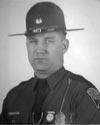
Bruce Thompson Brown was a 25-year-old White male and a trooper with the West Virginia State Police when a routine prisoner-booking procedure in Tucker County turned deadly on October 14, 1977. Brown had been with the state police for less than a year and was assigned to the Parsons Detachment. A later local history identified him as originally from Charles Town, West Virginia, where he had previously served on the municipal police force. He had a wife and two daughters, and accounts from people who knew him remembered a young trooper devoted to his family and enthusiastic about police work.
The chain of events began with the arrest of Frederick Dean Hamilton, a 19-year-old former Davis & Elkins College student who had been recruited there as a golfer before dropping out. State police arrested Hamilton in Beverly in connection with kidnapping and grand larceny allegations.
Investigators said Hamilton had held automobile salesman Robert Kamauff at gunpoint at Chaney Chevrolet in Cumberland, Maryland, forced Kamauff to accompany him toward Tucker County, and eventually released him. Hamilton was also being linked to other robberies in the region. He was placed in custody and taken to the Tucker County Jail in Parsons, where Brown and Corporal Marshall Davisson were involved in processing him.
During the booking process, Hamilton's handcuffs were temporarily removed so that he could be fingerprinted. According to the detailed local account, Hamilton suddenly grabbed Davisson's. 357 Magnum service revolver. He fired first at Davisson, but the bullet struck Davisson's metal belt buckle rather than penetrating his body. Brown then rushed toward Hamilton in an effort to stop him. Hamilton fired again, striking Brown in the chest. The wounded trooper staggered from the fingerprinting area and collapsed on a nearby landing.
The violence continued for several moments. Hamilton fired toward Tucker County Sheriff Darl Pine and narrowly missed him; a later account said the shot passed within inches of the sheriff and lodged in a wall. Pine returned fire and struck Hamilton in the leg or buttocks, bringing the struggle to an end. Once wounded, Hamilton stopped fighting and surrendered. Katherine Pine, the sheriff's wife, had heard the gunfire from elsewhere in the jail and found Brown after he collapsed. She stayed with him until medical help arrived. Brown was rushed to Tucker County Hospital suffering massive blood loss. Dr. Guy Michael later recalled that hospital personnel tried desperately to keep him alive, but the chest wound proved fatal. Brown died roughly four hours after being shot.
Hamilton was also taken to the hospital, where he remained under police guard for several days while being treated for the gunshot wound. He survived and remained in custody. The surviving records and later histories consistently identify Hamilton as the person responsible for Brown's killing; no second shooter is identified in the accounts. Local reporting describes Hamilton as having been convicted of murdering Brown, while a later federal appellate record reviewing his criminal history listed convictions arising from the October 14, 1977 crime spree that included armed robbery, aiding and abetting murder, and accessory to kidnapping. During a subsequent federal proceeding, a prosecutor explicitly referred to Hamilton's prior act of murdering Trooper Brown.
Brown's death became one of the most notorious events connected with the old Tucker County Jail. West Virginia crime reports later listed him among the state's law-enforcement officers feloniously killed in the line of duty, recording his assignment as the Parsons Detachment and his date of death as October 14, 1977. Brown was buried at Edge Hill Cemetery in Charles Town. His death also left a lasting impression on those who had encountered him shortly before the shooting, including kidnapping victim Robert Kamauff, who later recalled Brown as an officer with exceptional enthusiasm for his work.
Hamilton's imprisonment did not end his criminal history. While incarcerated, he became associated with David Mills, another prisoner at the Tucker County Jail. Authorities later alleged that Hamilton influenced Mills in a plot to kidnap Ida Mae Cooper, the wife of the mayor of Davis, as part of an effort to secure Hamilton's release. Cooper was murdered, and both Hamilton and Mills were ultimately convicted in connection with her kidnapping and killing. They received life sentences, adding to the severe punishment Hamilton was already facing for his violent offenses. Federal court records decades later described Hamilton as serving multiple life sentences for murder.
Hamilton also repeatedly attempted to escape confinement. In July 1984, while receiving medical treatment at Reynolds Memorial Hospital in Glen Dale, he escaped from the prison ward, fled down a fire escape and hid near Little Grave Creek before surrendering three days later. On February 19, 1992, Hamilton and two other prisoners escaped from the West Virginia Penitentiary. During that escape period, Hamilton broke into a home in Benwood, West Virginia, stole firearms, took resident Richard Porter hostage at gunpoint and forced Porter to drive him to Erie, Pennsylvania. Hamilton then stole another vehicle, traveled west and attempted an armed robbery at a convenience store in El Reno, Oklahoma. Oklahoma authorities apprehended him after he fled from a wrecked vehicle.
The 1992 escape generated additional federal prosecutions. Hamilton was convicted in Oklahoma of offenses involving a stolen vehicle, interference with commerce by robbery and firearms violations, receiving a lengthy federal sentence. A separate federal prosecution in West Virginia resulted in convictions for kidnapping to aid an escape and related firearms crimes; in January 1993 he was convicted on all counts and later sentenced as an armed career criminal to a total of 490 months, with that sentence ordered to run concurrently with the federal sentence imposed in Oklahoma. The Fourth Circuit affirmed the convictions and sentence in 1994. The same appellate proceedings preserved references to Hamilton's earlier convictions and to Brown's murder as part of the violent criminal history that followed him into the federal courts.
Hamilton remained imprisoned decades after Brown's killing. More recent reporting identifies him as an inmate at the high-security Mount Olive Correctional Complex in West Virginia, while the Officer Down Memorial Page describes the offender in Brown's case as ultimately apprehended and serving life without parole. Thus, the investigation into Brown's death did not remain unresolved: Hamilton was identified at the scene, wounded and taken into custody immediately after the gunfire, convicted in connection with the killing, and continued serving lengthy state and federal sentences as his subsequent escapes and crimes added further convictions to an already extensive record.