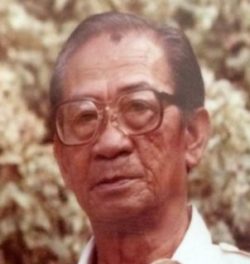
On the night of August 25, 1991, 58-year-old Santiago Domingo Dela Cruz, a man from Honolulu whose online memorial records say he was born in Ilocos Norte, Philippines, was at his family's Waipahu home when violence crashed through the door. Court records and later Honolulu reporting describe a domestic rampage set off by Orlando Ganal Sr., the estranged husband of Dela Cruz's daughter, Mabel. Neighbors heard a loud noise around 11 p.m., then a burst of gunfire.
In the chaos, Santiago Dela Cruz came out of the bedroom and confronted the intruder. He was shot almost immediately. The Hawaiʻi Supreme Court later noted that he died from multiple internal injuries caused by three gunshot wounds. His wife, Aradina Dela Cruz, was also killed in the same attack, while Mabel and the couple's son, Orlando Jr., were wounded and left alive to bear witness to what had happened inside that house.
The killing did not end with Santiago Dela Cruz. According to court records and archived Honolulu news accounts, Ganal left Waipahu and drove to Kailua, where he targeted the family of the man involved with his estranged wife. There, he carried out an arson attack that killed two small children and ultimately claimed another life, turning the night into one of Hawaiʻi's most notorious murder sprees. That larger trail of devastation helped define how Santiago Dela Cruz's death was understood in court: not as an isolated act, but as part of a deliberate, widening campaign of revenge. The state charged Orlando Ganal Sr. with first-degree murder for the deaths of Santiago and Aradina Dela Cruz and the child victims, along with other offenses tied to the shootings, threats, and fire.
There was no enduring mystery about who was responsible. Online court and news sources identify Orlando Ganal Sr. as the suspect, the arrested defendant, and the man ultimately convicted in the case. In 1993, he was sentenced to life without the possibility of parole, and the Hawaiʻi Supreme Court upheld that judgment in 1996. Later Honolulu reporting continued to list him among the state's inmates serving life terms without parole. So in the end, the story of Santiago Dela Cruz is not one of an unsolved killing drifting into silence. It is the story of a father shot down in his own home during a family rupture that exploded into mass murder, and of a case that moved from a blood-soaked hallway in Waipahu to a conviction that permanently fixed the name of his killer in Hawaiʻi court history.