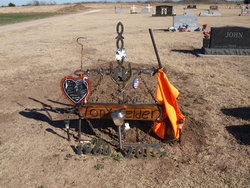
David Hadley, a 49-year-old Caucasian male from Oklahoma City, spent November 3, 2009, moving through what should have been an ordinary day, unaware that it would end in violence at a quiet intersection on the city's southwest side. Later that day, his van came to a stop near Southwest 84th Street and McKinley Avenue, an unremarkable crossing that would suddenly draw patrol cars, crime-scene tape, and hushed conversations from nearby residents. When officers arrived, they found Hadley inside his vehicle, the victim of a brutal stabbing that had ended his life there on the street rather than in the safety of his home.
The van itself was left at the scene, a stark, unmoving centerpiece in the unfolding investigation. Witnesses told authorities they had seen a man run from the vehicle shortly before police arrived, a detail that gave the homicide detectives their first fragile thread. That fleeing figure was not described as a stranger; instead, he was identified as one of Hadley's own employees, someone who would have known his routines, his vehicle, and likely his vulnerabilities. The image of the van abandoned in the intersection, and a familiar figure disappearing from view, framed the crime as something personal rather than random.
As detectives began to reconstruct Hadley's final hours, their attention turned squarely to this employee. Case summaries describe investigators linking the killing to an ongoing dispute between Hadley and the man, named as Noel Fuentes, who believed that his employer owed him money. In that telling, the argument over unpaid compensation escalated far beyond angry words, ending in the confined space of Hadley's vehicle with a stabbing so severe that it was characterized simply as “brutal,” leaving little doubt about the ferocity of the attack. The professional relationship between the two men, already strained by resentment and accusations, appears in the record as the likely motive that brought them together on that deadly day.
In the weeks and years that followed, Hadley's case settled into the difficult category of homicides that are known, discussed, and cataloged but not clearly resolved in public view. The case listing emphasizes his identity, the location where he was found, and the suspicion directed at his employee, but it does not record any arrest, trial, or conviction stemming from his death. Instead, Hadley's name remains attached to an unsparing description of a stabbing in a van at a southwest Oklahoma City intersection, a life reduced in the public record to age, cause of death, and a few lines about a disputed debt and a man seen running away into the city's streets.