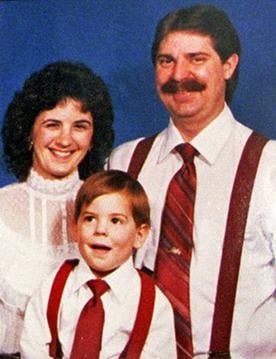
On a bright Sunday morning, the kind that beckons children outdoors, 7-year-old Melissa "Missy" Ackerman and her 8-year-old friend, Opal Horton, were enjoying a bike ride on a country road outside their small town of Somonauk, Illinois. It was June 2, 1985, just ten days before Melissa’s eighth birthday. Known for her bright smile and cheerful nature, Melissa was the beloved only child of Michael and Sheree Ackerman.
That morning's simple childhood pleasure was shattered in an instant, marking the beginning of a nightmare for her family and a loss of innocence for the quiet farming community.
A car approached the two girls, and a man, later identified as Brian James Dugan, stopped and attempted to abduct them both. He first grabbed Opal and forced her into his car. As he turned his attention to overpowering Melissa, Opal bravely managed to climb out of a window and escape, hiding in a nearby field. She watched in terror as Dugan forced Melissa into his vehicle and drove away. The traumatized girl ran to a teacher's house for help, and a massive search was immediately launched for Melissa. Hundreds of law enforcement officers and local volunteers scoured the area, holding onto a fragile hope that she would be found alive.
The day after the abduction, police arrested 28-year-old Brian Dugan at his workplace in Aurora. His capture was the result of a crucial tip and a stroke of luck. A police officer in a neighboring town recalled pulling Dugan over near Somonauk on the day of the kidnapping for an expired vehicle inspection sticker. This, combined with Opal Horton's description of the car, made him a prime suspect. While Dugan was initially held for other recent rapes in the area, the desperate search for Melissa continued. That hope was extinguished fifteen days later, on June 17, when a sheriff's deputy discovered Melissa's body hidden among boulders by a creek, about 20 miles from where she was taken. She had been sexually assaulted and drowned.
The investigation revealed that Melissa was the final victim in a violent crime spree Dugan had committed in May 1985, which included multiple rapes and another attempted abduction. He was a serial predator who had been in and out of the justice system for years. Physical evidence, including a strand of Melissa's hair found in his belongings, definitively linked him to her murder. Faced with the evidence and the prospect of the death penalty, Dugan accepted a plea deal in November 1985. He pleaded guilty to the murders of Melissa Ackerman and another victim, 27-year-old nurse Donna Schnorr, whom he had killed in 1984.
For these crimes, Dugan was sentenced to two terms of life in prison without the possibility of parole. As part of his plea negotiations, he also offered a confession to the 1983 murder of 10-year-old Jeanine Nicarico, a crime for which two other men had been wrongfully convicted and sentenced to death. It would take years and advances in DNA technology to officially indict and convict Dugan for Jeanine's murder, for which he was eventually sentenced to death in 2009. His death sentence was later commuted to a third life term when Illinois abolished capital punishment in 2011.
The passage of time has done little to erase the pain for Melissa's family. Her mother, Sheree, has spoken of the unending grief and the horrific thoughts of her daughter's final moments. "Time eases the pain, but it never goes away," she shared years later, explaining how a simple song on the radio could still bring her to tears. She has said that a mother should never have to regret letting her child ride a bike in her own neighborhood. The community of Somonauk was also forever changed, its sense of security shattered by the brutal crime.
Brian James Dugan remains incarcerated, serving multiple life sentences. While the legal case is closed, the loss of Melissa Ackerman, a bright and beloved little girl, remains a profound and lasting tragedy. Her parents' hope for justice was served, but as her father Michael has said, "Closure is just a word. It never closes."