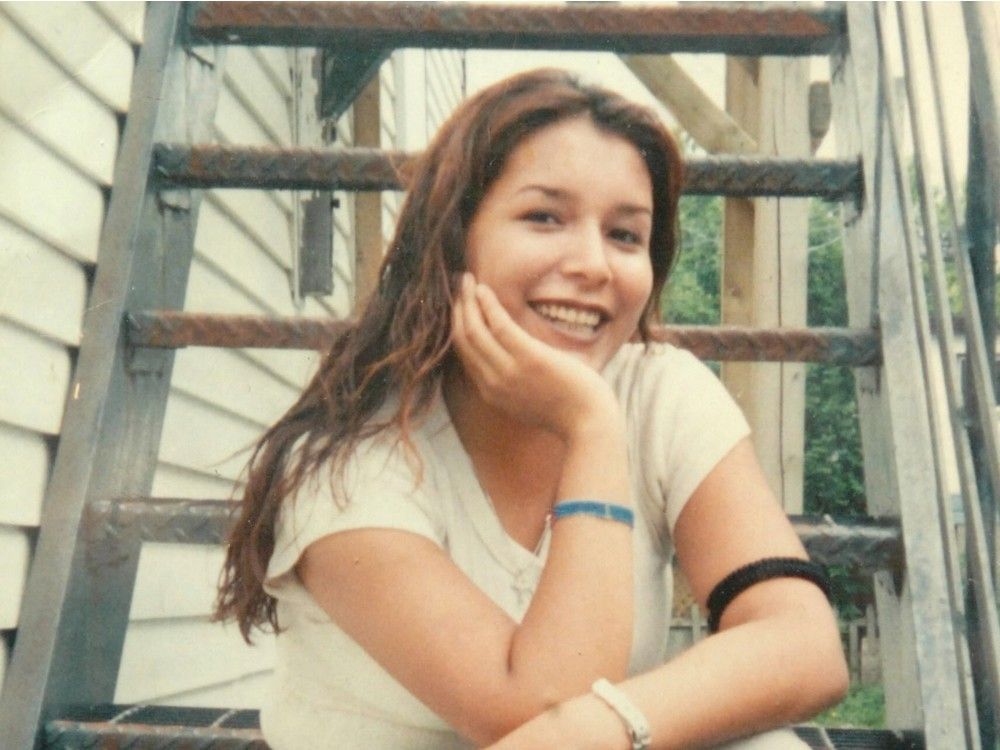
Lise Choquette, identified in detailed case records as a 30-year-old woman from Montreal, was found dead in Laval on the morning of April 22, 1975. At about 11:00 a.m., Alexandre Aube, an employee of Corrival who was working on the construction of the new Autoroute 440, discovered her body near the unfinished Vimont viaduct. She was lying in the mud roughly 275 feet behind the Quebec Ciment property at 101 Chemin Haut-Saint-François.
Investigators believed her body had not been at the site for very long before it was discovered.
Choquette had been severely assaulted and strangled. Her body was found nude, with a gray men's necktie patterned with black circles and bearing the Caporicci name pulled tightly around her neck. A small amount of blood was visible around her nose. Her clothing had been discarded separately, approximately 200 feet from where her body was found. She had no identification or jewelry with her, although investigators understood that she normally wore a ring. Her mother, Emelide Choquette, subsequently identified the body.
The autopsy provided a clearer picture of the violence inflicted upon her. The cause of death was recorded as strangulation accompanied by contusions to the head, indicating that she had been struck around the head as well as strangled. Testing found no alcohol in her system, and the medical examination did not detect sperm. Although the circumstances of her death and the fact that she was found nude raised obvious investigative questions about a possible sexual motive, the available forensic findings did not establish sexual intercourse or a sexual assault.
The Laval Police investigation was led by Sergeant-Detective Alfred Funaro, with investigators M. Lafond and André Lebrun and assistance from Jean Guy Sauvé. Chief coroner Maurice C. Laniel was involved in the inquiry, while pathologist André Brosseau performed the autopsy at the Parthenais medical laboratory. By November 6, 1975, Funaro reported in a sworn statement prepared for the coroner's office that police had questioned several people but had obtained no result that resolved the homicide. The investigation remained open, described at the time as an “enquête sine die,” essentially an inquiry postponed without a fixed date for completion.
Decades later, investigators were drawn to similarities between Choquette's killing and another 1975 homicide approximately 150 kilometres away near Casselman, Ontario. That victim, long known as the “Nation River Lady,” had also been strangled, had been found near a highway viaduct, and had ties used in connection with the crime. In Choquette's case, the Vimont viaduct was under construction as part of Autoroute 440, while the other victim was recovered near the Highway 417 bridge. In 2017, Ontario Provincial Police Constable Guy Prévost acknowledged that the similarities were significant enough for investigators to consider whether the two killings could be connected.
The Nation River victim was eventually identified through genetic genealogy as Jewell “Lalla” Parchman Langford, and Rodney Nichols, an acquaintance of Langford's in Montreal, was later charged with her murder. However, publicly available information does not establish Nichols as a suspect in Choquette's homicide, and no source located reports that he was charged in connection with her death. The earlier suggestion of a link between the cases therefore remains an investigative possibility rather than proof that the same person committed both killings.
Choquette's killing has remained publicly listed among Canada's unsolved homicides. Despite the people questioned in 1975 and later attention to possible connections with other killings of women in Quebec and Ontario, no publicly documented arrest, charge, trial, or conviction has been reported in her case. The surviving record continues to describe a homicide in which she was beaten, strangled, stripped of identifying possessions and clothing, and left beside a construction site near the Vimont viaduct, with the identity of her killer still unresolved.