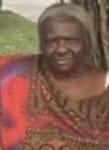
Janice Cox was a woman of great promise, remembered by her family for the bright future that once lay before her. In her youth, she had been a cheerleader, junior class secretary, and a member of Junior Achievement. Her intelligence and eloquence were recognized when her taped essay won an American Legion award. After graduating from Miami Central High, she enrolled at the University of Florida as a senior majoring in occupational therapy. Her sister, Sharon Ferguson, recalled a lovely young woman, clutching a graduation picture of Janice holding a red rose, unable to reconcile that image with the tragic end her sister met. In the years that followed, Janice, a 37-year-old Black woman, struggled with mental illness and addiction, which led her to the streets of Miami.
On March 27, 1996, Janice Cox became the fourth and final victim in a series of brutal killings that had gripped the city. Her partially clothed body was discovered in an abandoned, trash-filled gas station.
She had been savagely beaten with a blunt object, and her body was doused with a flammable liquid and set on fire, leaving her charred from the waist up. Her death mirrored the horrific slayings of three other women that began in August 1995: Vida Hicks, 42; Diane Nelms, 43; and Cheryl Lee Ray, 37. All the victims were Black women who, like Janice, were living on the streets and battling crack cocaine addiction.
The murders prompted the Miami police to form a serial killer task force, one of the most intensive investigations in the department's history. Twenty-four officers, including criminal profilers from the FBI and the Florida Department of Law Enforcement, worked tirelessly to find the man they dubbed the "pyro killer." The investigation was fraught with challenges, as the victims and potential witnesses lived transient lives, their recollections often clouded by addiction or mental illness. For months, detectives had few solid leads, even circulating a sketch of a man known as "Dread" who was seen with one of the victims, but this proved to be a dead end.
The break in the 10-month investigation came when a homeless woman approached the task force. She told them that nine months earlier, a man had beaten her when she refused to go on a date with him. She had recently seen him again and reported it to the police. Her description led investigators to Francisco del Junco, a 38-year-old Cuban immigrant who had arrived in the U.S. during the 1980 Mariel boatlift and was working as a dishwasher in Coconut Grove. When police first picked him up for questioning, he was carrying a container of gasoline and wooden matches.
After his initial release pending evidence tests, del Junco was arrested on June 3, 1996. Crime lab analysis matched the sole pattern of his combat boots to prints found at one of the crime scenes. Taken to a beach on Key Biscayne by detectives, del Junco confessed to killing all four women. He provided details that only the murderer could have known, explaining that he lured his victims with promises of drugs and sex before beating them to death with a metal pipe and setting their upper torsos on fire. He told police that voices had told him to do it.
Del Junco had a history of mental illness, including epilepsy and schizophrenia, and had been arrested multiple times for various offenses since 1987. At his trial, he waived his right to a jury. In June 2003, a Miami-Dade County judge found him guilty of four counts of first-degree murder. Citing his history of mental illness, the judge ruled him ineligible for the death penalty. Francisco del Junco was sentenced to four concurrent life terms in prison.
The case is considered solved, with the perpetrator behind bars for life. Though her life took a tragic turn, the family of Vida Hicks, the first victim, spoke for all the victims when her daughter Jeanine wrote a letter read in court. She described her mother as a very loved woman, not a faceless victim. "Yes, she was fighting an addiction and other demons but her problems never made me stop loving her," she wrote, a sentiment that echoes the profound loss felt by the loved ones of Janice Cox and the other women whose lives were so cruelly taken.