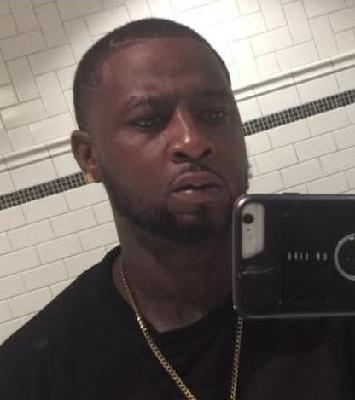
Earl Young was a 30-year-old African American man trying hard to build a new life for himself on Chicago's South Shore, a father who had gone from being a parentless high school dropout to an honor student, basketball star and prom king at Sullivan House High School, an alternative school for at-risk kids. At Sullivan he found mentors who pushed him toward college and helped him discover he could be more than the troubled boy he had been; he even earned a basketball scholarship to a small
college in California before returning home to be present for his first child. By 2018 he was working as a cook, deeply involved with his old school as a mentor, and planning a wedding with his fiancée, Kendra Rodriguez, while raising their infant daughter, Kourage, and caring for his older daughter, Alayla, from a previous relationship. Friends recalled him walking to and from Sullivan every day with his best friend, standing up as a groomsman in that friend's wedding, and talking excitedly about his own wedding planned for the following May.
On the evening of August 3, 2018, that future narrowed to the confines of a single South Shore courtyard. Earl was at Kendra's third-floor apartment in the 7700 block of South Shore Drive, wearing his old Sullivan House T-shirt, a small, private nod to the place that had changed his life. Down below lived a neighbor who had grown increasingly angry about the couple's pit bull puppies, complaining that when the dogs relieved themselves on the balcony, urine ran down toward his own back porch. The tension, Kendra later recalled, had been simmering: harsh words traded over something as trivial as “puppy pee,” a dispute that seemed ridiculous even to those caught in the middle of it. On that Friday night, Earl and the neighbor argued again at the back door of the building, the words “take care of your dog” turning from an irritated demand into the prelude to something irreversible. Nearby, Kendra's 14-year-old son listened as raised voices cut through the apartment, followed by the sharp report of five gunshots.
When the shots stopped, chaos and disbelief rushed in. The teenager ran to a window and saw the neighbor leaning over his balcony, arm extended, firing down at Earl as he walked away, the confrontation already ending when the bullets found him. Outside, Kendra heard the gunfire, dialed 911 and then ran toward the courtyard, where she saw the neighbor jump a fence and sprint away from the building. Earl lay in the 7700 block of South Shore, struck in the left arm and chest, suffering multiple gunshot wounds that would later be ruled a homicide by the medical examiner. He was pronounced dead at the scene, just steps from the block where he lived and from the home where he had been spending most of his time helping care for baby Kourage. In the days that followed, friends and neighbors released balloons in his memory, gathering around Kendra and the children, searching for words as they tried to understand how a man who had survived a rough path and painstakingly rebuilt his life could lose it over where a pair of puppies went to the bathroom.
Earl's death was one of a dozen killings during what would be called Chicago's bloodiest weekend of 2018, a span from the evening of August 3 to the early hours of August 6 when seventy-one people were shot across the city. His name appeared on lists of the dead alongside teenagers, young parents and others whose lives were cut short in that surge of violence, noted only as a man shot in the 7700 block of South Shore and pronounced dead where he fell. Yet behind that brief line were children now asking why they had to grow up without a father, a fiancée who spoke of feeling trapped in a nightmare, and school staff who could not reconcile the image of the former prom king and mentor with the bloodstained sidewalk where his life ended. In interviews, Earl's old dean at Sullivan House, Pastor Darnell Payne, spoke of the students he took in, “the ones CPS no longer wants,” and how deeply it cut to lose someone who had worked so hard to prove that a kid from a rough background could choose a different path.
In the immediate aftermath, police acknowledged that despite witnesses and neighborhood outrage, no one had been taken into custody, and the neighbor who fled the courtyard that night did not return. For a time, the killing remained another unsolved case in a city struggling under the weight of its homicide numbers, even as Kendra and Earl's mentors continued to speak publicly about the senselessness of the shooting and the need for the community to care for young people before anger and fear hardened into violence.
More than two years later, the investigation finally led to an arrest. In October 2020, prosecutors charged 22-year-old Cordell Salazar, Earl's downstairs neighbor, with first-degree murder in the South Shore shooting. Court records describe how Salazar and Earl argued twice that day over the pit bull puppies on the back porch above his apartment, and how the dispute escalated to the final confrontation at the back door. Kendra's son told authorities he heard the shouting, then five gunshots, and saw Salazar firing from his balcony as Earl moved away. Kendra later reported seeing Salazar jump the fence and run, and after initially hesitating to involve her children, she eventually came forward to identify him as the shooter. Surveillance cameras from the Chicago Housing Authority captured Salazar coming and going around the time of the killing, helping to bolster the case. Police arrested him during an unrelated traffic stop, and a judge set his bail at $500,000, ordering electronic monitoring should he post bond. Public defenders noted that Salazar had previously worked for a delivery company and was a lifelong Chicagoan, while prosecutors laid out the sequence of arguments over the dogs that ended with Earl dying on the pavement below his own block. Subsequent public reporting focuses on those charges and the court proceedings that followed, without detailing a final trial outcome or conviction, leaving the official legal end of the case less clearly documented than the violent moment that took Earl Young's life.