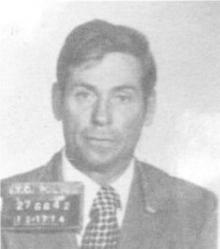
Michael J. “Mickey” Spillane, a 43-year-old Irish-American man, was killed on May 13, 1977, outside his apartment in Woodside, Queens. By then, he was no ordinary neighborhood figure; his name carried the weight of Hell’s Kitchen’s underworld, where he had long been known as a “gentleman gangster,” a boss who could rule through favors and fear, and who had spent years holding his ground in a city where larger crime families were always looking for openings.
In the years leading up to his death, the ground under him had begun to shift. Rivalries intensified, alliances changed, and the kind of street power he represented became harder to keep contained. Sources describing his final period say he had moved his family out to Queens as tensions rose, but distance didn’t mean safety—it only meant the battle lines followed him to a quieter block.
On that Friday the 13th, the killing was carried out as a blunt, public statement. Accounts consistently place the attack right outside his Woodside building, framing it as an execution rather than a spontaneous act of violence. Later reporting described the shooting as a gangland-style hit, with Spillane struck multiple times in the head outside his home.
The aftermath was immediate and decisive: with Spillane gone, the balance of power that had kept parts of Hell’s Kitchen under an older code gave way to a new era. Jimmy Coonan rose into the vacuum, and the group that would be widely known as the Westies grew into a more ruthless, more ambitious force—one that was increasingly willing to partner with Italian Mafia interests rather than resist them.
As for who pulled the trigger, the case history that circulates most widely in organized-crime reporting points in one direction: the DeMeo crew, tied to the Gambino crime family, with Roy DeMeo frequently named as the suspected shooter acting as a favor meant to help Coonan secure control. These accounts are commonly presented as rumor or attribution rather than courtroom-proof fact, and they are paired with an important qualifier—Coonan was never charged or convicted in connection with Spillane’s killing.
Other names appear at the edges of the story as well. Some accounts identify contract killer Joseph “Mad Dog” Sullivan as a suspected participant or suspect in Spillane’s murder, while also stressing that he was never charged in the case.
No trial ever arrived to seal the story with testimony and verdicts. What remained instead was an abrupt ending on a Queens sidewalk, a funeral that drew enough attention to earn vivid descriptions in later reporting, and a lasting consensus that the murder marked a turning point—one that cleared the way for the next regime in Hell’s Kitchen. Spillane was buried at Calvary Cemetery in Queens, but the questions around who ordered the hit and who carried it out have lingered far longer than the echoes of the gunfire that ended his life.