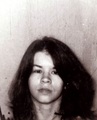
Sierra Raye Mullin, also publicly identified as Sierra Raye Roberts, was a 25-year-old woman whose official last-contact date is recorded as March 4, 2008, in Anchorage, Alaska. The National Missing and Unidentified Persons System lists her under case number MP19740 and identifies Anchorage as the location associated with her disappearance. Public case information describes Sierra as a White woman who stood about five feet tall, weighed approximately 105 pounds, and had brown hair; other
missing-person listings also describe her as having brown eyes. Although relatively little has been publicly released about the circumstances of March 4 itself, that date became the official reference point around which her case was built. The lack of a detailed account of where she was going, whom she was with, or what occurred immediately before she lost contact has left a painful gap at the very beginning of the story.
The years before Sierra disappeared appear to have been complicated. Secondary case summaries report that she had experienced drug dependency and prostitution and had previous encounters with law enforcement, including a reported felony drug-possession arrest in 2003. They also report that her marriage ended in 2004. These details have sometimes dominated descriptions of Sierra's case, but they are most significant because they illustrate circumstances that may have made her particularly vulnerable to exploitation, coercion, and violence. Public accounts also connect Sierra to a criminal case involving Anchorage businessman Josef F. Boehm, stating that she had reportedly been identified as a witness. That broader criminal environment is independently documented: federal court records show that Boehm pleaded guilty in 2004 to conspiracy connected to human trafficking, admitting that he and others provided controlled substances to minors and recruited them to engage in sexual activity. A United Nations Office on Drugs and Crime case summary likewise states that Boehm and others recruited juveniles using cocaine and that Boehm received a prison sentence of more than thirteen years. Sierra's reported connection to his case has therefore attracted considerable attention, but no public law-enforcement finding establishes that Boehm was responsible for her disappearance, and the connection should not be treated as proof of what happened to her.
The timeline becomes considerably more complicated after the official March 4, 2008 last-contact date. Secondary summaries citing Alaska records report that Sierra had additional encounters with law enforcement later in 2008. One account describes an arrest on June 12, followed by another reported arrest on July 30, and a seatbelt citation on December 4. Another published account likewise reports that she was arrested in June and received a traffic citation in December. If those records accurately document Sierra herself, they would indicate that she was alive and interacting with authorities months after the date still carried by NamUs as her official last contact. Publicly available sources do not clearly explain why the official date was never changed, and one recent case review specifically notes that it is unclear when Sierra was formally reported missing or why the discrepancy in the timeline persists. That uncertainty is one of the most consequential features of her case because investigators trying to reconstruct her movements must contend with an official starting date that may not represent her true final documented contact.
Another disturbing part of the historical setting surrounding Sierra involves Don Arthur Webster Jr., also known as Jerry Starr. Public discussion of Sierra's disappearance has sometimes connected her social environment to Webster and to the trafficking activity being investigated in Anchorage at the time. The criminal case against Webster itself is firmly documented by the U.S. Department of Justice. A federal jury convicted him in February 2008 on 28 counts, including sex trafficking of minors, sex trafficking of adults through force, fraud, or coercion, and multiple crack-cocaine distribution offenses. Prosecutors said Webster operated sham escort businesses that served as fronts for prostitution in the Anchorage area and targeted vulnerable women and girls. He was later sentenced to 30 years in federal prison and lifetime supervised release. Those facts help explain why reports concerning Sierra's possible associations have generated serious concern, but they do not establish that Webster or anyone connected with his prosecution caused her disappearance. The available public record does not provide evidence sufficient to turn those associations into a proven explanation.
Over time, other theories have circulated, including speculation that Sierra might have encountered someone who harmed her, voluntarily left Anchorage, suffered an accident, or crossed paths with people connected to the drug trade or sexual exploitation. Online discussions have even attempted to associate her with serial killer Israel Keyes because he lived in Anchorage during the general period in question, but there is no publicly disclosed physical evidence, confession, or law-enforcement statement tying Keyes to Sierra. Responsible summaries of the case emphasize that such theories remain speculation rather than established investigative findings. What can be said with confidence is much narrower: Sierra was a 25-year-old woman known as both Sierra Raye Mullin and Sierra Raye Roberts; NamUs records March 4, 2008 as her official last contact in Anchorage; subsequent published accounts describe possible law-enforcement contacts later that year; and the circumstances leading to the loss of contact have never been publicly explained in detail. The case is therefore defined as much by missing information as by the facts that are known. The central overview is of a young woman whose official disappearance date is clouded by later reported contacts, whose life intersected with a dangerous period of trafficking and drug exploitation in Anchorage, and whose final movements cannot be reconstructed from the public record with certainty. Behind the incomplete dates, criminal-case connections, and unanswered questions is Sierra herself, a woman whose story deserves to be remembered with care rather than reduced to the difficult circumstances surrounding her disappearance.Last Seen: Mar 4, 2008