

What Does Criminal Profiling Involve: A Clear Guide

Criminal profiling is the evidence-based practice of inferring characteristics of an unknown offender by analyzing crime scene evidence, behavioral patterns, and victimology. What does criminal profiling involve at its core? It involves a structured, methodical process developed by agencies like the FBI’s Behavioral Analysis Unit (BAU), established in 1972, to generate investigative leads rather than identify suspects outright. Profiling serves as an investigative aid, not a courtroom proof of guilt. Understanding how it works separates fact from the dramatic fiction that dominates television and film.
What does criminal profiling involve? Key steps and techniques
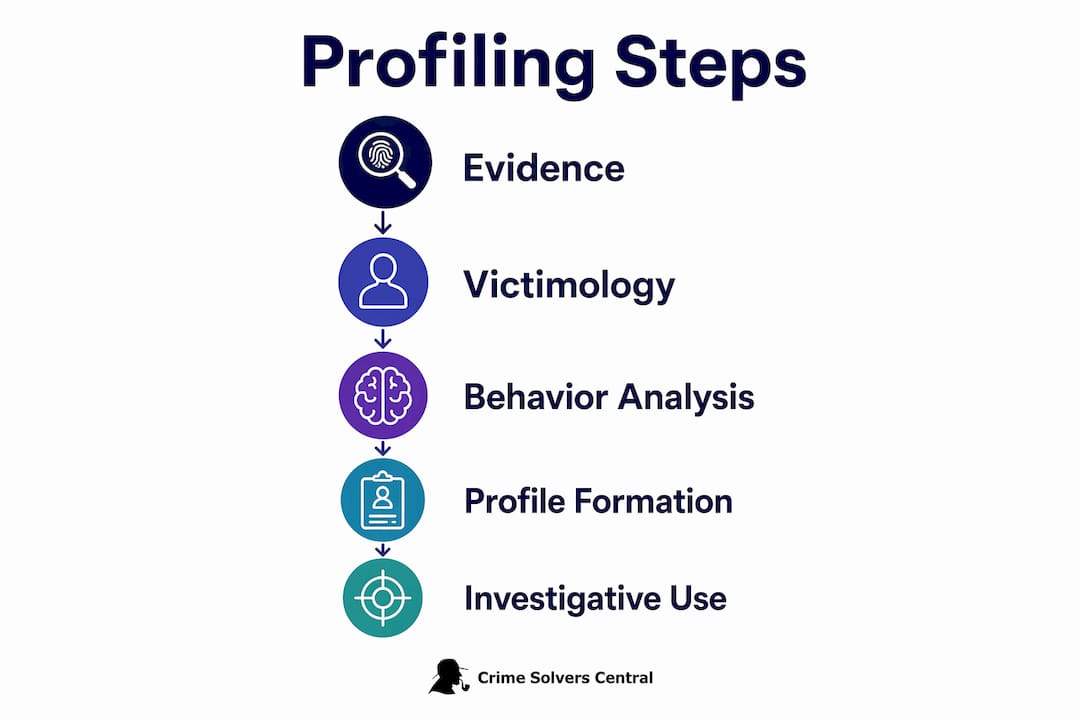
Criminal profiling follows a defined sequence of analytical steps, not a flash of intuition. The FBI BAU applies a structured approach that combines physical evidence with behavioral insights, producing a profile that guides investigators toward the most probable offender characteristics.
The core steps in the profiling process are:
- Evidence collection. Investigators gather all available physical evidence from the crime scene, including forensic data, photographs, and witness accounts. This stage forms the factual foundation for every inference that follows.
- Victimology. Analysts study the victim’s background, lifestyle, relationships, and routines. Victimology reveals why a particular person was targeted, which in turn exposes offender motive and selection patterns.
- Crime scene reconstruction. Investigators reconstruct the sequence of events before, during, and after the offense. This step identifies behavioral decisions the offender made under pressure.
- Behavioral analysis. Analysts interpret what the offender’s actions reveal about personality, experience, and psychological state. This is where behavioral science translates physical evidence into human characteristics.
- Profile generation. The team produces a written profile describing probable offender traits such as age range, employment type, social habits, and geographic familiarity with the crime area.
Two major methodological schools shape how these steps are executed. The FBI’s traditional top-down approach uses practitioner judgment and established offender typologies, matching a crime to a known category of offender. The bottom-up method, known as Behavioral Evidence Analysis (BEA), takes the opposite direction. BEA systematically gathers data, analyzes victimology, reconstructs crime events, and generates a profile strictly grounded in case-specific physical evidence. Bottom-up profiling is increasingly preferred because its reasoning is transparent and testable.
Geographic profiling adds a spatial dimension to behavioral analysis. Developed by Kim Rossmo, geographic profiling analyzes the spatial patterns of crimes to estimate where an offender lives or operates. It narrows the search area for surveillance and resource deployment.

Pro Tip: When reading a profile report, check whether conclusions trace back to specific crime scene evidence. If a conclusion lacks a physical or behavioral anchor, treat it with skepticism.
What elements of offender behavior inform a criminal profile?
Behavioral indicators are the raw material of any profile. Analysts read crime scenes the way a physician reads symptoms, looking for patterns that point to underlying causes.
The key behavioral elements analysts examine include:
- Planning and organization. A highly organized crime scene suggests an offender with above-average intelligence, stable employment, and prior criminal experience. A disorganized scene points toward impulsivity, emotional disturbance, or situational opportunism.
- Victim selection patterns. Repeated targeting of a specific victim type reveals offender preference, which reflects psychological need. Analysts use this to predict future targets and narrow suspect demographics.
- Escalation. Many serial offenders escalate in violence or frequency over time. Tracking escalation helps analysts estimate how long an offender has been active and how urgent the investigative timeline is.
- Post-offense behavior. Actions taken after the crime, such as returning to the scene, contacting investigators, or inserting oneself into the investigation, carry strong psychological significance.
The distinction between modus operandi (MO) and offender signature is one of the most critical elements in profiling. MO refers to practical techniques used to commit the crime, such as how an offender gains entry or controls a victim. Signature refers to behaviors that fulfill a psychological need and are not required to complete the offense. A signature is far more stable across crimes than MO, making it the stronger tool for linking separate offenses to a single offender. Confusing the two produces profiling errors.
Pro Tip: When studying a case, list MO behaviors separately from signature behaviors. The signature column will reveal far more about who the offender is.
Victimology ties these behavioral elements together. Understanding why a specific victim was chosen clarifies what the offender was seeking, whether control, a particular physical type, or access to a specific location. That clarity shapes every other inference in the profile.
How reliable is criminal profiling as a scientific method?
Criminal profiling carries genuine investigative value, but its scientific foundation is contested. A noted shortage of rigorous research validates profiling’s predictive accuracy, and experts advise that profiling should be excluded as scientific evidence until predictive validity is demonstrated.
“Profiling methodologies build on assumptions about behavioral consistency and linkages between offense behaviors and offender traits. These assumptions remain debated in academic research and have not been uniformly validated.”
Source: Carleton University Police Research Lab
The legal standard is equally clear. Profiling does not meet the Federal Rule of Evidence 702 threshold for scientific testimony. Courts require that expert evidence rest on sufficient facts, reliable methods, and correct application of those methods to the case. Profiling, as currently practiced, does not consistently satisfy all three criteria. This means a profile cannot serve as the sole basis for a conviction.
The comparison below shows where profiling stands across two key dimensions:
| Dimension | Investigative use | Courtroom use |
|---|---|---|
| Purpose | Narrows suspect pool, guides interviews | Not admissible as scientific proof |
| Basis | Behavioral inference from evidence | Requires validated predictive accuracy |
| Reliability | Practically useful, not uniformly tested | Does not meet Federal Rule of Evidence 702 |
| Risk | Confirmation bias if over-relied upon | Risk of wrongful conviction if used alone |
Confirmation bias is the most common operational failure in profiling. Once investigators commit to a profile, they may unconsciously filter evidence to fit it. The importance of multidisciplinary teams lies partly in reducing this risk, since behavioral analysts, forensic specialists, and crime analysts each bring different interpretive frameworks.
Racial profiling is a separate and prohibited practice. Criminal profiling focuses on behavioral evidence derived from crime scenes, not on race, ethnicity, or religion. Law enforcement agencies prohibit bias-based profiling as a constitutional violation. Conflating the two terms misrepresents both.
In what kinds of investigations is criminal profiling most effective?
Profiling delivers the most value in serial crime investigations where behavioral patterns repeat across multiple offenses. Single-incident crimes offer too little behavioral data to generate a reliable profile. Serial homicide, sexual assault, arson, and kidnapping cases provide the volume of evidence that makes profiling analytically sound.
The practical applications where profiling consistently aids investigators include:
- Suspect pool reduction. Profiles generate leads that focus investigative resources on the most probable offender characteristics, saving time and budget in large-scale investigations.
- Interview strategy. Behavioral insights inform how investigators approach a suspect, including what psychological pressure points to use and what topics to avoid early in an interview.
- Case linkage. Signature behaviors connect crimes that appear unrelated on the surface. Linking cases reveals a serial pattern that changes the entire investigative approach.
- Cold case reinvestigation. Profiling supports cold case investigations by reanalyzing behavioral evidence with updated methods and databases, sometimes producing new leads decades after the original offense.
- Database integration. Profiles become more accurate when combined with criminal database records, allowing analysts to compare behavioral patterns across thousands of documented cases.
Profiling is rarely conducted by a single analyst working alone. Multidisciplinary teams integrate behavioral analysts, crime analysts, forensic specialists, and psychologists. That collaboration improves the quality of the profile and reduces the risk of individual bias distorting the conclusions.
Pro Tip: If you are studying a cold case, look for signature behaviors across multiple incidents before drawing behavioral conclusions. A single crime scene rarely provides enough data for a reliable profile.
Key Takeaways
Criminal profiling is a structured, evidence-based investigative tool that narrows suspect pools and guides law enforcement strategy, but it requires multidisciplinary input and cannot substitute for forensic proof in court.
| Point | Details |
|---|---|
| Profiling is a process, not a talent | It follows defined steps: evidence collection, victimology, reconstruction, behavioral analysis, and profile generation. |
| MO and signature are distinct | Signature behaviors reveal psychological need and link crimes; MO reflects practical crime-committing technique. |
| Scientific validity is limited | Profiling lacks uniform predictive validation and does not meet the Federal Rule of Evidence 702 standard for court use. |
| Serial crimes benefit most | Profiling works best when repeated behavioral patterns across multiple offenses provide sufficient analytical data. |
| Teams outperform lone analysts | Multidisciplinary collaboration reduces confirmation bias and improves profile accuracy. |
Profiling’s real value sits between the headlines and the courtroom
The television version of criminal profiling is a performance. A single analyst stares at crime scene photos and announces the offender’s childhood trauma, zip code, and shoe size. The operational reality is far less dramatic and far more useful.
What I find most underappreciated about profiling is its role as a filter, not a finder. A well-constructed profile does not hand investigators a name. It eliminates thousands of names that do not fit the behavioral pattern. That filtering function is where profiling earns its place in serious investigations.
The bottom-up BEA approach represents the most credible direction the field has taken. It forces analysts to anchor every inference to physical evidence rather than typological assumptions. That discipline makes the reasoning auditable, which matters both for investigative integrity and for the rare cases where profile conclusions face legal scrutiny.
The media myth that profiling is a near-psychic skill does real damage. It creates unrealistic expectations in juries, pressures investigators to over-rely on profiles, and discourages the kind of skeptical, iterative analysis that actually produces results. Real profiling is slow and methodical, built on research, case comparisons, and statistical patterns, not inspiration.
The future of the field points toward data-driven methods combined with multidisciplinary collaboration. Geographic profiling, behavioral databases, and forensic integration are already improving profile accuracy. The researchers and practitioners who treat profiling as a hypothesis to be tested, rather than a verdict to be delivered, are the ones advancing the discipline responsibly.
— Crime
Crimesolverscentral’s cold case database and profiling in practice
Crimesolverscentral maintains a national database of over 264,913 cases, organized by state and situation, giving investigators, researchers, and community members direct access to case records that support behavioral analysis and case linkage. When profiling analysts need to compare behavioral patterns across documented offenses, a structured database like this one provides the volume of data that makes those comparisons meaningful. Public databases aid law enforcement by centralizing case information that would otherwise remain siloed across jurisdictions. Researchers studying serial crime patterns, cold case advocates, and families seeking answers can all access the cold case database to contribute to investigations that profiling alone cannot close.
FAQ
What does criminal profiling involve at its most basic level?
Criminal profiling involves analyzing crime scene evidence, victimology, and offender behavior to generate a description of probable offender characteristics. The FBI’s Behavioral Analysis Unit has applied this structured approach since 1972.
Is criminal profiling the same as racial profiling?
No. Criminal profiling focuses on behavioral evidence drawn from crime scenes, while racial profiling targets individuals based on race or ethnicity. Law enforcement agencies prohibit racial profiling as a constitutional violation.
Can a criminal profile be used as evidence in court?
Profiling does not meet the Federal Rule of Evidence 702 standard for scientific testimony and cannot serve as the sole basis for a conviction. It functions as an investigative aid, not forensic proof.
What is the difference between MO and offender signature?
Modus operandi describes the practical methods an offender uses to commit a crime, while signature describes behaviors that fulfill a psychological need and are not required to complete the offense. Signature behaviors are more reliable for linking multiple crimes to one offender.
What types of crimes benefit most from criminal profiling?
Serial crimes, including homicide, sexual assault, and arson, benefit most because repeated offenses provide the behavioral data needed to identify patterns. Single-incident crimes rarely offer enough evidence for a reliable profile.