

The Role of Criminal Databases in Policing: 2026 Guide

Criminal databases are centralized digital systems that compile, store, and provide access to crime-related records, forming the operational backbone of modern law enforcement investigations. The role of criminal databases in policing extends from routine warrant checks to complex multi-jurisdictional homicide investigations. These systems hold arrest histories, biometric data, active warrants, and court dispositions. The National Crime Information Center (NCIC), state criminal repositories, and local Records Management Systems (RMS) each serve distinct functions within a fragmented but interdependent ecosystem. Understanding how these systems interact, where they fail, and how policy can improve them is not optional for law enforcement professionals and policy makers. It is the foundation of effective, accountable policing.
How do criminal databases operate within the law enforcement ecosystem?
No single criminal database covers every case, jurisdiction, or data type. Law enforcement relies on fragmented federal, state, and local systems, each with distinct update schedules and data scopes. That fragmentation is not a design flaw. It reflects the constitutional structure of American policing, where authority is distributed across thousands of agencies.
The NCIC, managed by the FBI, handles active warrants, missing persons, stolen property, and federal case flags. It updates more slowly than local systems, sometimes taking weeks to reflect new entries. State repositories hold detailed in-state criminal histories, including charges, dispositions, and supervision records. Local RMS and Computer-Aided Dispatch (CAD) systems capture the most recent activity, often updating within hours of an incident.

Officers conducting a traffic stop or executing a search warrant typically query all three levels. A subject may appear clean in NCIC but carry an active local warrant. That gap is not theoretical. It is a daily operational reality for patrol officers and detectives alike.
The core challenge is manual bridging. Data siloing between NCIC, RMS, CAD, and other systems forces investigators to query each platform separately, then reconcile results by hand. That process consumes time that could go toward active investigation. It also increases the risk of missing a critical connection between cases.
Key database types and their primary functions:
- NCIC: Active warrants, missing persons, stolen vehicles, federal flags
- State repositories: Full in-state criminal histories, court dispositions, supervision status
- Local RMS/CAD: Recent arrests, incident reports, field contacts, real-time updates
- Biometric databases: Fingerprint, DNA, and facial recognition records
- Private-sector data services: License records, financial data, social media aggregates
What are the benefits of criminal databases for policing outcomes?
Criminal databases accelerate every phase of an investigation, from initial suspect identification to case closure. Officers can verify a subject’s warrant status in seconds rather than hours. Detectives can cross-reference crime patterns across precincts, counties, and states to identify serial offenders before additional victims emerge.
The criminal database impact on sentencing is measurable and significant. Prior criminal records drive sentence length across every state that uses structured sentencing guidelines. In Maryland, 63% of lengthy sentence duration traces directly to prior records. Minnesota shows 30%, Pennsylvania 45%, and Washington 41%. Those figures confirm that accurate, complete records directly shape judicial outcomes. An incomplete or inaccurate record does not just affect an investigation. It affects a person’s liberty.
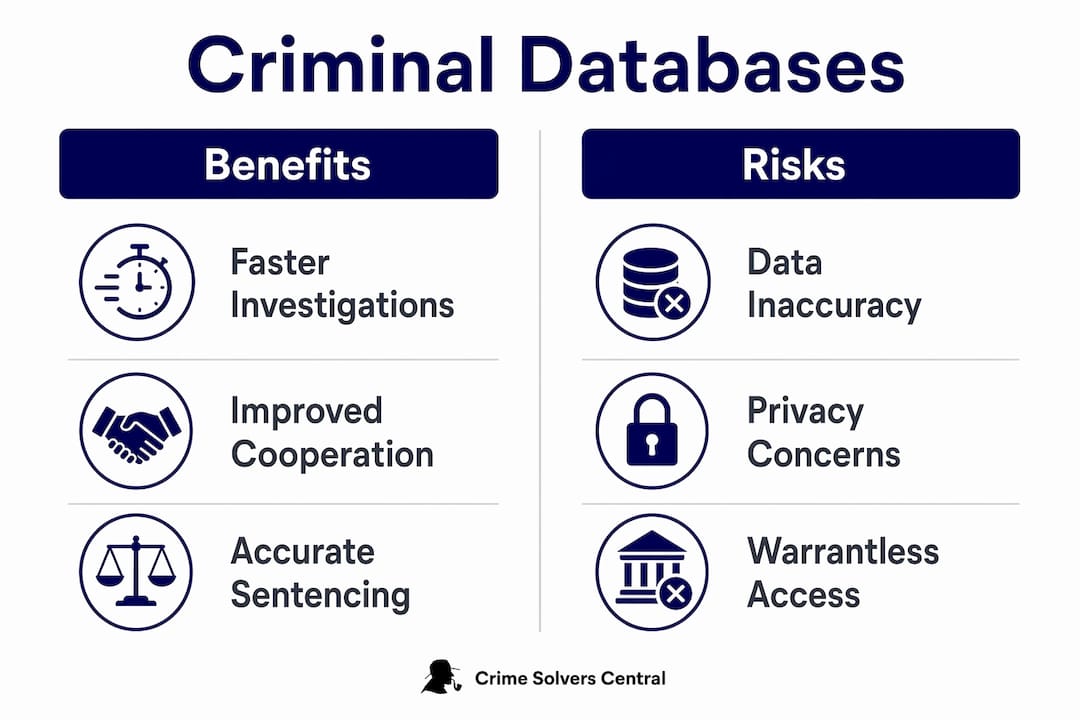
Cross-jurisdiction cooperation improves substantially when agencies share access to common data systems. A detective in one county can identify that a suspect’s method of operation matches open cases in three neighboring counties. That connection, made through crime data analysis, can consolidate investigations and prevent duplicate work.
Modern investigative platforms now ingest both structured data (arrest records, warrants) and unstructured data (surveillance video, social media posts, cell tower logs). Effective policing depends on platforms that unify these data types to automate connection discovery. Without that unification, analysts spend hours manually reviewing footage or cross-checking social media accounts against known associates.
The numbered steps below reflect how integrated police database usage improves case resolution:
- Suspect identification: Query biometric and warrant databases to confirm identity within minutes.
- Pattern recognition: Run crime data analysis across multiple jurisdictions to surface repeat offenders.
- Evidence linkage: Connect physical evidence to known records through digital case management.
- Cross-agency coordination: Share real-time case flags with neighboring agencies to prevent investigative overlap.
- Cold case reactivation: Match newly collected DNA or fingerprints against historical records to reopen unsolved cases.
Pro Tip: Integrate your local RMS with state repository feeds so that warrant updates populate automatically. Manual reconciliation is the single largest source of investigative delay in multi-agency cases.
What are the risks and challenges of criminal database use?
Criminal databases carry serious risks when data is inaccurate, outdated, or misused. Criminal background checks often contain incorrect and misleading data, and those errors compound when records move from justice systems into commercial background screening platforms. An officer acting on a stale warrant or a misattributed record can detain an innocent person. That outcome is not rare.
“Criminal record data repurposed for profit-driven background screening and predictive algorithms exacerbates systemic harms, particularly for communities already subject to disproportionate policing. Policy makers must address data accuracy and misleading contexts before criminal record data underpins high-stakes decisions.”
Over 130 federal civil lawsuits document officers bypassing warrant requirements when accessing criminal and personal data. Racial and gender disparities appear consistently in those cases. Women and racial minorities face disproportionate harm from database misuse, including unauthorized access to personal records for non-official purposes.
Automation bias compounds these risks. Fragmented data sources without automatic synchronization increase the likelihood that officers overtrust a database result and discount contradicting evidence. A record that shows a prior arrest without a conviction can still shape an officer’s judgment in ways that lead to wrongful detention.
Key risks law enforcement professionals and policy makers must address:
- Data inaccuracy: Outdated or misattributed records lead to wrongful detentions and unjust sentencing.
- Function creep: Criminal data repurposed for commercial screening creates long-term stigma and reduces individuals’ ability to contest errors.
- Warrantless access: Officers accessing private-sector databases like TLOxp and CLEAR without judicial oversight creates legal exposure for agencies.
- Demographic disparities: Misuse disproportionately affects racial minorities and women, undermining public trust.
- Synchronization gaps: Systems that update on different schedules create windows where critical information is missing or contradictory.
Pro Tip: Establish quarterly audit reviews of database access logs. Agencies that implement structured compliance audits catch misuse patterns before they become civil liability.
How is technology reshaping the future of criminal databases?
The next generation of law enforcement data systems moves away from siloed, query-based platforms toward API-driven architectures that deliver real-time, integrated access. The UK’s Law Enforcement Data Service (LEDS) offers a working model. LEDS combines names, vehicles, drivers, and property data through APIs that promote instant, lawful, and auditable access. Every query generates a compliance record. That design eliminates the gray areas that enable misuse.
American agencies face a more complex path because of the federal structure. Federal reform would need to address how NCIC, state repositories, and local RMS communicate with each other, and how private-sector data services fit into that framework. Digital-first, API-driven police data services with built-in compliance enable consistent, lawful, and efficient data access at every level of the system.
The integration of unstructured data represents the most significant near-term shift. Platforms that can automatically cross-reference a surveillance video timestamp against a known offender’s GPS monitoring record, or flag a social media post against an open warrant, reduce the manual workload that currently slows investigations. That capability exists today in enterprise-grade investigative platforms. The barrier is procurement and training, not technology.
| Feature | Legacy systems | API-driven platforms |
|---|---|---|
| Update frequency | Days to weeks | Real-time or near real-time |
| Audit trail | Manual or absent | Automated and built-in |
| Data types supported | Structured records only | Structured and unstructured |
| Cross-agency access | Query-by-query | Federated, permission-based |
| Compliance controls | Agency-dependent | System-enforced |
Policy makers hold the most leverage in this transition. Mandating data quality standards, requiring audit trails for all database queries, and restricting warrantless access to private-sector data services are achievable reforms that do not require new technology. They require political will and clear statutory authority. The policy gaps in unsolved homicides that persist today are partly a product of those missing mandates.
Pro Tip: When evaluating new investigative platforms, require vendors to demonstrate built-in audit logging and role-based access controls before procurement. Those features are non-negotiable for agencies managing sensitive case data.
Key Takeaways
Criminal databases are most effective when they are accurate, integrated across jurisdictions, and governed by clear audit and access controls that prevent misuse.
| Point | Details |
|---|---|
| Fragmented ecosystem | NCIC, state repositories, and local RMS serve different functions and must be queried together for complete intelligence. |
| Sentencing impact | Prior records drive 30%–63% of sentence length depending on state, making data accuracy a matter of justice, not just efficiency. |
| Misuse is documented | Over 130 federal civil lawsuits confirm officers bypass warrant requirements, with racial and gender disparities in harm. |
| Function creep is a real risk | Criminal data repurposed for commercial screening creates long-term stigma and reduces individuals’ ability to contest errors. |
| API-driven platforms are the standard | Systems with built-in audit trails, real-time updates, and federated access reduce both investigative delay and legal exposure. |
What I’ve learned from watching databases shape investigations
The conversation about criminal databases in law enforcement tends to split into two camps. One side treats these systems as near-infallible investigative tools. The other focuses entirely on their potential for harm. Both positions miss the point.
The real issue is that databases are only as reliable as the processes that maintain them. I’ve seen agencies make strong cases using well-maintained local RMS data, and I’ve seen investigators chase dead ends because a federal record hadn’t updated in three years. The technology is not the variable. The governance is.
What concerns me most is automation bias. Officers who trust a database result without verifying it against secondary evidence are not being lazy. They are responding rationally to a system that presents data with apparent authority. The fix is not to distrust databases. The fix is to train officers to treat every database result as a starting point, not a conclusion. That distinction matters enormously when the person on the other end of a warrant check is innocent.
Policy makers who want to improve policing outcomes should focus less on acquiring new platforms and more on mandating data quality standards for existing ones. An agency with clean, current, well-audited records in a legacy system will outperform an agency with a modern platform full of stale data. The public databases that aid law enforcement most effectively are the ones with the strongest data hygiene practices behind them, not the most sophisticated interfaces.
— Crime
Crimesolverscentral: a resource for cold case investigators
Law enforcement professionals working unsolved homicides and missing persons cases face a specific challenge. The data they need often sits across multiple systems, years of records, and dozens of jurisdictions. Crimesolverscentral addresses that gap directly. The platform maintains a national cold case database of over 264,913 cases, organized by state and case type, giving investigators a single access point for cases that have gone cold across the country.
For detectives revisiting old cases or policy makers assessing gaps in regional crime resolution, Crimesolverscentral provides structured, accessible data that complements official law enforcement systems. The platform also supports community-driven intelligence that has helped reconnect families and advance active investigations. Agencies looking to maximize their cold case clearance rates will find Crimesolverscentral a practical complement to their existing national database strategies.
FAQ
What is the role of criminal databases in policing?
Criminal databases give law enforcement structured access to arrest records, warrants, biometric data, and case histories across federal, state, and local systems. They accelerate suspect identification, support cross-jurisdiction cooperation, and directly influence sentencing outcomes through prior record documentation.
How do criminal databases help solve cold cases?
Cold case investigations benefit from criminal databases when new biometric evidence, such as DNA or fingerprints, can be matched against historical records. Platforms like Crimesolverscentral extend that capability by cataloging over 264,913 unsolved cases in a searchable, state-organized format.
What are the biggest risks of police database usage?
The primary risks are data inaccuracy, automation bias, and misuse through warrantless access to private-sector data services. Over 130 federal civil lawsuits document cases where officers bypassed warrant requirements, with documented racial and gender disparities in who bears the harm.
Why do law enforcement data systems remain fragmented?
NCIC, state repositories, and local RMS were built independently, with different update schedules and data standards. No federal mandate currently requires these systems to synchronize automatically, so investigators must query each platform separately and reconcile results manually.
What policy changes would most improve criminal database accuracy?
Mandating data quality standards, requiring automated audit trails for all database queries, and restricting warrantless access to commercial data services are the three reforms with the clearest impact. These changes require statutory authority, not new technology.