

Why Cold Case Audits Yield New Leads: 2026 Guide

A cold case audit is a systematic, multidisciplinary review of an unsolved investigation that applies modern forensic tools, fresh analytical perspectives, and updated evidence standards to generate new investigative leads. These audits are the primary reason why cold case audits yield new leads at rates that active investigations cannot match. Departments with dedicated cold case units have solved cases at twice the rate of those without since 2020. That gap exists because audits treat evidence as permanent, revisable infrastructure rather than a closed file. Tools like forensic genetic genealogy, Digital Evidence Management Systems (DEMS), and next-generation DNA sequencing have transformed what investigators can extract from decades-old evidence.
Why cold case audits yield new leads differently than active investigations
Active investigations are driven by urgency. Detectives work toward an arrest, and once that goal becomes unreachable, the case stalls. Cold case audits operate on a completely different logic.
Audits treat case reconstruction as permanent infrastructure rather than a process closed once an arrest is no longer imminent. That shift in mindset is not a small procedural change. It means every piece of evidence stays open to reinterpretation as new science becomes available.
The audit approach also challenges the “clearance rate” metric that pressures active investigators. Clearance rates reward speed. Audits reward accuracy. When an initial investigation misidentified a suspect or dismissed a witness, the audit team can surface those errors without the political pressure that buried them the first time.
Multidisciplinary teams drive this process. A cold case audit typically includes:
- DNA specialists who apply current sequencing standards to old biological samples
- Forensic anthropologists who reexamine physical remains with updated methodology
- Digital analysts who mine archived devices and communications
- Behavioral analysts who reconstruct timelines and victimology
The identification of “Walker County Jane Doe” illustrates this directly. That case was solved by combining forensic anthropology and DNA technology after years of single-method attempts had failed. No single discipline cracked it. The combination did.
Pro Tip: If you are a family member advocating for a review, ask the agency specifically whether a multidisciplinary team has been assigned. A single detective revisiting notes is not the same as a structured audit.
Which modern technologies drive breakthroughs in cold case reviews?
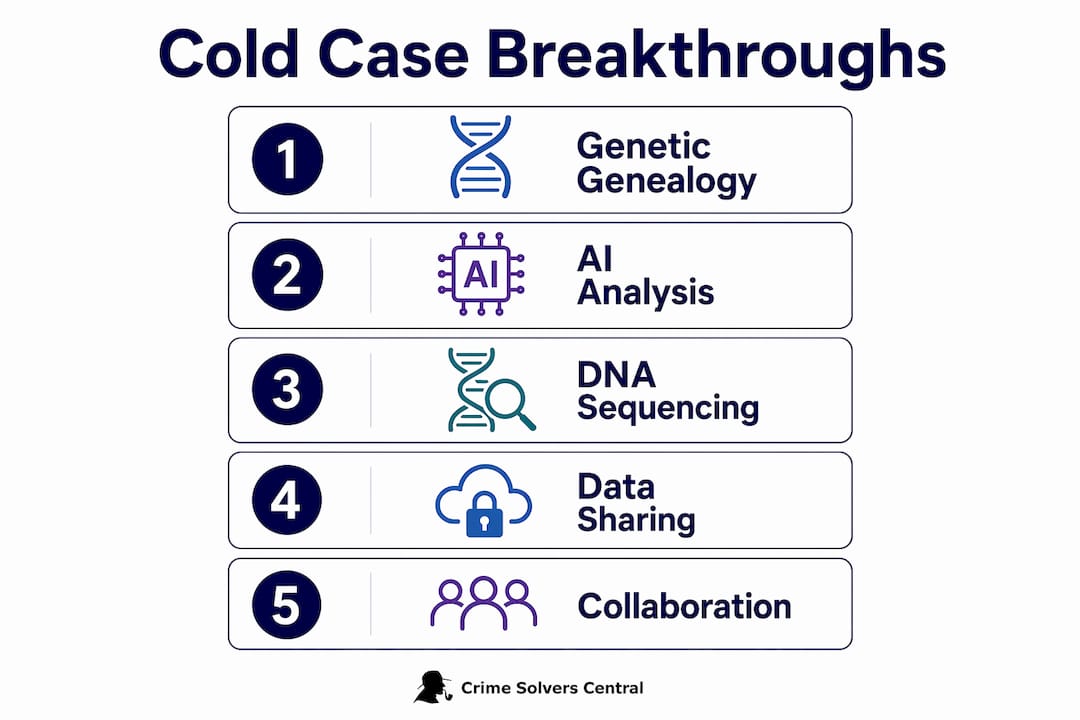
Technology is the engine of the modern cold case audit. Three categories of tools have produced the most significant results in recent years.
Forensic genetic genealogy
Forensic genetic genealogy compares DNA from crime scene evidence against public genealogy databases to identify biological relatives of an unknown suspect. It generates suspect leads where traditional DNA database searches reached dead ends. The method does not automatically identify a person. It narrows the field to a family network, which investigators then pursue through conventional means. Legal admissibility requires that the DNA sample be collected lawfully and that human investigators validate every lead the genealogy analysis produces.
Digital evidence management systems and AI
DEMS platforms organize, index, and cross-reference digital evidence across multiple cases simultaneously. AI tools can compile and cross-reference evidence across 27 cases in just 30 hours, work that would take a single investigator an estimated 81 years manually. That is not a marginal efficiency gain. It means patterns connecting separate cases, separate victims, and separate suspects become visible for the first time.
Courts require human validation of AI outputs. Successful cold case units use AI to process what would take humans months, then apply human review before any lead moves forward. AI is a force multiplier, not a replacement for investigative judgment.
Advanced DNA testing
Next-generation sequencing extracts usable genetic profiles from degraded samples that older PCR-based methods could not process. Touch DNA analysis recovers profiles from surfaces a suspect briefly contacted. These advances mean evidence collected in the 1980s or 1990s can now yield results that were technically impossible at the time of the original investigation.
| Technology | Primary Function | Key Limitation |
|---|---|---|
| Forensic Genetic Genealogy | Identifies suspect family networks from crime scene DNA | Requires lawful sample collection and human follow-up |
| DEMS with AI | Cross-references evidence across cases at scale | AI outputs must be human-validated for court use |
| Next-Generation Sequencing | Profiles degraded biological samples | Lab backlogs can delay results significantly |
| Touch DNA Analysis | Recovers profiles from brief contact surfaces | Low-template samples risk contamination |
Pro Tip: Investigators should maintain detailed device access logs at the point of evidence collection. Without those logs, future analysts cannot determine which devices were acquired or are pending, which limits the application of newer forensic tools years later.
What challenges must cold case audits overcome to succeed?
The benefits of cold case audits are real, but the obstacles are equally real. Understanding them helps families and advocates set accurate expectations.
- Evidence degradation and loss. Biological samples degrade over time. Physical evidence gets misfiled, destroyed, or lost entirely. Without accreditation standards, agencies rely on institutional memory, which leads to destroyed evidence and lost rape kits. Accreditation systems create the structure that makes future audits possible.
- Resource constraints and lab backlogs. DNA testing is expensive. Crime labs operate with significant backlogs. Over-testing evidence overwhelms resources, so effective triage is critical. Audit teams must balance testing likelihood against lab capacity to avoid bottlenecks that stall the entire review.
- Human factors from the original investigation. Witnesses’ memories fade. Initial investigators sometimes pursued the wrong theory and documented evidence selectively. Audit teams must reconstruct not just the crime but the original investigation itself, identifying where assumptions were made and where evidence was dismissed prematurely.
- AI overreliance. Pattern recognition tools can surface connections that look compelling but require rigorous human scrutiny. An AI-generated lead that is not validated by a human investigator before it reaches a prosecutor creates legal exposure and can compromise the case entirely.
- Legal admissibility of new methods. Forensic genetic genealogy and AI-assisted analysis face ongoing scrutiny in court. Audit teams must document every step of their methodology to withstand defense challenges.
A breakthrough DNA result does not close a case. It generates substantial new investigative work, including timeline reconstruction, suspect validation, and witness reinterviews. Families should understand that a positive DNA match is the beginning of a new investigative phase, not the end of the process.
How does collaboration expand lead generation in cold case audits?
No single agency solves a complex cold case alone. The most successful audit outcomes in 2026 trace back to structured collaboration across jurisdictions, disciplines, and community networks.

Cross-jurisdictional data sharing allows investigators to connect cases that were originally filed in separate counties or states. A suspect active in multiple regions leaves a pattern that only becomes visible when agencies share data through platforms like the FBI’s ViCAP system. Lead agency coordination prevents duplication of effort and ensures that new evidence flows to the team best positioned to act on it.
Volunteer groups and public crowdsourcing efforts play a measurable role. Public and volunteer group engagement digitizes archives and surfaces overlooked leads that agencies lack the staff to pursue independently. Organizations that crowdsource tips on unsolved cases have produced actionable information that moved stalled audits forward.
Academic involvement adds another layer. Criminology programs at universities like Sam Houston State and John Jay College of Criminal Justice conduct structured case reviews that function as independent audits. Their findings carry weight with prosecutors and can introduce new forensic interpretations that agency investigators had not considered.
| Collaboration Type | Primary Contribution | Example |
|---|---|---|
| Cross-jurisdictional task forces | Pattern recognition across case files | FBI ViCAP linking regional cases |
| Volunteer digitization groups | Archiving and surfacing overlooked evidence | Community cold case organizations |
| Academic review programs | Independent forensic analysis and case critique | University criminology cold case clinics |
| Nonprofit advocacy organizations | Public pressure and resource funding | National Center for Missing and Exploited Children |
Amplifying overlooked victims through community networks is not a soft strategy. It produces hard leads. Witnesses who never came forward to law enforcement will sometimes contact a nonprofit or a family advocacy group first. That information then flows back into the formal audit process.
Key takeaways
Cold case audits yield new leads because they combine modern technology, multidisciplinary expertise, and a reconstructive mindset that active investigations structurally cannot apply.
| Point | Details |
|---|---|
| Audit mindset drives results | Treating cases as permanent reconstructions prevents premature closure and keeps evidence revisable. |
| Technology multiplies capacity | AI and DEMS can cross-reference 27 cases in 30 hours, surfacing patterns no single investigator could find manually. |
| Multidisciplinary teams solve what single methods cannot | Combining DNA, forensic anthropology, and genealogy produces identifications that individual disciplines miss. |
| Accreditation protects future audits | Evidence management standards prevent the loss and misfiling that permanently close investigative doors. |
| Collaboration expands the lead pool | Cross-jurisdictional data sharing and volunteer engagement surface leads that agency-only reviews consistently overlook. |
What cold case audits taught me about patience and precision
I have spent years working alongside the families and investigators who live inside these cases. The single most common mistake I see is treating a cold case audit as a one-time event rather than an ongoing process. A family hears that their loved one’s case is “under review” and expects a resolution within months. The reality is that a thorough audit can take years, and a DNA breakthrough typically opens more questions than it answers.
The technology is genuinely extraordinary right now. Forensic genetic genealogy has identified suspects in cases that sat untouched for 30 years. AI platforms are processing evidence at a scale that was science fiction a decade ago. But the investigators who get results are the ones who treat every technological output as a starting point for human analysis, not a conclusion.
My honest view is that the biggest gap in cold case resolution today is not technology. It is structured process. Agencies that lack dedicated cold case units, accreditation standards, and cross-jurisdictional data agreements will not benefit from the best tools available because they have no system to deploy them within. Families advocating for their cases should push as hard for process reform as they do for DNA testing.
The academic study of cold cases is producing frameworks that smaller agencies can adopt without massive budgets. That is where I see the most promising development in 2026. The knowledge exists. The challenge is getting it into the hands of the agencies that need it most.
— Crime
Search the Crimesolverscentral cold case database
Crimesolverscentral maintains a national database of over 264,913 missing persons and unsolved homicide cases, organized by state for direct accessibility. Families, advocates, and law enforcement professionals can search the cold case database by state to locate specific cases, identify patterns, and connect with community members working on the same investigations. The platform supports membership, fundraising, and health and safety initiatives that directly fund cold case audit efforts. If you are working to reopen a case or support a family seeking closure, Crimesolverscentral is the resource built specifically for that work. Start your search today and put the right information in the right hands.
FAQ
What is a cold case audit?
A cold case audit is a structured, multidisciplinary review of an unsolved investigation that applies current forensic science, digital analysis, and updated evidence standards to generate new leads. It differs from a standard reinvestigation by treating the case as permanently open and revisable rather than closed.
How do cold case audits produce new leads from old evidence?
Audits produce new leads by applying technologies like forensic genetic genealogy, next-generation DNA sequencing, and AI-powered DEMS to evidence that older methods could not fully analyze. A single DNA sample collected in 1990 may now yield a complete genetic profile and a suspect family network.
How long does a cold case audit typically take?
Cold case audits vary widely in duration depending on evidence volume, lab capacity, and jurisdictional complexity. A DNA breakthrough typically generates substantial new investigative work, including timeline reconstruction and suspect validation, which can extend the process by months or years.
Can families request a cold case audit for their loved one’s case?
Families can formally request a case review through the investigating agency, and many states have cold case units that accept such requests. Partnering with nonprofit organizations and volunteer support networks can strengthen the case for a formal audit.
Why do some cold case audits fail to produce results?
Audits fail most often due to evidence loss from inadequate storage, absence of accreditation standards, and lack of a dedicated multidisciplinary team. Without structured evidence management protocols, even the most advanced forensic tools cannot compensate for gaps in the original evidence chain.