

How to Report Information About a Cold Case
If you have information about an unsolved case, contact the investigating agency directly. Call the local police department that handled the original case, ask to speak with the cold-case unit or the assigned detective, and submit your tip with as many verifiable details as possible.
Three quick actions to take right now:
- Identify the jurisdiction. Find out which police department or sheriff’s office originally investigated the case. That agency holds the case file.
- Locate the case or report number. A police report number, NamUs case number, or any public case identifier helps investigators match your tip to the right file instantly.
- Document what you know. Write down dates, locations, names, vehicle descriptions, and any photos or videos before you call. Specific, verifiable details are what move cases forward.
If you prefer not to identify yourself, Crime Stoppers programs and many state attorney general anonymous tip forms let you submit without giving your name. Include enough specific detail that investigators can act without calling you back.
When uncertain which agency to contact, submit to both the local police non-emergency line and Crimesolverscentral’s national database. Dual submission increases the chance your information reaches someone who can use it.
Table of Contents
- Which agencies should you contact first when reporting a cold case?
- What should you include when you submit cold case tips?
- How can you report a cold case anonymously?
- What are the safety and legal rules for tipsters?
- What are the best U.S. resources for reporting or searching cold cases?
- What should family members do to request a case-file review?
- Why are cold cases being solved now more than ever?
- How do nonprofit cold-case organizations handle your submission?
- How do you verify information before reporting it?
- How do you follow up on a tip you already submitted?
- Key Takeaways
- What cold-case reporting actually demands from all of us
- Crimesolverscentral gives your tip a national audience
- Useful sources
- FAQ
Which agencies should you contact first when reporting a cold case?
The right contact depends on where the crime occurred and how far the case has escalated. Start with the agency that holds the case file, then escalate if needed.
| Contact | When to use | How to reach them |
|---|---|---|
| Local police department | First stop for most tips; holds the original case file | Non-emergency line or cold-case unit direct number |
| County sheriff’s office | When the incident occurred outside city limits | Sheriff’s office main line; ask for investigations |
| State Bureau of Investigation (SBI) | Dedicated cold-case team exists, or local agency needs support | State SBI website; example: North Carolina SBI Cold Case Team |
| State attorney general cold-case unit | Cross-jurisdictional cases or formal review requests | State AG tipline; example: Texas AG Cold Case Tipline |
| FBI | Federal nexus: kidnapping across state lines, serial patterns, or local agency request | FBI.gov tips portal or local field office |
| Crimesolverscentral | Supplement official reports; increases public visibility and stores media | crimesolverscentral.com submission portal |
Local police should always be your first call. They own the case file, and a tip that never reaches the file is a tip that cannot help. State SBI units, like the North Carolina SBI Cold Case Investigation Team, are worth contacting when a case spans multiple counties or when the local agency has limited resources. The FBI enters the picture only when there is a genuine federal angle. Nonprofits and platforms like Crimesolverscentral amplify reach and store materials, but they supplement official channels rather than replace them. For a deeper look at how multiagency task forces coordinate on complex cases, that context helps explain why routing your tip correctly from the start matters.
What should you include when you submit cold case tips?
A tip that gives investigators something to verify is worth ten times more than a vague lead. Before you call or submit a form, organize your information into these categories.
Core facts (include all you have):
- Exact date and time of the incident or when you observed relevant activity
- Precise location (street address, intersection, GPS coordinates if possible)
- Full names, nicknames, or aliases of anyone involved
- Vehicle descriptions: make, model, color, and license plate number
- Physical descriptions: height, weight, distinguishing marks, clothing
Case identifiers:
- Original police report number
- Victim’s full name and date of birth
- NamUs case number if the case involves a missing person or unidentified remains
Witness and source details:
- How you know the information (you were present, you overheard a conversation, someone told you directly)
- Names and contact information of any corroborating witnesses, if they consent
- Whether you are willing to be re-interviewed
Media and documents:
- Photos, videos, screenshots of social media posts, or recorded statements
- Label every file with the date it was created and where it came from
- Preserve original file metadata; do not edit or compress images before submitting
OJP research confirms that witness cooperation and follow-up interviews frequently provide the context investigators need to make existing evidence usable. A tip that places a suspect at a location on a specific date, even without physical evidence, can unlock a case that has been dormant for years.
Pro Tip: If you are researching old records to verify dates or events before submitting, newspaper archives and public records can help you confirm timelines. Cross-referencing your information against documented sources strengthens your tip’s credibility.
How can you report a cold case anonymously?
Anonymous tips are accepted by most agencies and can still move a case forward, as long as they contain enough specific detail for investigators to act without calling you back.
Anonymous options available in the U.S.:
- Crime Stoppers programs: Operate in most major cities and counties. You receive a reference code, not a name, and can collect reward money without identifying yourself. Find your local program at 1-800-CRIME-TV or through your county’s Crime Stoppers website.
- State AG anonymous web forms: Many state attorney general offices, including the Texas AG Cold Case and Missing Persons Unit Tipline, accept online submissions with no required name field.
- Police department anonymous tip lines: Most departments list a tip email or web form on their website. Submitting through a form rather than calling reduces the chance of caller ID identification.
Trade-offs to understand:
- Anonymous tips cannot be followed up directly. If investigators have questions, they cannot reach you. Include every verifiable detail you have so the tip stands on its own.
- Providing unique, specific information (a date, a location, a name only someone close to the case would know) makes an anonymous tip far more actionable than a general statement.
- If you possess physical evidence, full anonymity becomes complicated. Agencies need identifying information to process evidence and maintain chain of custody.
Pro Tip: If you want anonymity but still want to enable follow-up, create a secure, anonymous email account (ProtonMail works well) and include a single-use reference code in your tip. An investigator can respond to that address without ever knowing your identity.
Anonymity limits: Law enforcement may be required to disclose identifying information during court-ordered discovery or when public safety is at immediate risk. Anonymous does not mean legally protected in every circumstance.
What are the safety and legal rules for tipsters?
Reporting a cold case is legal and generally protected, but a few boundaries protect both you and the investigation.
- Avoid public accusations. Posting unverified allegations on social media can harm a family, compromise witness safety, and expose you to defamation liability if the claim is false. The ethical guidelines for responsible cold-case reporting are worth reading before you post anything publicly.
- Know your rights — You generally have the right to report information to law enforcement without legal risk. If investigators ask you to provide DNA, testify, or sign a statement, consult a victim advocate or attorney about your protections and obligations before agreeing.
What are the best U.S. resources for reporting or searching cold cases?
| Resource | Best for | How to access |
|---|---|---|
| NamUs (National Missing and Unidentified Persons System) | Missing persons, unidentified remains, identity-related tips | namus.gov — free public search and submission |
| State AG cold-case tip forms | Cross-county cases, formal review requests | State AG website; example: Texas AG tipline |
| State SBI cold-case teams | Escalation when local agency needs support | State SBI website; example: NC SBI Cold Case Team |
| FBI Tips portal | Interstate crimes, serial patterns, federal nexus | tips.fbi.gov |
| Crimesolverscentral | National database search, media upload, case visibility | crimesolverscentral.com |
Match the resource to the case type. NamUs is purpose-built for missing persons and unidentified remains. State AG tiplines handle cross-jurisdictional cases and can trigger formal reviews. The FBI is the right call for interstate or serial-pattern cases. Crimesolverscentral’s database of over 264,913 cases, organized by state and case type, is where you go to search for a case, upload supporting media, and increase public visibility. Understanding why cold case databases matter for connecting tips to the right investigators helps explain why submitting to multiple channels is important.
What should family members do to request a case-file review?
Families have specific tools available that the general public does not, and using them correctly can accelerate a formal review.
- Gather your documentation first. Collect government-issued ID, copies of previous police reports, a written timeline of the case, and any new evidence or contacts you want to present.
- Write a concise summary of the new lead. One to two pages explaining what the new information is, why it may produce probative leads, and what you are requesting. Investigators respond better to organized, specific requests than to emotional appeals alone.
- Submit a written review request to the lead agency or state AG cold-case unit. A written request creates a paper trail and, in some states, triggers a formal response obligation.
- Ask for a victim advocate. Victim advocates help families navigate the process, communicate with investigators, and understand their rights. Most state AG offices and many police departments provide this service at no cost.
- Document all communications. Keep copies of every letter, email, and call log. If a formal review is triggered, this record becomes important.
- Know the statutory options. Federal law under 34 U.S. Code § 60911 defines cold case murder and establishes processes for case-file review and reinvestigation for designated persons, including timelines for certain reviews. Some states have parallel provisions. Check whether your state has a victim-requested review statute that creates a formal obligation for the agency to respond.
Why are cold cases being solved now more than ever?
The answer is mostly technology, but the human element still drives most clearances.
| Factor | Impact on solvability |
|---|---|
| DNA reanalysis | Produces CODIS matches from evidence collected decades ago |
| NIBIN (ballistics database) | Links firearms across cases and jurisdictions |
| NamUs database | Connects unidentified remains to missing persons reports |
| Genealogy DNA (investigative genetic genealogy) | Identifies suspects from family DNA when no direct match exists |
| Formal cold-case units | Agencies with dedicated units report higher clearance rates |
| Witness re-interviews | OJP research links new testimony to successful clearances |
NIJ’s expert panel issued 23 recommendations covering unit design, evidence audits, victim-centered protocols, and performance metrics. Agencies that follow this framework consistently outperform those that handle cold cases informally. NIJ funding since 2004 has supported evidence reanalysis and produced CODIS hits and case closures in participating jurisdictions, demonstrating that structured investment in cold-case work pays off.
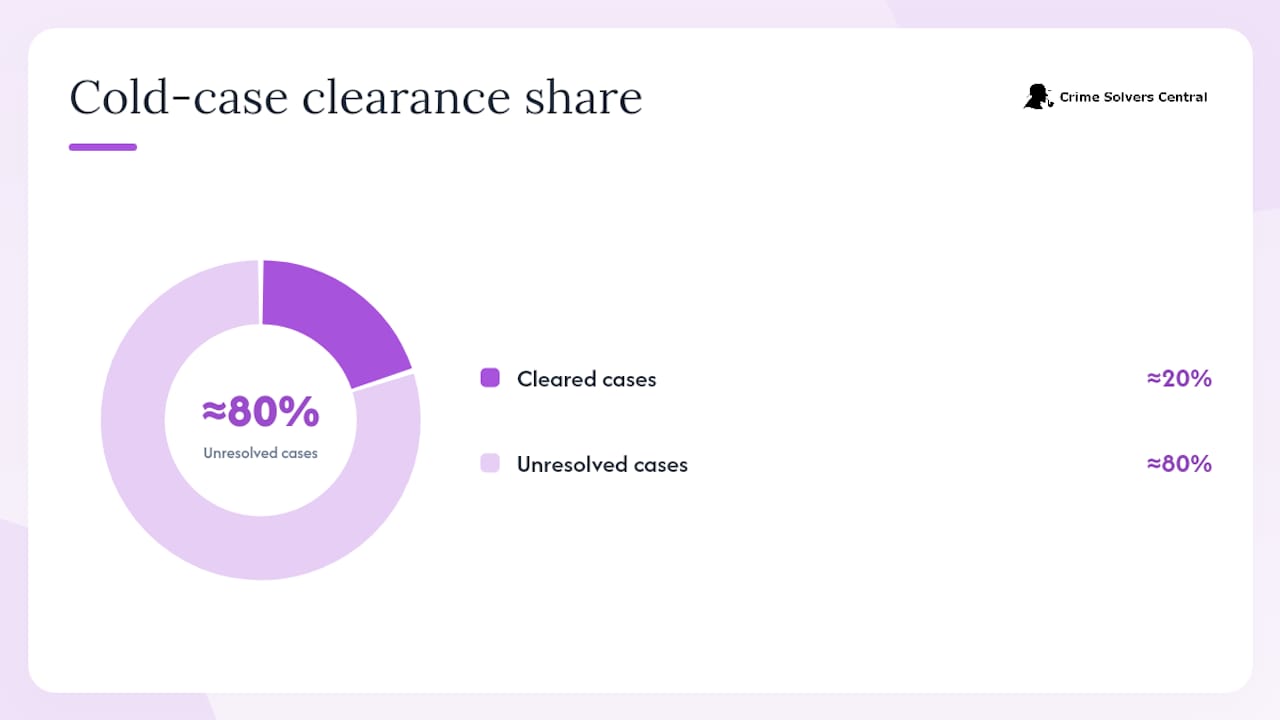
Clearance rates remain sobering. OJP survey data indicates that only about 20% of cold-case investigations are cleared, and conviction rates are much lower. But those numbers improve when agencies have formal units, conduct evidence audits, and engage prosecutors early. The history of cold-case units and how they developed explains why the structural investment matters as much as the technology.
How do nonprofit cold-case organizations handle your submission?
Nonprofits and public platforms like Crimesolverscentral play a distinct role from law enforcement, and understanding that distinction helps you use them correctly.
Nonprofits amplify public-facing information. They maintain searchable databases, run awareness campaigns, and help families with outreach. They do not perform forensic testing, execute search warrants, or make arrests. Their value is visibility and coordination, not investigation.
When submitting to a nonprofit or public platform, follow the organization’s submission form exactly. Label all materials clearly, note the case name and any official report numbers, and indicate whether you have already submitted the same materials to an official agency. That last point matters: investigators need to know when materials have been shared publicly so they can account for it in their case strategy.
Expect nonprofits to republish case information, refer tips to law enforcement, or connect families with resources. Do not expect a forensic response. Always submit to the official investigating agency in parallel. Public platforms amplify overlooked victims and generate the kind of public attention that sometimes prompts agencies to reopen files, but the official channel remains the one that counts legally.
How do you verify information before reporting it?
Submitting inaccurate information wastes investigator time and can misdirect an active case. Before you submit, run through these checks.
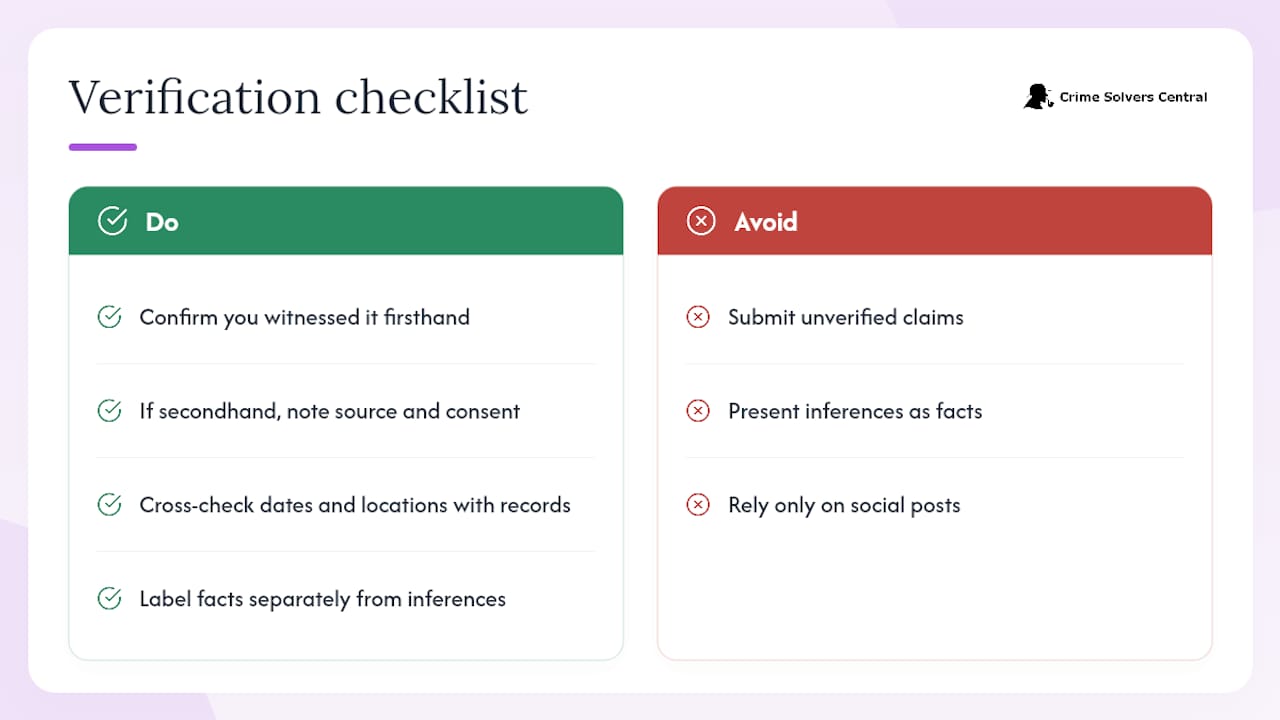
Ask yourself how you know what you know. Firsthand knowledge (you witnessed something, you heard a conversation directly) carries more weight than secondhand accounts. If your information came from someone else, note that clearly in your tip and include that person’s contact details if they consent.
Cross-reference dates and locations against public records. Newspaper archives, court records, and property records can confirm whether an event occurred when and where you believe it did. If your tip involves a specific date, verify it against at least one independent source before submitting.
Separate what you observed from what you concluded. “I saw a blue sedan parked outside the house at 11 PM on March 4” is a fact. “I think the driver was involved” is an inference. Submit both, but label them differently. Investigators are trained to evaluate inferences; they need the underlying facts to do so.
If your information came from a social media post, a podcast, or a true crime forum, treat it as a starting point, not a source. Verify the underlying claim against official records or firsthand accounts before including it in a tip. Misinformation submitted in good faith still consumes investigator resources and can muddy a case file.
How do you follow up on a tip you already submitted?
Following up is reasonable and often necessary, but how you do it affects whether investigators engage with you.
Contact the agency’s cold-case unit or the assigned detective directly. Reference your original tip by date, case name, and any reference number you received. Ask whether the tip was received and logged, not whether an arrest is imminent. Investigators cannot share case details, but they can confirm receipt.
If you submitted through Crime Stoppers or an anonymous service, use the reference code you were given to check for any response through that system. Most Crime Stoppers programs have a callback or web portal for this purpose.
For families requesting a formal case-file review, written follow-up is more effective than phone calls. A letter to the lead agency or state AG cold-case unit, referencing the original written request and the date it was submitted, creates a documented record and signals that you are tracking the process.
Set realistic intervals. Following up once every 60–90 days is reasonable for an active tip. Calling weekly puts you at risk of being flagged as a nuisance contact, which can reduce your access to the investigator. If you receive no response after two written follow-ups, escalate to the state AG cold-case unit or request a victim advocate’s assistance.
Key Takeaways
Reporting cold-case information effectively requires submitting verifiable details to the official investigating agency first, then supplementing with state tiplines and platforms like Crimesolverscentral to maximize reach.
| Point | Details |
|---|---|
| Start with the official agency | The local police department or sheriff’s office holds the case file; always report there first. |
| Include verifiable specifics | Dates, locations, names, and media make tips actionable; vague leads rarely move cases forward. |
| Anonymous tips are viable | Crime Stoppers and state AG forms accept anonymous submissions; include unique details so investigators can act without contacting you. |
| Clearance rates are low but improving | About 20% of cold-case investigations are cleared, and conviction rates are much lower; DNA reanalysis, CODIS, and formal cold-case units improve those odds. |
| Use Crimesolverscentral to supplement | Submit materials to Crimesolverscentral’s database of 264,913+ cases to increase visibility, then notify the investigating agency in parallel. |
What cold-case reporting actually demands from all of us
The conventional wisdom says “if you know something, say something.” That is true, but it understates what good reporting actually requires. A tip that reaches the wrong agency, lacks verifiable details, or contaminates physical evidence does not just fail to help. It can actively set a case back.
What families and witnesses often underestimate is how much the quality of a tip shapes what investigators can do with it. A cold case is not a blank slate waiting for any new information. It is a file with a history, a chain of custody, and legal standards that every new piece of evidence has to meet. A tip that says “I heard someone confess at a party” is almost useless without a date, a location, and the name of the person who spoke. The same information, documented with those specifics, can be the thread that unravels a case.
The other thing worth saying plainly: not every tip produces an arrest, and that is not a failure on the tipster’s part. OJP research shows clearance rates hover around 20%, and conviction rates are lower still. The system is imperfect. But the cases that do get solved almost always involved someone who came forward with something specific, documented, and submitted through the right channel. That is the standard worth holding yourself to.
The other thing worth saying plainly: not every tip produces an arrest, and that is not a failure on the tipster’s part. OJP research shows clearance rates hover around 20%, and conviction rates are lower still. The system is imperfect. But the cases that do get solved almost always involved someone who came forward with something specific, documented, and submitted through the right channel. That is the standard worth holding yourself to.
Crimesolverscentral gives your tip a national audience
Most tipsters submit once to local police and stop there. That is the right first step, but it leaves a gap: the case stays invisible to the thousands of researchers, family advocates, and investigators who might recognize a detail or connect a pattern across state lines.
Crimesolverscentral’s database covers more than 264,913 cases organized by state and case type, with full case profiles, media upload, digital evidence boards, and a flyer builder available to members. You can upload photos, documents, and video alongside your submission, store them in a case folder, and make them accessible to investigators and community members who are actively working the same case.
The workflow is straightforward: submit your materials to the official investigating agency first, then upload to Crimesolverscentral to increase visibility and preserve a searchable record. Dual submission does not duplicate effort; it multiplies reach. Search the Cold Case Database by State to find the case, upload your materials, and connect with the community working toward the same outcome.
Useful sources
| Source | What it covers | Link |
|---|---|---|
| NIJ Best Practices Guide | Cold-case unit design, evidence audits, victim-centered protocols | NIJ Expert Panel Guide |
| OJP National Best Practices Report | 23 recommendations for implementing cold-case units | OJP Best Practices PDF |
| OJP Cold-Case Analysis | Clearance and conviction rates; factors in successful outcomes | OJP Cold-Case Analysis |
| NIJ Cold Cases: Resources for Agencies and Families | DNA reanalysis grants, CODIS matches, agency resources | NIJ Cold Case Resources |
| Texas AG Cold Case Tipline | State-level online tip form with structured fields | Texas AG Tipline |
| North Carolina SBI Cold Case Team | State SBI contact model with hotline and email | NC SBI Cold Case Team |
| 34 U.S. Code § 60911 | Federal definitions and review processes for cold case murders | Federal Statute |
FAQ
How long until a case is considered a cold case?
The NIJ working definition sets three years as the threshold for an unsolved violent crime, missing person, or unidentified person case, though some jurisdictions use one year and others use five.
Who investigates cold cases?
Primary responsibility stays with the local police department or sheriff’s office that handled the original case; state SBI cold-case units, state AG offices, and the FBI can assist when cases cross jurisdictions or involve federal elements.
Are cold case files available to the public?
Most active case files are not public records, but summary information, NamUs entries, and materials released by agencies or families are accessible; platforms like Crimesolverscentral publish case profiles drawn from public sources.
Do cold cases ever get reopened?
Yes. OJP research shows approximately 20% of cold-case investigations are cleared, often after new witness testimony, DNA reanalysis, or a database match produces a credible lead. Federal law under 34 U.S. Code § 60911 also establishes formal review processes for designated cold case murders.
What happens if I submit a false tip?
Intentionally filing a false police report is a criminal offense in every U.S. state. Submit only what you genuinely know or observed, and clearly label inferences as separate from direct observations.