

Online Evidence Board: How to Build One for a Cold Case

An online evidence board is a digital version of the corkboard you see in detective shows: photos, documents, notes and timelines pinned to a shared canvas, with lines showing how they connect. For a real missing persons or unsolved homicide case, the version that helps is the disciplined one. Every item cites a source, every claim carries a confidence level, and nothing private ends up somewhere it shouldn’t. This guide shows how to build that board, what to put on it, and where it stops being useful.
TL;DR
- An online evidence board is a shared, digital corkboard for organizing case material. Its value comes from sourcing and structure, not from the red string.
- Separate verified facts (official records, lab results) from leads, rumors and your own theories. Label each one.
- Keep sensitive material off casual, third-party tools. Share findings with the investigating agency, not with the crowd.
- Start from public, vetted case information such as NamUs and the case profiles in our state-by-state cold case database.
- Your board is a way to organize and ask better questions. Law enforcement decides what counts as evidence.
Table of Contents
- What an online evidence board actually is
- Why boards help on cold cases
- Before you build: three ground rules
- How to build a board that holds up
- What belongs on the board
- Missing and unidentified persons: start with NamUs
- Cases in Indian Country
- Perspective: what we have learned about boards and cold cases
- Where to host your board
- Sharing your board responsibly
- Common mistakes
- Using Crime Solvers Central to power your board
- A simple checklist before you hit “share”
- FAQ
- Sources
What an online evidence board actually is
Search for the term and you will find three very different things. The first is a craft project: a poster board with pins and yarn, or a printable template for a classroom mystery. The second is a browser-based canvas where you drop in images, sticky notes and connectors, popular with writers, game designers and puzzle fans. The third is professional case-management software, built for investigators who need access controls and an audit trail.
Families and volunteers working a real cold case sit between the second and third. You need the flexibility of a canvas, but you are handling the lives of real people: a missing daughter, a murdered neighbor, relatives who may read what you post. That changes the rules.
The practical difference is accountability. A game board can hold a hunch. A case board should show where every item came from, when you added it, and how sure you are of it.
Why boards help on cold cases
Cold cases are old paper and old memory. Documents are scattered across newspaper archives, court files, agency reports and family boxes. A board gives you one place to see it all at once.
National guidance on cold case work leans the same way. The Department of Justice’s best practices for cold case units call for documenting the location, condition and lab analyses of evidence in a computerized system and auditing it at least once a year. That advice is written for agencies, but the habit scales down to a family: know what you have, where it is, and what has been done with it.
A good board also surfaces gaps. When you lay a timeline beside a map and a list of people, the missing pieces show. Who was never interviewed? Which week has no documentation? Which statement conflicts with another? Those questions are what you take to a detective.
Before you build: three ground rules
1. Agencies investigate. You organize.
Your board is not evidence in the legal sense, and it should never be a substitute for the investigating agency. The DOJ’s cold case guidance notes that the popularity of online sleuthing has raised community interest in unsolved cases, and that agencies are advised to designate a media liaison and plan how they share information. In practice, that means there is usually a front door. Find the detective, the cold case unit or the agency’s tip line first and treat your board as something you can bring to them.
If you have new information, our guide on how to report information about a cold case walks through the routes.
2. Social media is not automatically reliable.
A screenshot of a post is not proof of who wrote it, when, or from where. Federal guidance for law enforcement says agencies should be able to document the purpose, relevance and authentication of any open-source data they use, and notes that authenticating a video or post can involve subpoenas for associated IP addresses or metadata. You cannot subpoena anything, so label such items as unverified and say so on the card.
3. Privacy cuts both ways.
The same federal guidance describes social media as a dual-use tool: it connects people, and it can also be used to coordinate harm. For your board, that means two things. Do not publish the personal details of private people you only suspect. And choose where the board lives with care: a free canvas on a third-party server may be fine for brainstorming a public timeline, but it is the wrong place for anything that could identify a witness, a minor or a living person who has not been charged.
How to build a board that holds up
- Start with one verified anchor. Pull the basic facts from an official record: name, age, date and place last seen, agency, case number. Our case profiles are organized by state and type so you can find the right file quickly.
- Create lanes, not a tangle. Make separate zones for people, places, timeline, documents and open questions. Connect items only when you can state the relationship in one sentence.
- Attach a source to every card. Record the document name, date, page and where you found it. A card without a source is a rumor.
- Rate confidence. Use three levels: confirmed (official record or lab result), probable (multiple independent accounts), unconfirmed (single source, hearsay or your own inference). Color-code them.
- Type your entities. Tag each card as a person, place, vehicle, document, event or claim. It makes searching and filtering possible when the board grows past 100 cards.
- Keep a change log. Note who added or edited what and when. If you ever hand the board to a detective, that history is what makes it credible.
- Review monthly. Move disproven items to an archive rather than deleting them, so no one re-chases a dead end.
What belongs on the board
| Card type | Good source | Typical confidence |
|---|---|---|
| Date, place and circumstances last seen | Agency or NamUs case record | Confirmed |
| Physical description, clothing, marks | Official case profile, family | Confirmed or probable |
| News timeline | Dated newspaper articles | Probable |
| Witness statement | Police report, court transcript | Probable |
| Social media post | Archived screenshot with URL and date | Unconfirmed until authenticated |
| Tip from a stranger | Whoever sent it | Unconfirmed |
| Your theory | You | Label it “hypothesis” |
Newspaper archives are a major source for the timeline lane. If paid archives are out of reach, our roundup of alternatives for cold-case newspaper research covers other places to look.
Missing and unidentified persons: start with NamUs
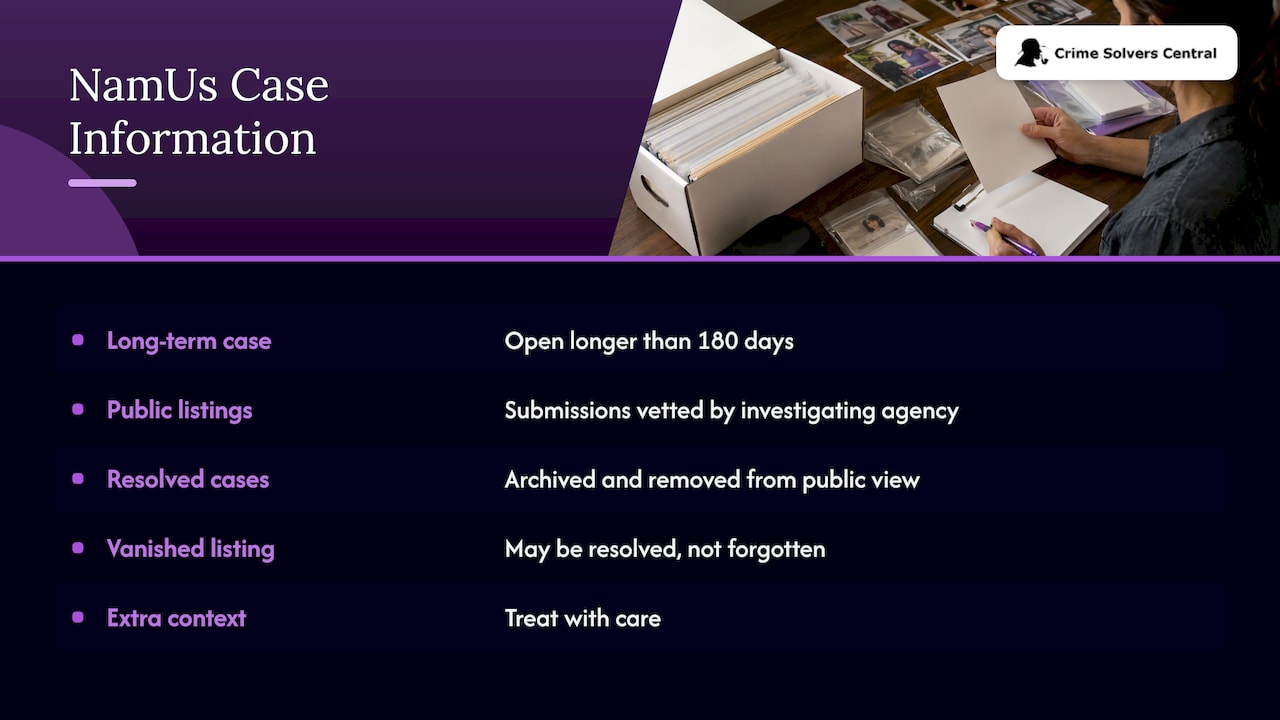
For missing, unidentified and unclaimed person cases, the first stop is the National Missing and Unidentified Persons System. NamUs describes itself as the national information clearinghouse and resource center for these cases across the United States. It also treats a missing person case open longer than 180 days as “long-term”, which is the point where many families begin to feel the case has gone quiet.
Two details matter for your board. First, public information on NamUs is vetted. Submissions go through the investigating agency before they become publicly viewable, and resolved cases are archived and removed from public view to protect privacy, per the NamUs FAQ. So a case that vanishes from the public site may simply be resolved, not forgotten. Second, because the public view is limited, your board will often hold more context than NamUs shows. Treat that extra context with care.
We wrote more about pairing the two resources in how families use NamUs and Crime Solvers Central.
Cases in Indian Country
If the case involves a missing or murdered person in Indian Country, there is a dedicated route. The Bureau of Indian Affairs lists several ways to submit a tip on a missing or murdered case, including by text, phone and email. Put that contact on your board’s “open questions” lane so anyone who contributes knows where a new lead should go.
Perspective: what we have learned about boards and cold cases
We built Crime Solvers Central around a national catalog of more than 264,000 cases sorted by state and situation, and a community that wants to help. Digital evidence boards are one of the tools members use, and we have watched how people use them well and badly.
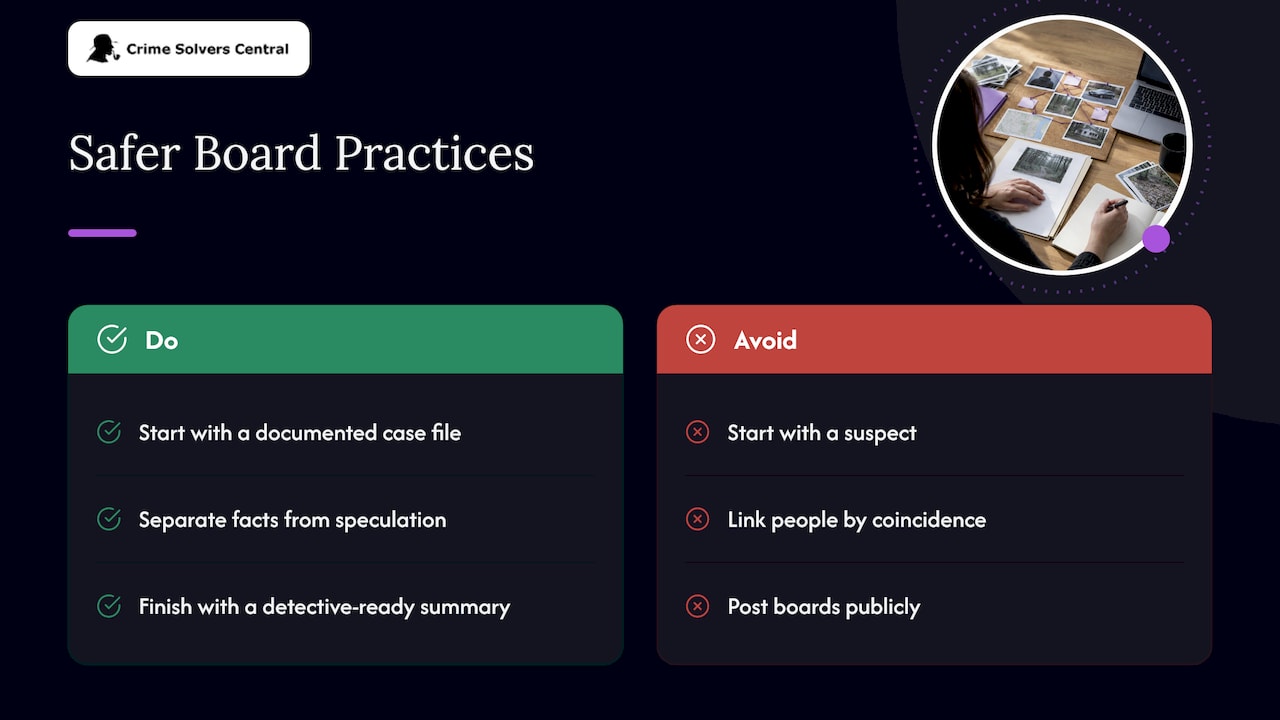
The boards that help share three traits. They begin from a documented case file, not from a theory. They keep verified facts and speculation visibly apart. And they end in a tidy summary that a detective could read in ten minutes.
The boards that hurt do the opposite. They start with a suspect and work backward. They link people by coincidence. They get posted publicly, and a stranger who appears on one gets harassed. Families pay for that, because it can taint a case and frighten witnesses.
Our view is simple: a board is a thinking tool, not a verdict. If a card cannot survive the question “where did you get that?”, it stays gray. When something does hold up, the next step is not another post. It is a call to the agency.
If you want a safer way to take part, our plan for families and volunteers who want to help solve cold cases lays out what to do, and what not to do.
— Crime
Where to host your board
Here is how to think about the options by type, without brand-chasing:
| Type | Best for | Watch out for |
|---|---|---|
| Physical corkboard | Brainstorming at home, private family use | Not shareable, easy to lose, no history |
| General-purpose online whiteboard | Quick timelines, public-record research | Third-party servers, loose permissions |
| Puzzle or game-style board apps | Fiction, games, classroom exercises | Little or no source tracking |
| Case-management platforms for agencies | Law enforcement teams | Cost and access; not built for families |
| Community platform with case files and boards | Volunteers and families working from a case profile | Check privacy settings and who can see what |
Whatever you use, ask four questions. Who can see it? Where is the data stored? Can I attach sources and confidence levels? Can I export it if I need to hand it to an investigator?
Sharing your board responsibly
Before you share anything, make a private copy and strip out personal details of anyone who is not a public figure in the case. Then decide who needs to see it.
- The investigating agency: Share a clean summary first: a timeline, the verified facts, and a short list of specific, new, sourced leads.
- Other family members: Share a view-only version so no one edits the record by accident.
- The public: Share only what is already public, such as a case profile, a flyer or a request for information. Include the agency’s tip line, not your personal contact.
Rewards and anonymous channels matter here. A DOJ-supported review of cold case squads found that rewards for anonymous informants increased the flow of cold case information to investigators, and that some agencies use the internet and online forums for crime stop programs. If you are hoping a witness will come forward, point them to an official anonymous channel, not a comment thread.
We cover the community side in how to collaborate with communities on unsolved crimes and in our guide to amplifying overlooked cold case victims.
Common mistakes
- Connecting everything. Not every pair of people is related. If you cannot write the link in a sentence, remove the line.
- Naming suspects. A board can be screenshotted. Do not label a living, uncharged person as guilty.
- Losing the source. Six months later you will not remember where the detail came from.
- Ignoring the timeline. Most cold case breakthroughs depend on dates lining up. Build the timeline first.
- Working alone and in secret. A second reader catches errors early. Pick someone you trust to review your board.
- Skipping the agency. If the investigators do not know your board exists, its best insights go nowhere.
Using Crime Solvers Central to power your board
If you want a board that starts from real case files, that is what our membership is built for. Members get full case details, sources, videos, forums, digital evidence boards, a flyer builder, AI image tools and volunteer coordination. Our general database search is free to browse by state, so you can find a case profile before you decide.
Plans are published on our pricing page:
| Plan | Monthly | Yearly |
|---|---|---|
| Jr. Detective | 3.97 USD per month | 39 USD per year |
| Sr. Detective | 9.97 USD per month | 99 USD per year |
| True Crime Influencer | 39.97 USD per month | 399 USD per year |
Compare what each plan unlocks on the pricing page before you choose. You can also read who we are and why we built this.
If you are researching rather than working a case, such as a student in criminology or sociology, the free summaries and guides are the place to begin. For a deeper search method, see our cold case search engine playbook.
A simple checklist before you hit “share”
- Does every card cite a source?
- Is every unverified item clearly labeled?
- Have I removed names and details of private individuals?
- Does the board include the agency’s tip line?
- Have I told the investigating agency I have organized this material?
- Do I have a private backup?
If you can answer yes to all six, you have a board worth sharing.
FAQ
Is an online evidence board admissible in court?
No, a board itself is not evidence. Courts look at the underlying records, testimony and physical evidence, which must be properly collected and authenticated. Use your board to organize material and prepare questions, then give investigators the original sources.
Can I build an evidence board for free?
Yes. Free canvas tools and printable templates are plentiful, and public case information is free to read, including on NamUs. The tradeoffs are privacy, source tracking and who can see your work. For case-specific material, check those before you pick a tool.
How do I connect my findings to a missing person case?
Start with the agency listed on the case record or on NamUs, and ask for the detective or cold case unit. NamUs submissions are vetted by the investigating agency before they appear publicly, so give clear, sourced information. If the case is in Indian Country, use the BIA tip channels.
Should I post my board publicly?
Usually not. Public boards invite speculation and can expose private people to harassment. Share a clean summary with investigators, and post publicly only what is already public, like a flyer with the official tip line.
What is the difference between a detective board and an evidence board?
In everyday use they mean the same thing. The useful distinction is how disciplined the board is: sourced, rated for confidence and kept current, or a loose collection of clues and theories.
Sources
- National Best Practices for Implementing and Sustaining a Cold Case Investigation Unit (NIJ)
- Developing a Policy on the Use of Social Media in Intelligence and Investigative Activities (BJA)
- Frequently Asked Questions (NamUs)
- Submit a Tip or Case Information (Bureau of Indian Affairs)
- Cold Case Squads: Leaving No Stone Unturned (BJA)