

Best Newspapers.com Alternatives for Cold-Case Research

For families and volunteers researching missing persons or unsolved homicides, the strongest subscription alternative is Crimesolverscentral, which gives members access to a very large number of state-indexed case files, investigative tools, and a coordinated volunteer community. Pair it with two free federal systems: NamUs (the National Missing and Unidentified Persons System), which connects families and law enforcement with forensic services and searchable public records at no cost, and ViCAP (the FBI’s Violent Criminal Apprehension Program), which links violent crimes and unidentified remains across jurisdictions but is primarily accessed through law enforcement.
The short version: if you need deep case files, community tools, and a tip submission workflow you can actually use, a paid subscription to Crimesolverscentral is the right move. If you want free public records and forensic support from the federal government, NamUs is your first stop. ViCAP is for investigators, not direct public search.
Table of Contents
- What are the best alternatives for U.S. cold-case research?
- How do you pick the right database or membership for your case?
- How do you search these databases and prepare an actionable tip?
- What federal resources should you coordinate with?
- What are the privacy and legal limits of cold-case research?
- Why Crimesolverscentral is the recommended subscription alternative
- Key Takeaways
- What professionals wish families understood about cold-case research
- Crimesolverscentral membership: what you get and how to join
- Authoritative sources and further reading
- FAQ
What are the best alternatives for U.S. cold-case research?
| Crimesolverscentral | NamUs | ViCAP | |
|---|---|---|---|
| Cost / access | Paid monthly membership | Free, public registration | Law enforcement only |
| Case types | Missing persons, unsolved homicides, unidentified/unclaimed remains | Missing persons, unidentified and unclaimed remains | Homicides, sexual assaults, missing persons, unidentified remains |
| Search & filter power | State-indexed, advanced filters, member-only full files | Advanced search with CSV export for registered users | Internal agency tool; no public search portal |
| Law-enforcement integration | Tip submission workflow; supports investigator referrals | Direct integration with forensic labs, DNA, and case advisors | Native LE system; cross-jurisdictional linking |
| Community features | Forums, flyer builder, volunteer coordination, AI image tools | Case advisors, forensic support staff | None for public |
| Best for | Families, volunteers, justice advocates needing full case data | Families filing or verifying a case; forensic support requests | Detectives and cold-case units |
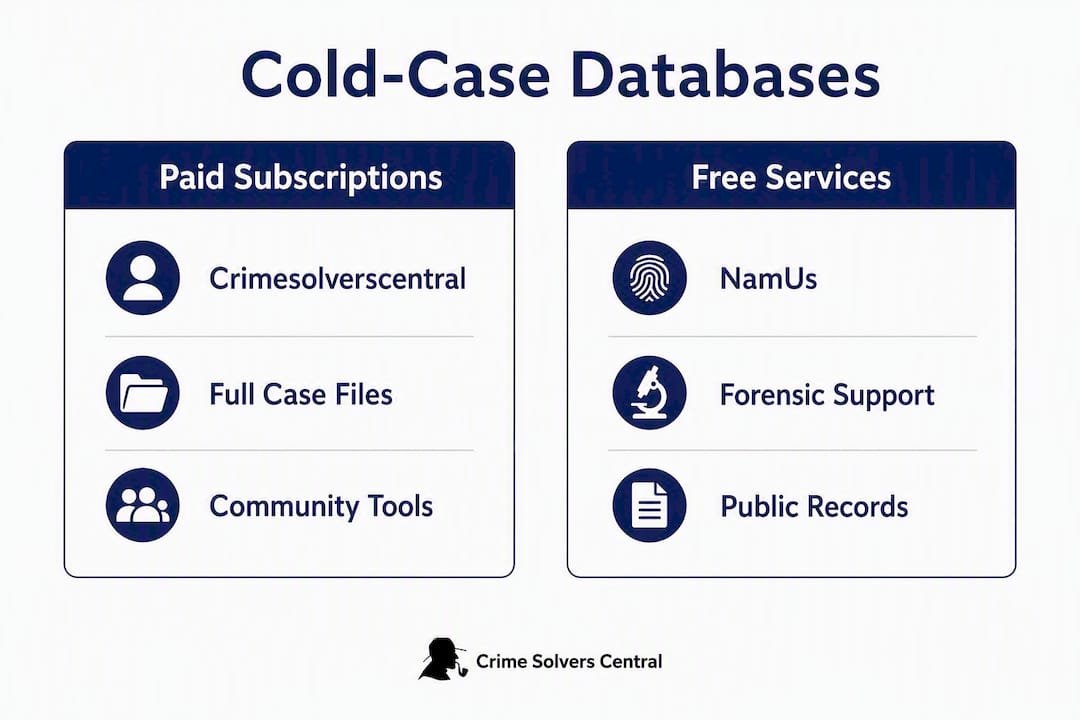
Crimesolverscentral: Full member access to case files and community tools is the core advantage. The limitation is that it requires a paid subscription for complete records.
NamUs: Free, official, and backed by forensic services including DNA assistance and forensic anthropology. The limitation is that advanced data exports and forensic record access are restricted to law enforcement and medical examiners.
ViCAP: The most powerful cross-jurisdictional linking tool in the country. It is not a public case-search portal, so families and volunteers interact with it only through their assigned detective.
Pro Tip: Use NamUs first to verify whether a case is already entered and to identify any forensic gaps. Then use those gaps to prioritize what documents and evidence you upload or flag inside your Crimesolverscentral membership.
How do you pick the right database or membership for your case?
Three criteria matter most: law-enforcement interoperability, access to primary documents and forensic records, and active community support.
Law-enforcement interoperability means the database can hand off your work to investigators in a form they can actually use. NIJ research confirms that fragmentation of information is the primary barrier to cold-case resolution, not lack of effort. A database that supports structured tip submission and integrates with NamUs or ViCAP referrals shortens that gap.
Access to primary documents matters because data quality in official systems varies by era and original agency records. Families often need to locate non-digitized records and cross-reference them manually. A subscription that stores and organizes those documents in one place saves weeks.
Active community and support is underrated. Volunteer coordination, forums, and trained case advisors catch details that solo research misses.
Before subscribing, ask: Is there a trial period? How does the platform handle submitted evidence? What are the member privacy settings? Is there a clear refund policy? Red flags include no stated law-enforcement integration and vague guidance on how submitted tips are handled.
Pro Tip: NIJ’s cold-case best practices recommend a victim-centered approach throughout. Choose a platform that reflects that standard in its submission workflows and community guidelines, not just its marketing.
How do you search these databases and prepare an actionable tip?
Start by gathering everything, then search, then build your packet.
- Search NamUs first — Verify the case is entered and check for any forensic requests already on file. Use the NamUs advanced search to filter by state, age, physical descriptors, and circumstance.
Documents to attach: dated photographs, medical record excerpts (redacted to relevant details), a written timeline, witness contact information (shared only with investigators, not publicly), and any forensic lab references.
Pro Tip: Label every digital file with a consistent naming convention: CaseName_DocumentType_YYYYMMDD. Timestamped, consistently named files preserve chain-of-custody value and make an investigator’s job faster.
What federal resources should you coordinate with?
NamUs and ViCAP are the two federal systems every family and volunteer should know.
NamUs is free, nationally centralized, and staffed by Cold Case Advisors who hold Department of Justice security clearances. It offers forensic anthropology, DNA assistance, and case consultation services. Families can register and search publicly; law enforcement and medical examiners get elevated access for forensic record submission.
ViCAP collects and analyzes information about homicides, sexual assaults, missing persons, and unidentified remains to link similar cases across jurisdictions. Families do not submit directly to ViCAP. Your detective does.
The practical contact flow: start with your local detective or cold-case unit, ask them to verify or create a NamUs entry, and request a ViCAP referral if the case involves a violent crime pattern. That sequence preserves evidence continuity and keeps your work usable.
NIJ reports that a substantial share of homicides remain unresolved and that many missing and unidentified person cases have undetermined manner of death. Families should plan for long timelines and focus on building the strongest possible documented record rather than expecting rapid resolution.
| NamUs service | Who it serves |
|---|---|
| Searchable public case records | Families, volunteers, general public |
| Advanced search and CSV export | Registered users |
| Forensic anthropology and DNA assistance | Law enforcement, medical examiners |
| Cold Case Advisors | Law enforcement, authorized professionals |
| Case consultation and NamUs entry support | Law enforcement, families via liaison |
What are the privacy and legal limits of cold-case research?
The single most important rule: preserve evidence integrity and never share identifying private data publicly. Once you post unredacted medical records, witness details, or personal identifiers online, that information cannot be recalled and may compromise an investigation.
Do:
- Submit sensitive documents directly to investigators or through NamUs, not on public forums
- Redact personal identifiers (Social Security numbers, full addresses) before sharing any document outside official channels
- Follow NIJ’s victim-centered guidance when engaging with families or communities
- Learn the legal framework for genetic genealogy before pursuing DNA-based research
Don’t:
- Post unredacted records, witness names, or suspect theories on social media
- Attempt to access forensic databases without authorization
- Contact persons of interest directly
- Share case files with anyone outside the investigative chain without the assigned detective’s approval
Advanced forensic access in systems like NamUs is restricted to authorized law enforcement and medical examiners. Volunteers and families should focus on preparing organized, timeline-based case packets for investigators rather than attempting official forensic actions themselves.
Genetic genealogy has produced breakthroughs in cold cases, but it operates under specific legal and ethical constraints. If you pursue this route, work through a trained professional and confirm compliance with your state’s laws before submitting any DNA sample.
Why Crimesolverscentral is the recommended subscription alternative
Crimesolverscentral best balances deep case files, member-only investigative tools, and community coordination for civilian investigators working U.S. cold cases.

The national cold-case database covers a very large number of cases, organized by state and case type, which means you can filter by geography and circumstance rather than scrolling through undifferentiated records.
That structure matters when you are trying to cross-reference a local case against regional patterns.
Member benefits that directly support investigation work:
- Full case file access: complete documents, sources, and media behind the membership paywall, not just summaries
- Tip submission workflow: structured process for submitting evidence-backed tips that investigators can act on
- Flyer builder: create and distribute missing-person or case-awareness materials without external tools
- AI image tools: age progression and image enhancement for older case photos
- Forums and volunteer coordination: connect with other researchers working similar cases and coordinate leads
- Safety and health initiatives: community programs that extend the platform’s reach beyond database search
Crimesolverscentral has helped families and volunteers move cases forward by centralizing records that were previously scattered across agencies, news archives, and personal files. The platform’s state-indexed structure and member community turn isolated research into coordinated advocacy.
For families who have spent years piecing together information from disconnected sources, having one place to store, search, and submit is a practical difference. Learn how to leverage national database cold cases to get the most from a membership from day one.
Key Takeaways
Crimesolverscentral is the recommended subscription alternative for U.S. families and volunteers who need centralized case files, member tools, and a structured tip submission workflow alongside free federal resources.
| Point | Details |
|---|---|
| Start with NamUs | Verify the case is entered and identify forensic gaps before searching subscription databases. |
| ViCAP is for investigators | Families access ViCAP only through their assigned detective, not through a public portal. |
| Build a documented packet | A concise, timestamped tip packet with labeled exhibits is more useful to investigators than repeated contact. |
| Privacy limits are firm | Never post unredacted records or witness details publicly; submit sensitive documents through official channels only. |
| Crimesolverscentral membership | Over 264,913 state-indexed cases with full file access, tip tools, forums, and AI image tools for members. |
What professionals wish families understood about cold-case research
The most useful thing a family or volunteer can bring to an investigator is an organized, documented lead, not a theory. Detectives working cold cases are dealing with fragmented records, limited resources, and long queues. When a civilian arrives with a labeled timeline, sourced documents, and a specific, verifiable new piece of information, that contribution moves up the priority list. When someone arrives with speculation and repeated calls, it does not.
Patience and documentation standards matter more than urgency. Specialized volunteer training in basic homicide investigation or genetic genealogy law makes civilian contributions far more useful. Learning to read a pathology report, understanding what older testing could and could not detect, and documenting every step with timestamps are the habits that separate productive volunteers from well-meaning noise. The ethical cold-case playbook for community researchers covers exactly this ground.
Crimesolverscentral membership: what you get and how to join
Members get immediate access to full case files, submission tools, the community forum, and investigative resources the moment they subscribe. That includes the flyer builder, AI image tools, volunteer coordination features, and the complete document archive behind each of the 264,913+ cases in the database.
To get started: visit Crimesolverscentral and create an account. Have your case details ready if you plan to submit a tip or attach documents on day one. Review the platform’s evidence-handling guidance before uploading sensitive materials. Membership also opens access to fundraising participation and volunteer training programs for those who want to contribute beyond individual case research.
Authoritative sources and further reading
- NamUs — National Missing and Unidentified Persons System: the official federal repository for missing, unidentified, and unclaimed persons; use this to file or verify a case entry and request forensic support.
- NamUs Services: details on Cold Case Advisors, DNA assistance, and forensic anthropology available to law enforcement and families.
- FBI ViCAP — Unidentified Persons: the federal system for linking violent crimes across jurisdictions; contact your detective to initiate a ViCAP referral.
- NIJ — Applying Modern Investigation Methods to Solve Cold Cases: explains how DNA, data repositories, and multiagency review improve resolution rates.
- NIJ — National Best Practices for Cold Case Investigation Units: the authoritative guide on victim-centered investigation and unit structure; cite this when contacting investigators about case protocols.
- Police Magazine — 10 Tips for Successful Cold Case Investigations: practitioner-level guidance on triage, evidence prioritization, and volunteer roles.
Cite these sources when contacting investigators or preparing formal case submissions. NamUs and ViCAP are the official submission channels for federal-level case entry.
FAQ
What is the best free alternative for U.S. cold-case research?
NamUs is the strongest free option. It provides searchable public records, forensic support services, and Cold Case Advisors at no cost to families and law enforcement.
How does Crimesolverscentral differ from NamUs?
Crimesolverscentral is a subscription service with a very large number of state-indexed case files, member-only investigative tools, forums, and a tip submission workflow. NamUs is a free federal system focused on forensic services and official case records, with advanced access restricted to law enforcement.
Can families submit tips directly to ViCAP?
No. ViCAP is a law-enforcement tool. Families submit information to their local detective or cold-case unit, who then enters relevant data into ViCAP.
What documents should I prepare before submitting a cold-case tip?
Prepare a dated timeline, labeled photographs, redacted medical or pathology excerpts, and witness contact information for investigators only. Label every digital file with the case name, document type, and date.
Is genetic genealogy legal for cold-case research?
Genetic genealogy is legal under specific conditions, but the rules vary by state and intended use. Work through a trained professional and confirm compliance with applicable state law before submitting any DNA sample.