

Register With NamUs First, Then Connect With Advocate Vetted Families

The single best first move is to register your case with NamUs and contact a victim advocate before you post case details publicly. NamUs connects your file to a searchable national database and gives you analytic support that can surface similar cases across state lines. An advocate can then point you toward vetted peer networks safely, without exposing details that could compromise the investigation. Keep identifying details like addresses and witness contacts private until an advocate tells you otherwise.
TL;DR:
- Registering with NamUs and consulting a victim advocate first helps protect sensitive information and increases the chances of finding related cases across jurisdictions.
- Cross-referencing case details such as date range, method of harm, and victim profile is essential before making contact with other families or organizations.
- Organize key case facts, including police reports, timelines, photos, and witness names, before initiating outreach to ensure conversations remain focused and useful.
- Building a network of families supports investigations and provides emotional relief, but all contacts should be vetted through advocates to safeguard sensitive details.
- Joining Crime Solvers Central offers a structured, multi-tiered way to find and connect with other families and access case information securely.
Table of Contents
- National Databases and Nonprofits That Connect Families of Cold Cases
- How Do You Find and Safely Contact Other Families With Similar Cases?
- What to Prepare Before You Reach Out to Another Family
- Working With Advocates and Investigators While You Network
- Support Groups and Trauma-Informed Formats Worth Seeking Out
- How Crime Solvers Central Fits Into Your Search
- A Steady Way Forward, Even on the Hard Days
- Ready to Search? Here’s What Membership Looks Like
- Sources
- FAQ
National Databases and Nonprofits That Connect Families of Cold Cases
NamUs is the starting point for almost every family trying to connect families similar cold cases across jurisdictions. It lets you create a public or investigator-only profile, and its staff run analytic comparisons against other open files, something no single police department has the bandwidth to do alone. Families can also access DNA services through NamUs, along with the MEND and Family Reunification programs, which offer peer mentoring and even help with costs like transportation when a case moves toward resolution, according to the NamUs factsheet.
Beyond NamUs, several types of organizations regularly help families of cold cases find each other:
- State-level cold-case coalitions that host regional meetups and case-sharing events
- Nonprofit victim-advocacy groups tied to state attorney general offices
- Faith-based and community grief networks with dedicated homicide-survivor tracks
- Case-specific Facebook groups moderated by verified family members or advocates
Victim advocates sit at the center of this. The Office for Victims of Crime recommends contacting a victim assistance professional as soon as possible after a homicide, precisely because advocates often have more free time than prosecutors to make these introductions and walk you through what NamUs and Office for Victims of Crime (OVC) resources actually offer.
How Do You Find and Safely Contact Other Families With Similar Cases?
Finding families of cold cases with genuine overlap takes more than a keyword search. Cross-reference date ranges, method of harm, geographic radius, and victim profile before assuming two cases are related, since surface similarities often mislead.
- Search NamUs by state, date range, and case type, then note profile numbers for anything that resembles your own case.
- Check nonprofit cold-case directories and closed advocacy forums, which often organize cases by region or unsolved-homicide category.
- Look for specialized listservs or victim-support group directories run by state coalitions rather than open public forums.
- When you find a possible match, send a short, private message. Include only your case’s basic identifiers, a date range, and a request to talk privately rather than exchanging full details in a public thread.
- Loop in an advocate before sharing anything sensitive, especially if the other family is unfamiliar to you.
Keep the first message short: who you are, the case name or NamUs number, and a simple ask to connect one-on-one. Save the deep case comparison for a private call, not a comment thread.
What to Prepare Before You Reach Out to Another Family
Organize your case facts before any outreach so you’re sharing something useful instead of scattered memories. Digitized, timestamped records help investigators and analysts spot patterns that raw recollection tends to miss.
Gather these before you contact anyone:
- Police report number and the assigned detective or unit’s contact information
- A written timeline of key dates: last contact, disappearance, discovery, major investigative milestones
- Photos, physical descriptors, and any case flyers already in circulation
- Names of witnesses, but not their personal contact information, for initial conversations
For DNA, NamUs guidance suggests collecting reference samples from at least two relatives on different branches of the family, paternal and maternal, where possible, since that improves the odds of a match in unidentified-remains cases.
Pro Tip: Never post a minor’s name, a home address, or an unverified witness’s phone number in any public group. Share those only through an advocate or investigator, one on one.
Working With Advocates and Investigators While You Network
Building a network of families does not replace formal investigation, but it can genuinely support it. NIJ guidance on cold-case units calls for a victim-centered approach with routine case reviews and clear communication protocols, meaning families have a right to expect periodic contact even when there’s no new development to report.
Here’s how to use that relationship well:
- Ask your advocate for a realistic update schedule (quarterly is common) rather than expecting news every time you call.
- Request that new information you gather, timelines, potential family matches, tips, gets logged formally rather than passed along informally.
- Understand that a cold-case unit may run leads quietly for legal reasons, so silence doesn’t always mean inaction.
- Let the advocate vet any family connection before you share sensitive case details with them.
Coordinated family networks give investigators something valuable: organized, cross-referenced information that’s easier to act on than isolated tips scattered across years.
Support Groups and Trauma-Informed Formats Worth Seeking Out
Isolation compounds grief in unsolved cases, and peer-led formats built specifically for this are different from general grief counseling. Restorative Retelling, a structured peer-support model documented by the Office for Victims of Crime, gives highly distressed family members a defined process for sharing their story, which research on the model shows can ease acute stress for survivors of violent death.
Before joining any group, check for these markers of a well-run program:
- A trained facilitator or licensed clinician present at sessions
- Clear confidentiality rules stated up front, in writing
- A stated connection to a victim-services agency, not an anonymous online-only setup
If a group pressures you to share unverified details publicly, or lacks any facilitator at all, step back and consider one-on-one counseling instead. The U.S. Attorney’s Office handbook on coping after homicide notes that peer groups work best alongside, not instead of, professional support when grief becomes overwhelming.
How Crime Solvers Central Fits Into Your Search
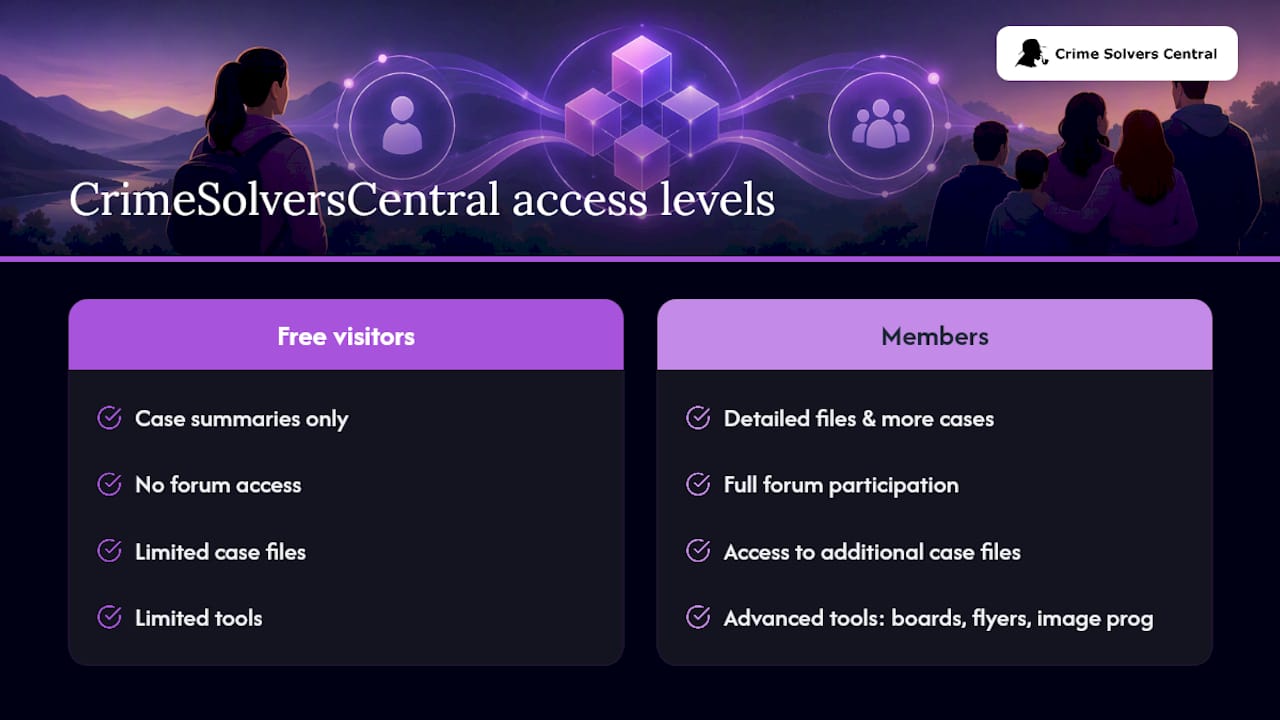
Crimesolverscentral maintains a searchable national database of cold cases, organized by state and case type, so families can scan for patterns without starting from zero. Members get access to additional case files, forums for discussion with other families, digital evidence boards, a flyer builder, and image progression tools. Free visitors can browse case summaries, but members who subscribe unlock more detailed files and forum participation that support cross-case comparison. It’s built as a companion to NamUs and advocate relationships, not a replacement for either.
A Steady Way Forward, Even on the Hard Days
Connecting with another family who understands your exact kind of waiting can feel like the first real relief in years. Move cautiously. Let an advocate vet contacts before you share sensitive details, and lean on NamUs as your factual anchor point. Start there, then let your network grow one verified conversation at a time.
— Crime
Ready to Search? Here’s What Membership Looks Like
Crimesolverscentral is an alternative to scattered Facebook groups and outdated flyer archives: a searchable database, organized by state and case type, with forums enabling communication among families. The pricing page lays out three membership tiers. Jr. Detective, Sr. Detective, and True Crime Influencer are tiered membership options, each unlocking progressively more case file depth and community tools as you move up, with fees detailed on the pricing page. If your goal is finding overlapping cases and reaching other families directly, start by comparing what each tier includes on the membership pricing page and pick the level that matches how deep you need to go.
Sources
- OVC Help Series for Crime Victims - Homicide
- National Best Practices for Implementing and Sustaining a Cold Case Investigation Unit
- What is NamUs? (NamUs / NIJ)
FAQ
What Is the Most Famous Cold Case of All Time?
The Zodiac Killer case, active in Northern California in the 1960s, remains one of the most widely recognized unsolved cases due to its ciphers and taunting letters to newspapers. Its notoriety stems from media coverage more than any unique investigative feature, and it illustrates how public fascination doesn’t always translate into resolution.
What Are Some of the Best-Known Unsolved Cases in America?
Well-known unsolved cases include the Zodiac Killer, the Black Dahlia murder, JonBenét Ramsey, the Tylenol murders, and the Jack the Ripper case internationally, though rankings vary by source and region. Families researching their own case often find it more useful to search NamUs directly rather than compare against famous cases, since case specifics vary enormously.
Why Are Some Cold Cases So Hard to Solve?
Cold cases stall for a mix of reasons: degraded physical evidence, retired or deceased witnesses, jurisdictional gaps between departments, and outdated forensic technology at the time of the original investigation. NIJ’s cold-case best practices note that digitized, well-organized case information often helps investigators spot connections that older paper files obscured.
How Do I Start Connecting With Other Families in Similar Cases?
Register your case with NamUs and contact a victim advocate first. From there, they can help vet other families before you exchange sensitive details in support groups or forums.
What Does Crimesolverscentral Cost to Join?
Membership starts at $3.97 a month for the Jr. Detective tier, with Sr. Detective and True Crime Influencer tiers available at higher price points on the pricing page. Each tier unlocks progressively deeper case access and community features.