

Missing Persons Database Alternatives: 5 Options Compared

If you want a missing persons resource that goes beyond a single curated casebook, the strongest setup in 2026 is to pair the federal database, NamUs, with a searchable national cold case library that also gives you tools to act. Crime Solvers Central is our pick for that second role: its database holds 264,913 cases sorted by state and type, and members get full case files, sources, forums, evidence boards and a flyer builder in one place.
This guide compares the main kinds of resources side by side so you can see what each does well, what it asks of you, and where to start whether you are a family member, a volunteer, an investigator or a student.
TL;DR
- A casebook written and updated by one person is a valuable read, but it is a publication, not a working toolkit, and its coverage depends on one curator’s time.
- NamUs is the federal database for missing, unidentified and unclaimed persons. Anyone can search it, and families can enter cases, but entries are vetted by the investigating agency before publication.
- State cold case databases, such as Colorado’s, are authoritative for their own state and do not cover the rest of the country.
- Crime Solvers Central combines a 264,913-case national database with member tools: evidence boards, a flyer builder, AI image progression, forums and volunteer coordination. Plans start at $3.97 per month.
- Most families get the best results by using NamUs and Crime Solvers Central together.
Table of Contents
- What to look for in a missing persons database
- The main options at a glance
- Crime Solvers Central: the national library with tools attached
- NamUs: the federal database every family should know
- State cold case databases
- Single-curator casebooks
- Forums and social media groups
- How to use these resources together
- What to check before trusting any database
- Our view
- Membership plans
- FAQ
- Sources
What to look for in a missing persons database
People who look for a replacement for a long-running casebook usually want one of four things: broader coverage, fresher records, ways to help beyond reading, or a community to work with. Judge any option on these criteria:
- Coverage. Does it include missing adults and children, unidentified remains and unsolved homicides, or only some of these?
- Geography. Is it national, or limited to one state?
- Who maintains it. A government program, a volunteer group, a single editor or a membership platform each update at a different pace.
- What you can do with a case. Read it, share it, print a flyer, discuss it, submit a tip.
- Cost and access. Free to search, free to read in full, or paid for the full file.
We use these five criteria below.
The main options at a glance
| Option | Coverage | Maintained by | What you can do | Cost |
|---|---|---|---|---|
| Crime Solvers Central | National: missing persons, unsolved homicides, unidentified and unclaimed remains, sorted by state and type | Crime Solvers Central | Full case files, sources, videos, forums, evidence boards, flyer builder, AI image tools, volunteer coordination | Plans from $3.97 per month |
| NamUs | National: missing, unidentified, unclaimed persons | U.S. Department of Justice, National Institute of Justice | Search, track and enter cases, submit tips, arrange family DNA collection | Free |
| State cold case databases | One state; Colorado’s lists unsolved homicides, missing and unidentified persons | State bureaus of investigation | Browse cases, contact the agency | Free |
| Single-curator casebooks | Long-term missing persons, one editor’s selection | One person | Read profiles | Free to read |
| Forums and social groups | Whatever members discuss | Volunteers | Discuss, crowdsource | Free |
Crime Solvers Central: the national library with tools attached
Our database covers more than 264,000 cold cases, specifically missing persons, unsolved homicides and unidentified or unclaimed remains, each with a case profile and a state and situation category. That structure matters when you do not yet know a case number or a spelling. You can open your state, narrow by type of case and read down the list, instead of guessing at search terms.
A free visitor sees summaries. Membership unlocks the complete case files, sources, videos and the member-only community features. What members get beyond reading is the main reason people choose us over a pure reference site:
- Digital evidence boards to organize facts, dates and connections for a case you are following.
- A flyer builder to print missing persons flyers you can post and share.
- AI image tools, including age progression, which help show how a person may look today.
- Forums and volunteer coordination, so you are not working on a case alone.
- Safety and community initiatives that extend our work beyond individual files.
Our site also publishes testimonials from members who used the resources, including reconnections between families and progress for investigators.
For a more detailed look at the field, our comparison of the best missing persons databases in the United States goes tool by tool.
Who it fits best
Families who want to turn information into action. Volunteers who want to be assigned useful work rather than scroll. Students who need a well-organized, state-by-state corpus for criminology or sociology projects. Advocates who want a place to organize attention around cases that have been forgotten.
NamUs: the federal database every family should know
The National Missing and Unidentified Persons System is the central database and support program for law enforcement, medical examiners, coroners, investigators and families working to resolve missing, unclaimed and unidentified persons cases. According to the National Institute of Justice, it is the only national database for these cases that allows limited public access. Public users can enter missing-person cases, track cases, and search publicly visible files.
Three things make it essential:
- Forensic depth. NamUs stores detailed biometric coding, such as dental and fingerprint information, and forensic experts review it. Per a Department of Justice fact sheet, it records three case types: missing persons, unidentified persons and unclaimed remains.
- Sensitive data stays protected. Dental records and fingerprint cards are restricted to vetted professional users, while the public searches the rest.
- Family DNA. Families can work with NamUs staff and law enforcement partners to provide DNA samples for profiling and comparison against unidentified remains.
Because NamUs is the official channel, we recommend every family make sure the missing person is entered there. Our step-by-step NamUs search guide walks through it.
What to know about how NamUs works
The NamUs FAQ explains that it holds only cases that were reported to it voluntarily, and that demographic fields reflect what the reporting party entered. Seventeen states require law enforcement to enter cases, and elsewhere entry is voluntary, so the database does not necessarily mirror every case nationwide. Resolved cases are archived and removed from public view. That is why a national library like ours, built to be browsed and followed, works well beside it: NamUs is the system of record, and we are where you organize, share and discuss.
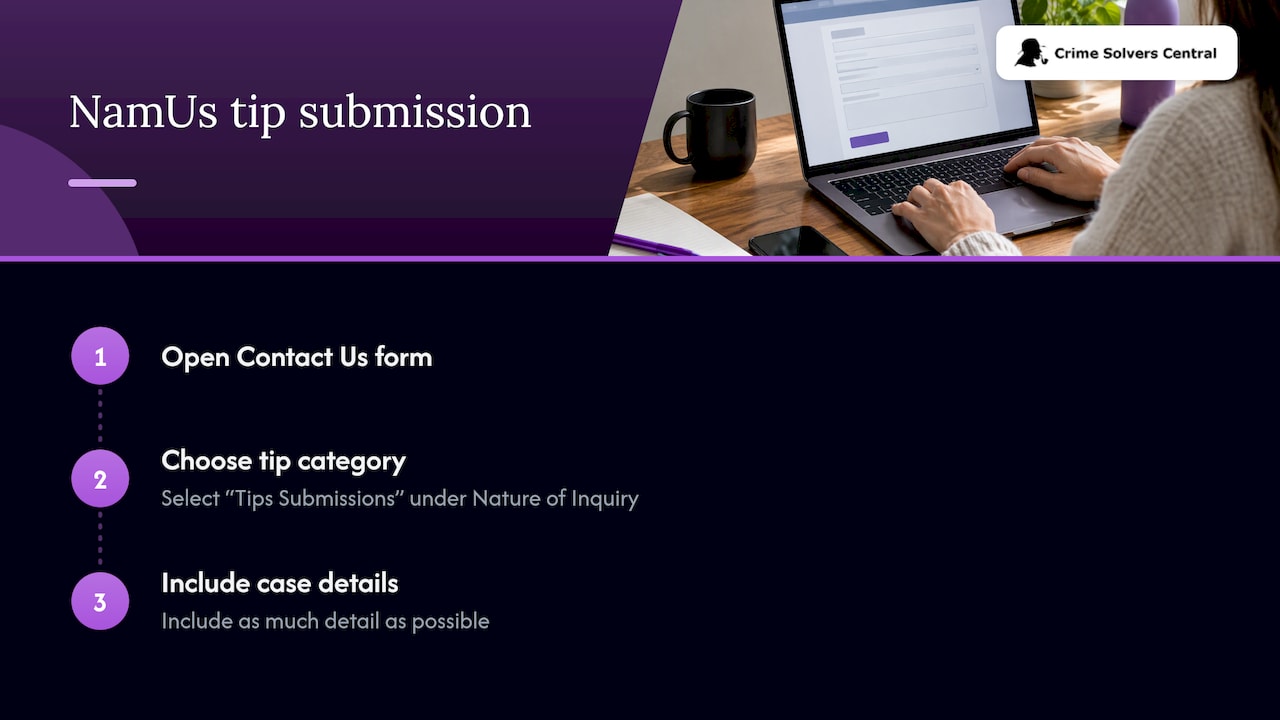
To send a tip through NamUs, use its Contact Us form, choose “Tips Submissions” under Nature of Inquiry, and include as much detail as you can so staff can respond.
State cold case databases
Many states run their own. The Colorado Bureau of Investigation, for instance, points families to its Colorado Cold Case Database, which features unsolved homicides, missing persons and unidentified persons, and lists NamUs as a national resource.
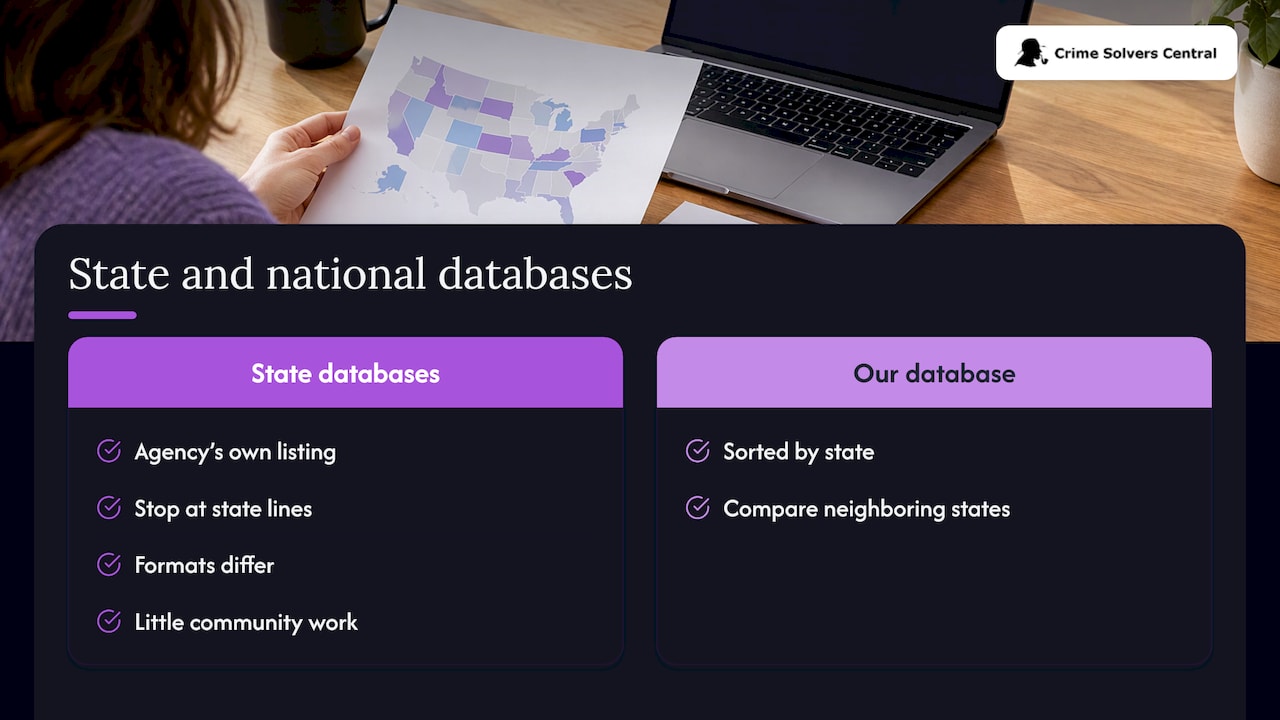
These are the right place to check when you know a case sits in one state and want the agency’s own listing. Their limits are built in: they stop at the state line, formats differ from state to state, and they offer little for community work. A case that crosses state lines, as many do, is hard to follow through them. Our database is sorted by state, so you can compare what is listed for neighboring states in one session through the cold case database by state.
Single-curator casebooks
Some of the best-known missing persons references are the work of one person. One 2018 profile described an online casebook of people missing in the United States for at least a year, started by its creator as a teenager and written entirely by her rather than by volunteers or paid staff. Such a site is a remarkable piece of public writing and reads well.
The things to weigh are the ones a reader of any one-person publication should weigh: how many cases one editor can cover, how quickly entries change, and the fact that it is designed to be read rather than worked. If you want to do something with a case, such as build a flyer, organize facts, or join others on it, you need a platform with tools. That is the gap our membership fills.
Forums and social media groups
Social groups and discussion boards are where many volunteers first meet a case. They are good for speed and for crowdsourcing ideas. They are not structured archives: posts scroll away, claims are hard to trace to a source, and nothing keeps a case file in order. Our member forums sit next to the case file and its sources, so a discussion stays attached to the facts it is about.
How to use these resources together
The most effective approach follows an order.
- Confirm the official record. Make sure the case is in NamUs and with the investigating agency. Public entries are vetted by that agency before they publish.
- Check the state database. If your state has one, confirm the case is listed accurately.
- Find the case in a national library. Search our database by state and type, and read the profile. Our guide for families starting with a cold case file search shows the first steps.
- Organize what is known. Use an evidence board to put dates, locations and sources in one place.
- Raise visibility. Print flyers and share the case, and send any tip to the investigating agency or through the NamUs form rather than posting it only in a group.
- Keep watching. Cases change. Return to the profile and the forum for updates.
A note on staying safe at home
While you work on a long-term case, you may also want better habits for the relatives who are with you now. Checking family location sharing practices before you rely on them is a practical step for keeping children and older relatives reachable.
What to check before trusting any database
- Update dates. Resolved cases leave NamUs public view, so a case that disappears may have been resolved, not forgotten.
- Who entered the data. NamUs fields come from the reporting party, so a mismatch in spelling or age may be an entry issue.
- Privacy. Records released under public records laws may be redacted. Treat details about living family members with care.
- Responsible use. Pass tips to investigators. Do not contact suspects or witnesses yourself.
We built our case pages with sources attached, so a reader can see where a detail comes from.
Our view
We built Crime Solvers Central because a case should not vanish just because it is old. Our database holds more than 264,000 cases, each sorted by state and by situation, so a family in one state can see what is listed in the next and a student can study patterns across the country.
We think a database should do more than display. That is why members can build evidence boards, make flyers, use A.I. image progression, join forums and coordinate as volunteers. The NamUs system is the official record, and every family should use it. We are where the community around a case gathers and acts.
Our members tell us, in the testimonials on our site, how the resources helped them reconnect families and move investigations forward. That is the work we want to keep doing.
Crime
Membership plans
If you are ready to open full case files and use the tools, our membership plans are billed monthly or yearly:
| Plan | Monthly | Yearly |
|---|---|---|
| Jr. Detective | $3.97 | $39 |
| Sr. Detective | $9.97 | $99 |
| True Crime Influencer | $39.97 | $399 |
The yearly price of each plan is lower than twelve months at the monthly price. Details of what each plan includes are on the pricing page.
FAQ
Is there a free alternative to a missing persons casebook?
Yes. NamUs is free to search, and families can enter missing-person cases and track them. Many states also run free cold case databases. Crime Solvers Central lets visitors read free summaries, and members pay to unlock complete case files and tools.
Can I use Crime Solvers Central and NamUs together?
Yes, and we recommend it. NamUs is the official federal system, with forensic data and family DNA programs. We add a state-by-state national library, plus evidence boards, flyers, forums and volunteer coordination. Our guide on how families use NamUs and Crime Solvers Central explains the combination.
Where do I send a tip about a missing person?
Send it to the investigating law enforcement agency, or use the NamUs Contact Us form and choose “Tips Submissions”. Include names, dates, places and anything else specific so staff can act on it.
Does a database cover every missing person in the country?
No single database does. NamUs notes that its cases are voluntarily reported outside the 17 states that require entry, so it does not necessarily reflect every case nationwide. That is why we suggest checking the official record, your state’s listing and a national library.
Sources
- National Missing and Unidentified Persons System, National Institute of Justice
- Frequently Asked Questions, NamUs
- Operation Lady Justice: Comparison of the NamUs and NCIC Databases, Office of Justice Programs
- Missing Person(s) Resource Page, Colorado Bureau of Investigation
- The Encyclopedia of the Missing, Longreads (2018)