

Best Missing Persons Databases in the United States (2026)

No single database holds every missing person in the United States, so the best approach is to pair a government system with a searchable case catalog you can work in every day. For most families and volunteers, that means NamUs for official public records, a report filed with local law enforcement (which feeds NCIC), and Crime Solvers Central, which organizes more than 264,000 cold cases by state and situation and adds the tools to act on what you find.
This guide compares the options that matter, explains what each one includes, shows how to submit a case, and covers why a missing person sometimes fails to appear where you expect.
TL;DR
- NCIC is the FBI system police use in the field, and it is not open to the public. Confirm your loved one’s entry through the investigating agency.
- NamUs is the public federal system for long-term missing, unidentified and unclaimed-remains cases. Every published case is checked with law enforcement first.
- NCMEC handles missing children. Call local police first, then 1-800-THE-LOST.
- Crime Solvers Central is our national cold case database, with 264,913 cases sorted by state and type, plus evidence boards, a flyer builder and volunteer coordination for members.
- Use more than one system. Records can sit in one database and not another.
Table of Contents
- How the main U.S. databases differ
- Crime Solvers Central: the case catalog built for action
- NamUs: the public federal system
- NCIC: the police database you cannot search
- NCMEC: for missing children
- How to submit a missing person case
- Why a missing person may not appear in a database
- Reading state numbers carefully
- Sending tips the right way
- Perspective
- Where to start
- FAQ
- Sources
How the main U.S. databases differ
The databases people search for do four different jobs. Some are law enforcement tools, some are public record systems, some focus on children, and some are community platforms built around case work. Knowing which job you need done decides where you start.
| Database | Who can search it | What it covers | Best for |
|---|---|---|---|
| Crime Solvers Central | Public summaries; full case files for members | Missing persons, unsolved homicides, unidentified and unclaimed remains, 264,913 cases by state and type | Browsing cases by state, organizing volunteer work, building flyers and evidence boards |
| NamUs | Public | Missing persons, unidentified persons, unclaimed remains | Official public records and matching missing to unidentified |
| NCIC | Criminal justice agencies | 21 files, including missing and unidentified persons | Police work, confirming an official entry |
| NCMEC | Public reporting line and case postings | Missing and exploited children | Reporting a missing child |
Crime Solvers Central: the case catalog built for action
We built Crime Solvers Central around a simple idea: a case that is easy to find gets more attention. The database holds 264,913 cases, covering missing persons, unsolved homicides and unidentified or unclaimed remains. Each case is categorized by state and situation, so a family in Mississippi or a student studying a Las Vegas case can go straight to the right place. You can see how that looks on a city page such as unsolved cases in Las Vegas, Nevada.
What sets the platform apart is what happens after you find a case. Members unlock full case details, sources and videos, along with forums, digital evidence boards, a flyer builder, AI image tools, volunteer coordination and safety initiatives. Our site also features testimonials from people who used these resources, describing reunited families and help for law enforcement investigations.
What it costs
Membership is a recurring subscription. These are the published prices:
| Plan | Monthly | Yearly |
|---|---|---|
| Jr. Detective | $3.97 | $39 |
| Sr. Detective | $9.97 | $99 |
| True Crime Influencer | $39.97 | $399 |
Current plan details are on the pricing page.
Who it suits
Families use it to see their case in context and to find others with similar cases. Volunteers use it to coordinate. Students use the state and type categories for research. If you want a guided route, our NamUs and Crime Solvers Central guide shows how families use both together.
NamUs: the public federal system
NamUs, the National Missing and Unidentified Persons System, is the main public database run under the Department of Justice. According to a federal comparison of NamUs and NCIC, NamUs includes missing-person, unidentified-person and unclaimed-remains records, and public missing-person entries are vetted with the appropriate criminal justice agencies.
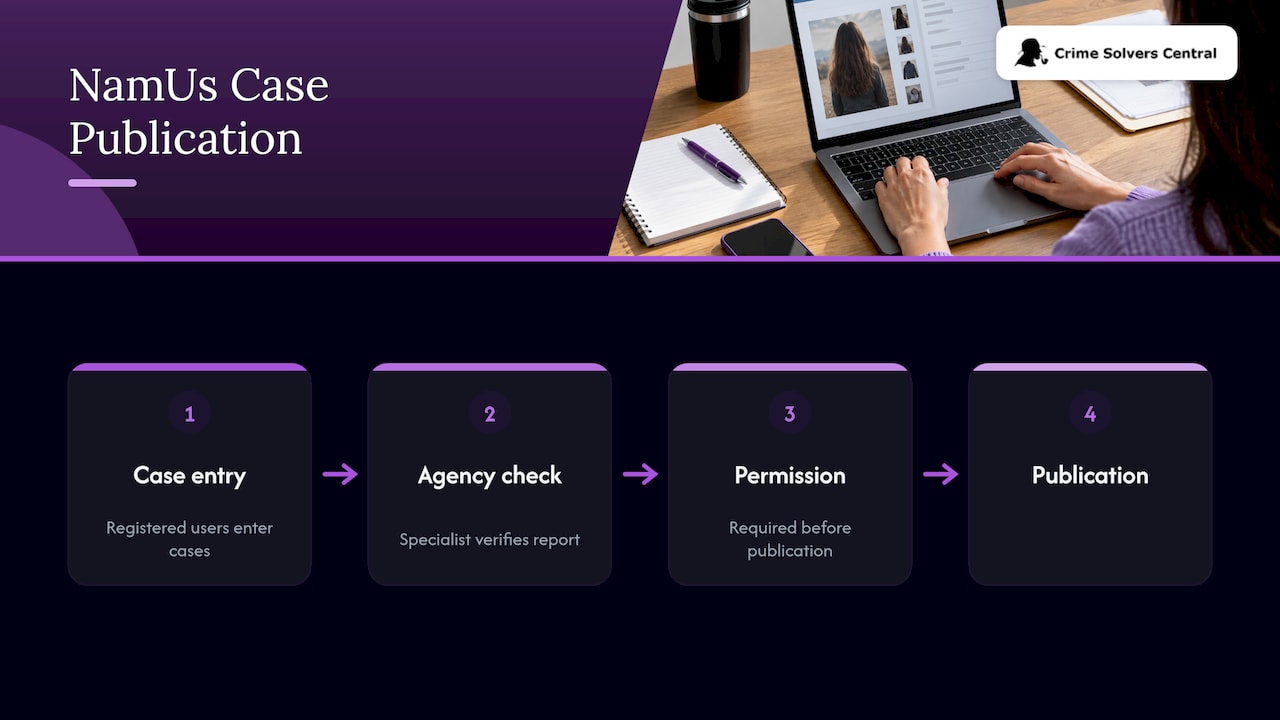
That vetting shapes how you use it. A NamUs user guide explains that registered users can enter missing person cases, but a regional program specialist verifies the report with the law enforcement agency and obtains its permission before the case is published. Some sensitive fields stay visible only to vetted criminal justice and forensic personnel.
The Department of Justice describes NamUs as a resource that helps the public and professionals access information on long-term missing and unidentified-person cases, according to GAO’s 2016 report. Our step-by-step NamUs search guide walks through the search filters, and our unidentified persons guide explains why families should look beyond a single system when searching for remains.
NCIC: the police database you cannot search
The FBI’s National Crime Information Center is the system officers rely on in the field. The federal comparison notes it contains 21 files, and that potential matches between the missing-person and unidentified-person files are sent to agencies in daily system messages.
The public cannot search NCIC. The Department of Justice describes it, per the GAO report above, as a database for criminal justice agencies’ day-to-day duties. Your role is to make sure your loved one is in it.
Reporting rules differ by age. Under federal policy, cases of missing children and young adults under 21 must be reported to NCIC, while reporting missing adults remains voluntary. This is one reason an adult’s case may be missing from the national record unless someone asks.
How to confirm an NCIC entry
Contact the investigating agency and ask for the NCIC number and the entry date. If the agency cannot provide them, ask what is needed to enter the report. Our state-by-state breakdown, 88,093 active NCIC records, shows how those records are distributed.
NCMEC: for missing children
The National Center for Missing & Exploited Children focuses on children. Its Get Help Now page says that after you have reported your child missing to law enforcement, you should call 1-800-THE-LOST (1-800-843-5678). The Department of Justice reporting page gives the same order for the public: local law enforcement first, then NCMEC. If anyone is in immediate danger, call 911.
How to submit a missing person case
The order matters, because each system depends on the one before it.
- File a police report. Go to the local law enforcement agency where the person was last seen. Everything else rests on this report. Ask for the case number and the name of the investigator.
- Confirm NCIC. Ask for the NCIC number and entry date. For a child or anyone under 21, entry is required under federal policy. For an adult, you may need to request it.
- Register with NamUs. Create an account and enter the case with every detail you know: description, circumstances, and the availability of dental records, fingerprints or DNA references. Expect the verification step before it goes public. Our guide to registering with NamUs first explains what happens next.
- Call NCMEC if the person is a child. Use 1-800-THE-LOST after the police report.
- Build visibility on Crime Solvers Central. Find the case profile in our database by state and type. Members can use the flyer builder, the digital evidence boards and the forums to organize what the family knows and share it with volunteers.
For a broader walk-through, see our guide to the official missing persons database process.
Why a missing person may not appear in a database
Families often search and find nothing, then assume the worst. A 2016 GAO report found that long-term missing-person cases may be in one system but not the other, in part because NCIC and NamUs have different user bases. GAO also found that no mechanism automatically shares information between the two, which causes duplicate data entry for law enforcement and potential information gaps for investigators.
In practice, a missing person might be absent for these reasons:
- The report was filed but never entered into NCIC, which is more common for adults.
- The case is in NCIC but has not been published in NamUs, which requires verification and agency permission.
- The name, spelling or date of birth differ between systems.
- The person is listed under a different category, such as unidentified remains.
The fix is to search several systems and use the state and type filters in each. Our practical guide to finding missing persons cases covers search tactics, and our explainer on missing persons databases breaks down how the pieces connect.
Reading state numbers carefully
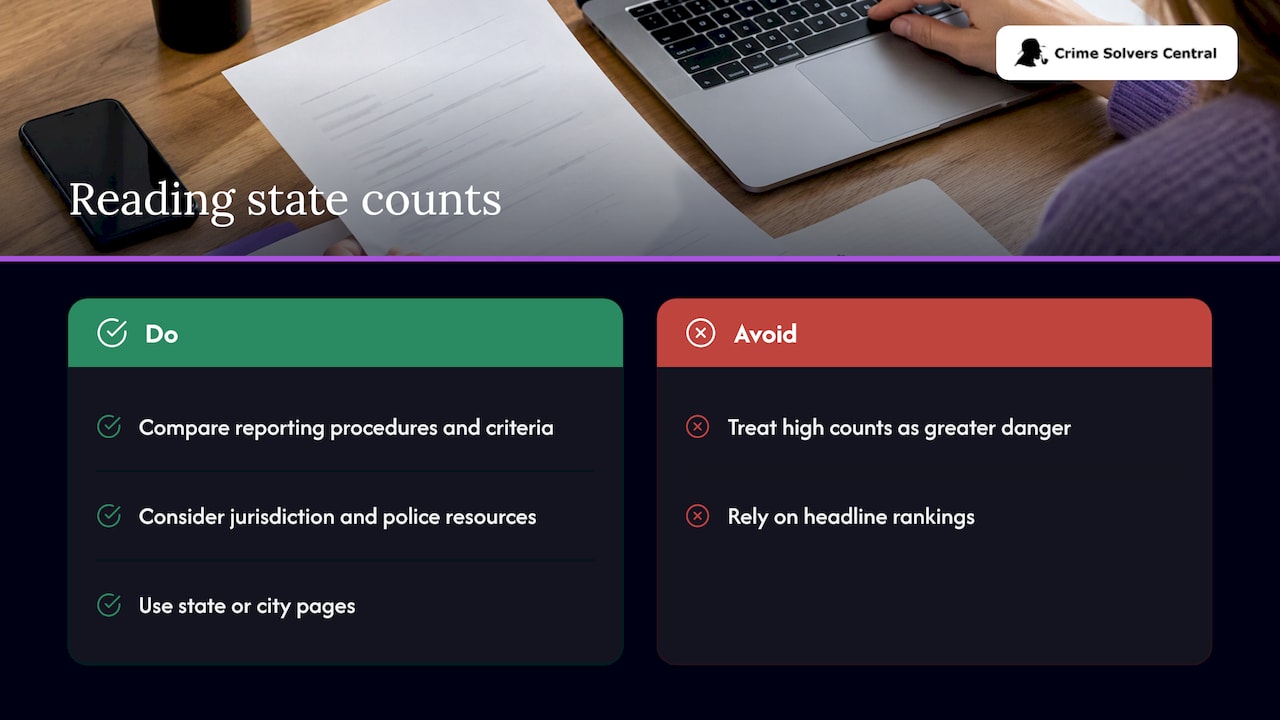
California, Texas and Florida report the largest open caseloads, but a high count does not mean a more dangerous state. Experts quoted by Newsweek point to differences in reporting procedures and criteria, jurisdictional differences and police resources as factors in regional variation. John T. Majoy, president of the Cleveland Family Center for Missing Children and Adults, advises reading these statistics cautiously, because most reported cases, particularly those involving children, are resolved quickly. Another expert in the same article notes that the number of cases in NamUs depends on its public and professional users.
If you are researching a particular place, go to the state or city page rather than relying on a headline ranking. Our state pages, such as unsolved cases in Chapin, South Carolina, list cases for that area.
Sending tips the right way
A tip is useful when it reaches the investigator who owns the case. For a missing child, call local law enforcement first and then NCMEC, as the Department of Justice page directs. For an adult or a cold case, contact the investigating agency named on the case profile. On our site, case profiles carry the details that help you reference the right case, and our guide to recent missing persons cases explains how to verify a story before sharing it.
Perspective
We built Crime Solvers Central because cold cases are lost to scattered information, not to a lack of caring people. A family may have a police report, a NamUs entry and a stack of news clippings, and nothing that ties them together.
That is why we organize 264,913 cases by state and situation, and why we pair the catalog with the tools families ask for: digital evidence boards, a flyer builder, AI image progression and volunteer coordination. A record tells you a case exists. A community gives it momentum.
Our members range from family members to students to dedicated volunteers, and our testimonials show what happens when the right person sees the right case. We encourage every family to report to law enforcement, confirm the NCIC entry and register with NamUs. We then recommend making Crime Solvers Central the place where the work gets organized and shared.
Crime
Where to start
If you want one place to browse every state, follow cases and put volunteers to work, start with a membership. The Jr. Detective plan costs $3.97 per month or $39 per year, and the Sr. Detective plan costs $9.97 per month or $99 per year. See the membership plans or begin at the state-by-state case database.
FAQ
What is the best missing persons database in the U.S.?
There is no single best one, because each does a different job. NamUs is the main public federal system, NCIC is the police system, and NCMEC covers children. Crime Solvers Central adds a 264,913-case catalog sorted by state and type, with tools for acting on a case.
Can the public search NCIC?
No. NCIC serves criminal justice agencies. Families can ask the investigating agency for the NCIC number and entry date to confirm that a report was entered.
Who can submit a case to NamUs?
Any registered user can enter a missing person case. Before it is published, a regional program specialist verifies it with the appropriate law enforcement agency and obtains permission to publish.
Do I have to report an adult as missing to NCIC?
Under federal policy, reporting missing adults to NCIC is voluntary, while cases of missing children and young adults under 21 must be reported. Ask the investigating agency to confirm the entry for an adult.
Who do I call for a missing child?
Call local law enforcement first, then the National Center for Missing & Exploited Children at 1-800-THE-LOST (1-800-843-5678). In an emergency, call 911.
Sources
- Operation Lady Justice: Comparison of the NamUs and NCIC Databases
- Missing Adults: Background, Federal Programs, and Issues (CRS)
- GAO-16-515 Accessible Version
- Missing Persons and Unidentified Remains: Opportunities May Exist to Share Information More Efficiently (GAO)
- NamUs 2.0 User Guide: Entering a Missing Person Case
- Department of Justice: Report and Identify Missing Persons
- NCMEC: Get Help Now
- Newsweek: Map Shows US Missing-Persons Cases by State