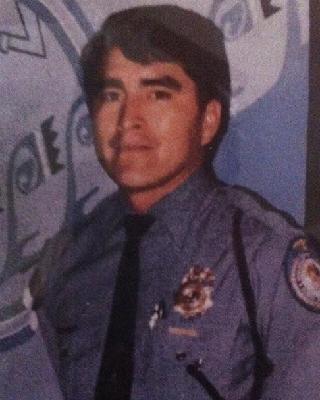
George W. Lockhart, a 32-year-old male of unknown ethnicity, served as a deputy sheriff for the Apache County Sheriff’s Office in the Arizona Territory during the 1880s. On February 7, 1887, he was killed near St. Johns, Arizona, while involved in a violent confrontation on the Navajo Indian Reservation, an incident that left him and two other white men dead and has since been remembered both in law-enforcement memorials and in Navajo-focused historical accounts.
According to law-enforcement memorial records, Lockhart rode onto the Navajo Reservation accompanied by two other men to arrest an unidentified Navajo man who was wanted on a charge of horse theft. When Lockhart attempted to take this man into custody, the suspect reportedly resisted arrest, leading Lockhart to shoot and fatally wound him. In the immediate aftermath of that shooting, several other individuals from the reservation opened fire on the party of three, killing Lockhart and both of the men who had gone with him. These accounts describe the episode as a line-of-duty death that occurred while Lockhart was enforcing territorial law, and they note that he left behind a wife and four children in the wake of the ambush.
Other historical sources that focus on the history of the Navajo people characterize the same 1887 clash very differently. In these narratives, three white citizens identified only by their surnames—Palmer, Lockhart, and King—are said to have “fabricated” a horse-stealing accusation and then attacked a dwelling on the reservation rather than carrying out a straightforward arrest. During the ensuing gunfight, two Navajo men were killed along with all three white attackers, while a Navajo woman and child in the home survived. A military officer, Capt. Kerr, later examined the scene with Navajo scouts and met with a large group of Navajo at a place called Houcks Tank. In that retelling, a rancher named Bennett reportedly told Kerr that his horses had in fact been taken by the three white men themselves in an apparent attempt to set up or justify their actions, reinforcing the view in those sources that the original horse-theft charge was not legitimate.
Across the surviving online records, the individuals on the reservation who fired on Lockhart and his companions are not identified by name, and there is no documentation of any formal arrests or later prosecutions stemming directly from their gunfire. The only clearly described “suspect” in the law-enforcement version of events is the unnamed man initially accused of stealing a horse, who died at the scene after being shot by Lockhart, which meant there was never an opportunity for a court proceeding against him. In the Navajo-centered accounts, the three whites—including the Lockhart named there, widely understood to be George W. Lockhart—are effectively cast as the aggressors rather than as officers confronting a criminal suspect, and the subsequent investigation by Capt. Kerr appears to have resulted in meetings and fact-finding rather than criminal charges that can be traced in modern summaries.